Silicon carbide (SiC) power electronics can make an electric vehicle’s traction inverter more efficient, but a SiC inverter does not automatically give every car a fixed percentage more range. The inverter is the electronic bridge between the high-voltage battery and the traction motor. It converts the battery’s direct current into precisely controlled alternating current and regulates how much torque the motor produces. SiC devices are one engineering option for reducing losses and packaging size within this system.
This technical guide explains SiC vs silicon EV inverters, what a wide-bandgap semiconductor changes, how it relates to 400 V and 800 V architectures and why inverter efficiency must not be confused with battery charging speed.
What does an EV traction inverter do?
An electric car stores energy in its traction battery as DC electricity. Many traction motors operate using three-phase AC power whose frequency and effective voltage need to vary with motor speed and torque. The U.S. Department of Energy (DOE) describes the inverter as the component that converts battery DC to motor-drive AC while contributing to control of motor speed and torque.
During regenerative braking, the electric machine can operate as a generator, with power electronics controlling energy flow back toward the battery where permitted by the battery-management system. The inverter is therefore not merely an on/off converter; it is a key part of the propulsion-control system.
For the distinction between permanent-magnet and induction drive machines, see our electric-car motor types comparison.
How does silicon carbide differ from conventional silicon?
Silicon carbide is a wide-bandgap semiconductor material. It can be used in power switching devices such as MOSFETs, which switch electrical current extremely rapidly inside an inverter. The DOE’s overview of silicon-carbide power electronics identifies the material’s higher-voltage tolerance, high-temperature capability and fast switching as potential advantages compared with conventional silicon devices.
Many established electric drivetrains have used silicon insulated-gate bipolar transistors (IGBTs). SiC MOSFETs offer a different set of switching and conduction characteristics; under suitable conditions they can lower power-conversion losses and enable compact, high-performing designs. However, transistor type alone does not determine overall drivetrain efficiency: control software, switching frequency, cooling, device packaging, voltage, motor and gearbox also matter.
SiC MOSFET vs silicon IGBT: practical differences
| Engineering question | Conventional silicon IGBT | Silicon-carbide MOSFET |
|---|---|---|
| Switching and conduction losses | Can be higher at some relevant operating points | Can be lower, depending on device and control design |
| High-voltage operation | Proven technology with voltage-class-specific limits | Wide-bandgap devices support demanding high-voltage designs |
| Switching speed | Often lower than comparable SiC designs | May allow faster switching and different passive-component design |
| Cooling and packaging | Mature engineering solutions | Potential for lower heat generation and compact packaging, but thermal design remains essential |
| Economics and validation | Established manufacturing ecosystem | Device cost, gate driving, electromagnetic compatibility and reliability validation must be managed |
These are common engineering trade-offs, not independent performance tests of specific vehicles. A well-designed silicon inverter can outperform a poorly implemented SiC inverter in a particular operating condition.
Why do inverter losses matter to electric-car range?
No practical traction inverter converts and controls power without losses. Some electrical energy becomes heat in semiconductor switches, conductors and supporting components. Because that energy cannot all reach the motor, reducing conversion loss can improve overall propulsion efficiency.
Worked example: 97% versus 98% inverter efficiency
Suppose, for illustration, two hypothetical inverters receive the same 50 kW DC input power from a battery at one operating point:
| Illustrative inverter efficiency | AC output power | Power lost as heat/other conversion loss |
|---|---|---|
| 97% | 48.5 kW | 1.5 kW |
| 98% | 49.0 kW | 1.0 kW |
In this example, one percentage point more efficiency saves 0.5 kW of loss at this exact input power. That is a one-third reduction in the illustrative loss, not a 1% increase in the vehicle’s range and certainly not a universal 33% range improvement. Actual gains depend on the whole driving cycle and how much energy passes through the inverter under different conditions.
The DOE has identified inverter efficiency, power density, device cost, cooling and electronics integration as interconnected research goals. It would be misleading to apply a laboratory-level gain directly to every electric vehicle on the road.
Does a silicon-carbide inverter mean the car has an 800 V battery?
No. Silicon carbide is a semiconductor choice; 400 V and 800 V describe nominal electrical architectures (actual operating voltages vary). A manufacturer may select SiC devices in a system with a lower or higher nominal battery voltage depending on requirements, transistor voltage class and engineering trade-offs. The presence of an 800 V battery does not, by itself, prove which semiconductors are installed in the inverter.
Similarly, a car that uses an 800 V class architecture is not automatically faster to charge: DC charge performance depends on the battery, cell chemistry, pack temperature, current, connector, charging infrastructure and software limits. Our EV charging-time guide explains the difference between station peak kW and energy added over a stop.
Is a traction inverter the same as an onboard charger?
No. Both use power electronics, but their primary jobs differ:
- Traction inverter: transforms and controls battery DC power for the AC traction motor and manages bidirectional drive/regeneration flows.
- Onboard AC charger: converts incoming grid AC into controlled DC to charge the traction battery.
- DC/DC converter: adapts DC voltage levels for electrical subsystems, such as supporting a low-voltage battery and accessories.
- Offboard DC fast charger: supplies controlled high-power DC from charging equipment outside the vehicle.
The DOE separately identifies these components in its electric-car architecture explainer. Some vehicle designs integrate more functions into shared power electronics, but it is still important to understand the roles when reading a specification.
Why isn’t every EV built with silicon-carbide technology?
Inverter design balances efficiency, manufacturing cost, supply-chain availability, thermal performance, electromagnetic interference, durability and vehicle operating requirements. High switching speeds can create new control and electromagnetic-compatibility challenges. The DOE’s power-electronics research programme highlights device packaging, high-temperature capacitors and scalable designs alongside the semiconductor itself.
Choosing a silicon-based design is not automatically a sign that a vehicle is outdated; the relevant question is how well the complete powertrain meets the target cost and efficiency requirements. Manufacturers may also change inverter designs across model years, power levels or geographic specifications.
Can SiC reduce the need for cooling?
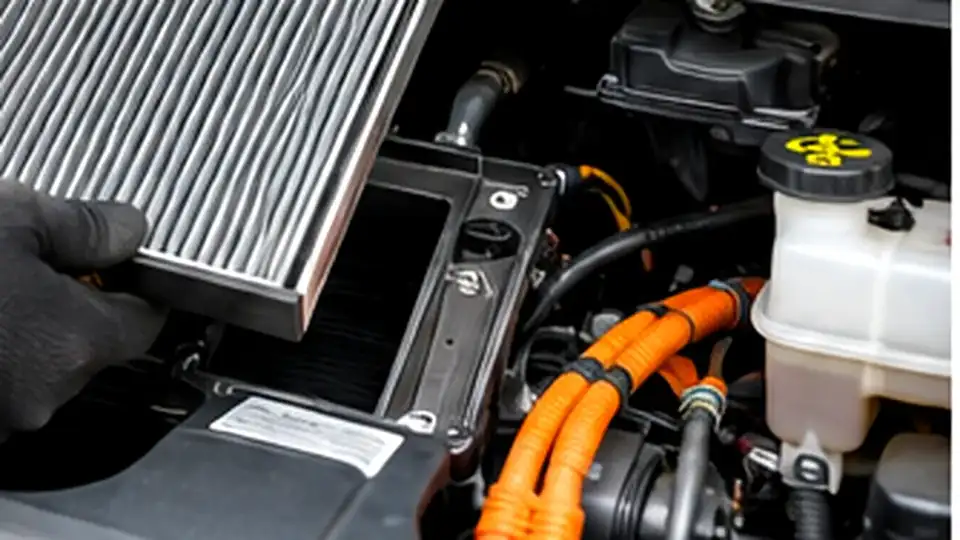
Lower semiconductor losses can mean less waste heat for a given operating point, creating opportunities for a smaller or differently designed cooling system. But SiC devices still generate heat, and compact, high-power modules need carefully engineered thermal paths, insulation and protection. Higher material temperature tolerance should never be interpreted as permission to remove cooling or handle an energized high-voltage inverter.
For the wider topic of electric-vehicle thermal systems, read our battery cooling and thermal management guide. A battery cooling circuit and an inverter’s cooling requirements may interact but are not the same component.
How can buyers tell if an EV actually uses a SiC inverter?
- Look for an explicit manufacturer technical document naming the traction inverter semiconductor technology.
- Check the model year, drivetrain and market; do not transfer claims from a concept car or another trim.
- Distinguish marketing language such as “advanced 800 V powertrain” from a verified statement about SiC power devices.
- Compare whole-vehicle tested consumption, charging and performance rather than using one semiconductor specification as a proxy for overall quality.
- Do not remove inverter covers or high-voltage assemblies to investigate; consult authorised documentation and qualified technicians.
Does SiC make electric cars fundamentally more sustainable?
It may reduce operating-energy losses and permit design changes, but the net environmental impact depends on component manufacturing, the efficiency improvement achieved in the actual vehicle and total kilometres driven. A materials or chip substitution is not by itself an emissions life-cycle analysis. For context, see our EV battery recovery and recycling guide.
The bottom line
A SiC traction inverter is one route to lower electrical losses and potentially greater power density. Its benefits arise from the implemented powertrain—not from a magic range multiplier. Understand the inverter’s role, verify the hardware on the exact model and rely on measured vehicle consumption when comparing EVs.
Explainer reviewed 6 November 2026 against U.S. Department of Energy technical sources. This is not an engineering teardown or first-hand measurement of any particular EV.
Sık Sorulan Sorular
What does a silicon carbide inverter do in an electric car?
It uses SiC power semiconductors to switch and control electrical energy between the high-voltage DC battery and the traction motor, potentially reducing losses.
Does an SiC inverter increase EV range?
It can improve conversion efficiency and potentially whole-vehicle range, but the gain depends on the implemented inverter, drive cycle and the complete powertrain. There is no universal percentage.
Is an 800 V electric car always equipped with silicon carbide?
No. Nominal battery voltage class and semiconductor material are separate engineering choices; check the exact vehicle's technical specification.
Is SiC the same as the onboard charger?
No. SiC names a semiconductor material that can be used in several power-electronics devices. The traction inverter drives the motor, whereas an onboard charger converts grid AC to DC for the battery.
Why don't all electric cars use SiC?
Designers must balance device cost, reliability, sourcing, thermal and electromagnetic performance, powertrain targets and manufacturing complexity; a complete silicon-based inverter may still suit some designs.