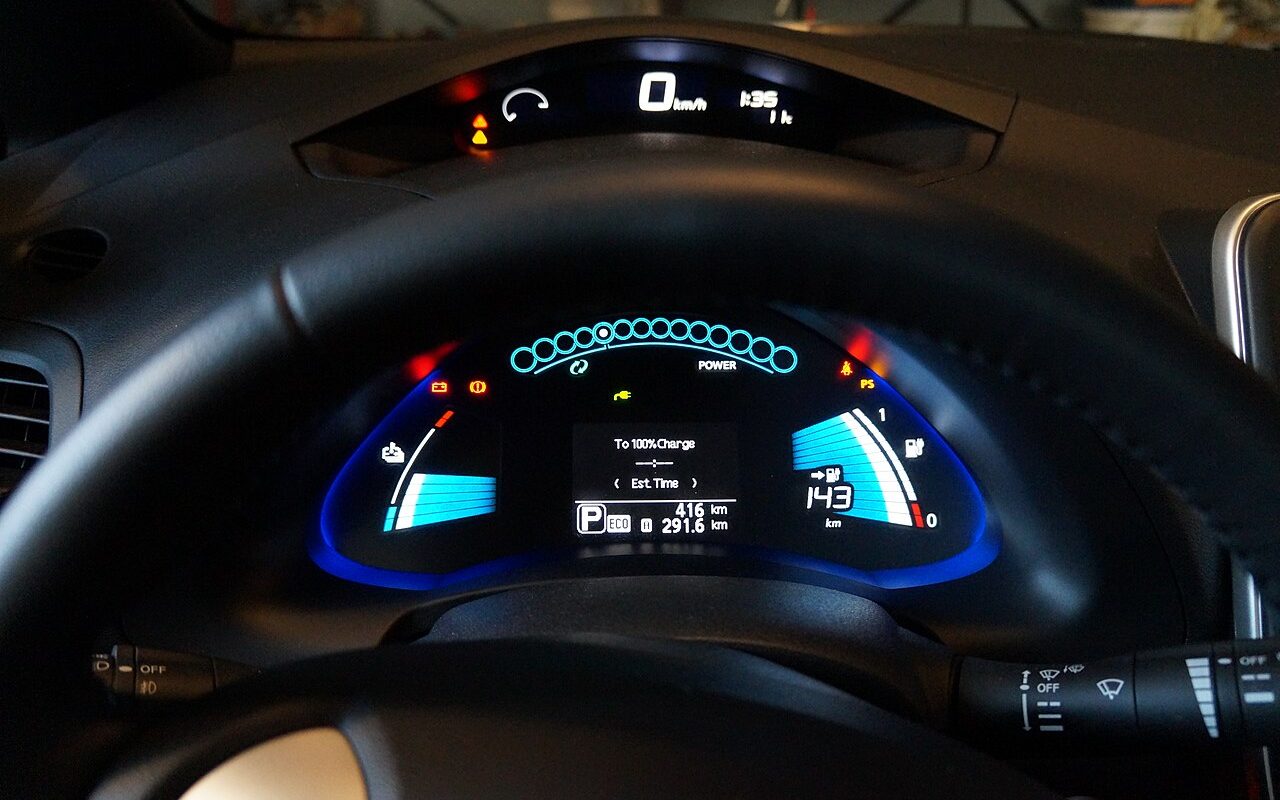
Short answer: Regenerative braking may become weaker when an EV battery is nearly full, very cold or unusually hot. Regeneration turns some of the car’s motion back into electricity, but the battery must be able to accept that energy. A limit on regeneration does not necessarily mean a failure of the friction braking system; however, drivers must follow the vehicle’s warnings and use the brake pedal whenever needed.
If your electric car normally slows noticeably when you lift off the accelerator but feels different at the top of a hill after charging to 100%, there is a physical explanation. The answer also varies by manufacturer: some vehicles supplement reduced regenerative braking with ordinary brakes to keep pedal-lift deceleration consistent, while others give you less off-throttle slowing. Always use your own model’s current owner’s manual.
What actually happens during regenerative braking?
In a battery-electric car, the traction motor can operate as a generator during deceleration. Part of the vehicle’s kinetic energy is converted into electrical energy and sent to the traction battery, rather than all of that energy being dissipated as heat in the friction brakes. Energy is also lost to drag, rolling resistance and conversion inefficiencies, so regeneration can never return all the energy used to accelerate the vehicle.
The U.S. Department of Energy’s efficiency explanation describes net regenerative recovery of roughly 22% on an EPA combined city/highway drive cycle for its representative EV energy-flow assessment. That is a reference illustration, not a guarantee for any trip, driver or model.
Why regenerative braking can feel weak at 100% charge
Regeneration charges the battery. If the high-voltage battery is already full, there may be little available capacity to absorb additional energy. To protect the battery, the vehicle can restrict or temporarily disable regeneration. Hyundai’s owner’s manual explicitly describes a message that regenerative braking is temporarily limited because the battery is fully charged, and says hydraulic braking using the brake pedal remains available.
This matters particularly when starting a downhill journey from a charger at a higher elevation. Do not assume one-pedal driving will provide its normal degree of deceleration. Maintain space, observe warnings and use the brake pedal as required.
Why cold weather also reduces regeneration
Battery charge acceptance depends on temperature. When the battery is very cold, the battery management system may restrict how quickly it receives energy. Regeneration may therefore be weaker soon after setting off on a freezing morning, even if the battery is not full. Tesla’s cold-weather guidance for Model Y notes that a cold battery can limit regenerative braking and describes preconditioning as a way to reduce that limitation. Hyundai also identifies extreme battery or motor temperatures as relevant limits.
Depending on the vehicle, scheduled preconditioning while plugged in may make performance more consistent. Use your manufacturer’s specific recommendations; never assume a temperature, timing or charging target that applies to every EV.
Does the car automatically replace lost regeneration with friction brakes?
Sometimes, and it is model-dependent. The Tesla Model Y braking manual describes a configuration in which conventional braking is applied when regenerative braking is limited, preserving deceleration after accelerator release. Other vehicles and settings may behave differently. Hyundai’s instructions direct the driver to use the brake pedal if additional slowing is needed.
Neither one-pedal driving nor regenerative braking replaces the need to remain ready to brake. If the car displays a brake-system fault, abnormal braking performance, or a warning that instructs you to stop or seek service, follow the owner’s manual immediately rather than treating it as a harmless cold-weather effect.
Physics example: how much energy is in one ordinary stop?
For a simplified illustration, take a vehicle of mass 2,000 kg traveling at 50 km/h (approximately 13.89 m/s). Its kinetic energy is E = ½mv². That gives ½ × 2,000 × 13.89² ≈ 192,900 joules, or 0.0536 kWh (53.6 Wh). If a hypothetical braking event stored half of that energy in the battery, it would return about 0.0268 kWh (26.8 Wh).
Those numbers are a teaching exercise, not a measured regenerative-braking efficiency. Actual recovery depends on speed profile, drag, mechanical braking, drivetrain and battery conditions. Speed is squared in the formula, so doubling speed multiplies the car’s kinetic energy by four if mass is unchanged. The example also excludes rotating components and other second-order effects.
A practical test without making braking unsafe
- Check the dashboard for a regeneration-limited notification or icon, and consult its explanation in the vehicle manual.
- Note whether the battery is full or the weather is very cold or hot; these are possible causes, not a complete diagnosis.
- Drive normally and anticipate stops. Use the brake pedal to achieve the required deceleration; do not perform risky road tests.
- Use approved battery preconditioning or schedule features if available, and watch whether the limitation clears as conditions change.
- If a fault indicator persists, or the braking system behaves abnormally, arrange qualified vehicle service.
Related questions: brake lights, brake pads and battery preparation
Regenerative systems can also influence how brake lights work under one-pedal driving. Read our brake-light explanation, why EVs still need friction brakes and battery preconditioning before fast charging for adjacent but distinct topics.
What this guide does and does not establish
The cited Tesla and Hyundai manuals describe particular manufacturer systems; software versions, regions, models and vehicle settings can differ. This article explains the physical mechanism and consumer safety implications, and does not diagnose an individual vehicle or establish a universal deceleration behavior.
Primary references: Hyundai regenerative braking limitations; Tesla Model Y cold-weather practices; Tesla Model Y braking systems; U.S. Department of Energy energy flow.
Illustrative cover image: 2013 Nissan LEAF dashboard showing a full battery, photographed by Kiwiev; Wikimedia Commons / CC0 1.0. The image is not a model-specific demonstration of reduced regeneration.
Sık Sorulan Sorular
Why is my EV regenerative braking limited at 100% charge?
A full battery has little room to accept additional energy from regenerative braking, so the vehicle may temporarily limit the system to protect the battery.
Does cold weather reduce regenerative braking?
Yes. A cold traction battery may be unable to accept energy at its normal rate; the vehicle may limit regenerative braking until its conditions improve.
Are regular brakes still available if regeneration is limited?
Yes, conventional brakes are a distinct safety system, but model-specific behavior and warnings vary. Use the brake pedal as needed and seek service for any actual brake-system fault.
Does every electric car replace lost regeneration with automatic friction braking?
No. Some vehicle systems compensate in some modes, while others can give the driver less deceleration on accelerator release. Check your exact owner's manual.