Quick answer: Yes, electric-car brake lights can turn on during regenerative braking even when the driver does not touch the brake pedal. The determining factor can be how strongly the car slows down, not merely whether the brake pedal is pressed. However, gentle lift-off regeneration does not always trigger the brake lamps. Tesla’s Model 3 manual confirms that its brake lights illuminate when regenerative braking is aggressively slowing the car.
This matters in one-pedal driving, where releasing the accelerator can slow an EV significantly and may eventually bring it to a stop. The exact behavior depends on model year, vehicle software and the regulations applicable to the car.
Do brake lights turn on when you lift off the accelerator?
Sometimes. In a combustion-engine car, drivers generally expect brake lights when the brake pedal is pressed. In an EV, lifting the accelerator may command the electric motor to recover energy while creating significant deceleration. If the car slows strongly enough, its brake-light system may alert drivers behind it without any brake-pedal input.
Tesla’s Model 3 owner’s manual explicitly says that the brake lights turn on if regenerative braking is aggressively slowing the car. This is an example of manufacturer-documented behavior, not a claim that every EV uses identical thresholds worldwide.
UN Regulation 13-H: the brake-light thresholds
UN Regulation No. 13-H includes rules for cars equipped with accelerator-release regenerative braking. The following table summarises the published provision 5.2.22.4, which specifies the stop-lamp signal based on vehicle deceleration from this regenerative braking function:
| Vehicle deceleration | Regenerative brake-light signal |
|---|---|
| 0.7 m/s² or less | Must not be generated |
| More than 0.7, up to 1.3 m/s² | May be generated |
| More than 1.3 m/s² | Must be generated |
The rule further specifies deactivation conditions once deceleration drops below the lower threshold. The table applies to the specific accelerator-release regenerative braking provision, not every possible braking event. When the driver activates the service brake, separate stop-lamp signal requirements apply.
Regulatory scope: These figures come from the cited UN regulation adopted through relevant approval frameworks. They are not a universal description of how every model sold in the United States or every other market is programmed. Check the up-to-date applicable regulation and manufacturer handbook for the relevant vehicle.
Why might the brake lights stay off while the car slows down?
Light regenerative deceleration can be too small to require a brake-light signal under the cited rules. The driver may feel the vehicle slowing when the accelerator is released, but that sensation does not guarantee that the stop lamps illuminate. Weather, road grade, battery state of charge, vehicle software and driving mode can also change the available regenerative force.
On a downhill road, the car’s speed can change differently from what accelerator position alone suggests. Do not treat the one-pedal mode indicator as a direct representation of what following traffic sees.
What happens when regeneration is reduced by a cold or full battery?
Regenerative braking returns energy to the traction battery, and a battery that is very cold or already full may accept less energy. Tesla’s Model 3 manual notes that regeneration may be limited in these circumstances and describes a setting that can use friction brakes to provide a more consistent slowing sensation. However, the driver remains responsible for braking safely.
See our battery preconditioning explainer for another example of how battery temperature influences EV behavior.
Does one-pedal driving eliminate the need for the brake pedal?
No. Even if an EV can slow or stop after the accelerator is released, its regular brake pedal is still essential for emergency braking, unforeseen hazards and situations where regeneration is limited. One-pedal operation is a driving convenience and energy-recovery feature, not a substitute for active hazard awareness.
Our EV maintenance checklist explains why friction brakes still need periodic inspection even though regenerative braking may reduce their routine use.
Do the brake lights turn on at a complete stop?
Do not assume that every EV holds its brake lamps in the same state after the vehicle becomes stationary. Behavior can depend on the driver’s brake-pedal use, automatic hold features, vehicle settings and applicable stop-lamp regulations. The deceleration thresholds described above concern accelerator-release regenerative braking while the car is slowing; they do not completely define all stop or parking states.
Can a driver safely check their own brake lights?
Brake-light operation and the function of any one-pedal mode should be checked using the manufacturer’s recommended procedure. Do not look away from traffic, use a phone while driving or make sudden deceleration manoeuvres merely to test the lamps. If the vehicle displays a brake-light fault or a driver behind reports a problem, arrange professional inspection. The brake-light icon in some vehicle displays may help show active lamp states, but only when the automaker provides that function and the driver can consult it safely.
How are regenerative braking and conventional braking different?
Regenerative braking uses the drive motor as a generator to recover some kinetic energy. Friction brakes create deceleration through braking components such as discs and pads and turn motion primarily into heat. EV control systems may blend both mechanisms. The lamps communicate deceleration or service brake activation as regulated; they do not simply indicate which of the two systems is being used at every instant.
For more information about the drivetrain behind regeneration, read electric motor types explained.
Primary sources and photo attribution
The key references are Tesla Model 3 braking guidance, UN Regulation 13-H as published in EUR-Lex, and the UNECE regulation series for subsequent revisions.
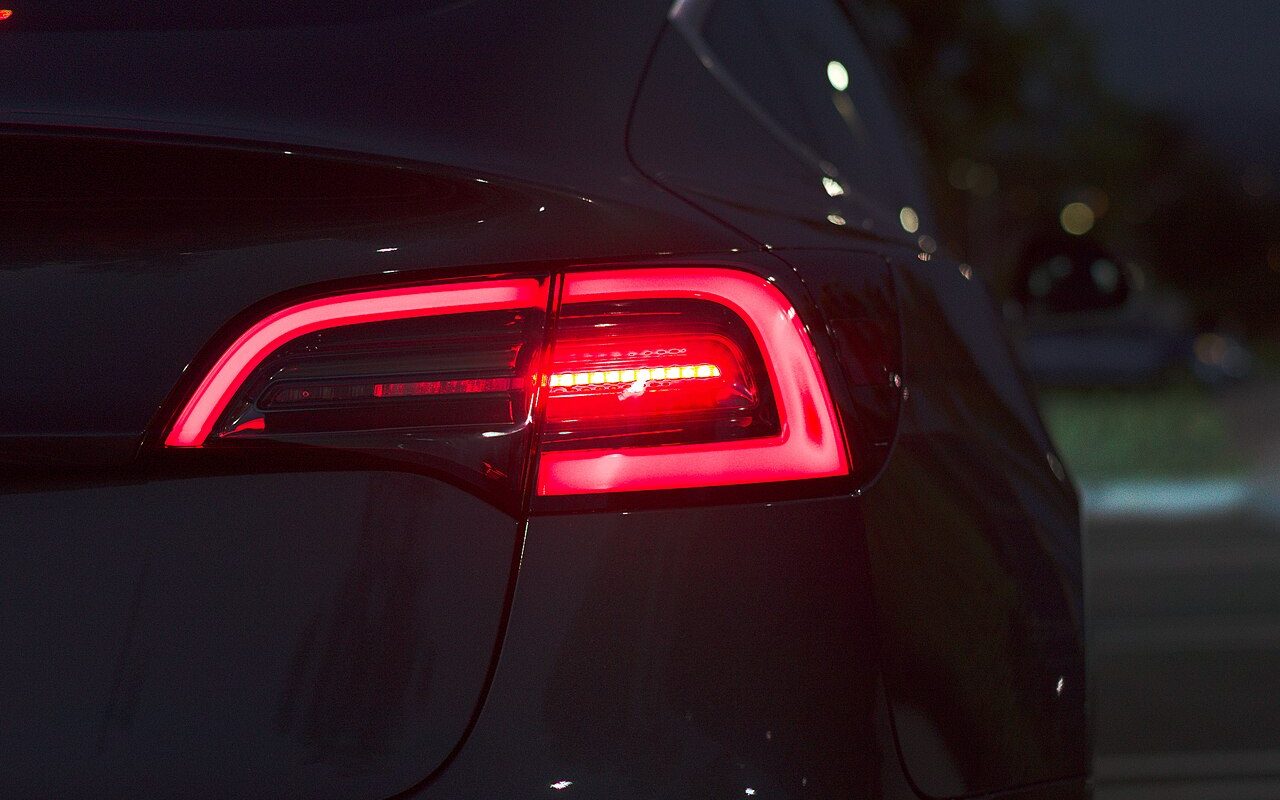
Featured photograph of a Tesla Model 3 rear lamp: Darin Caggiano / Wikimedia Commons, CC BY-SA 4.0. Image resized for site use. The photo illustrates the rear lamp assembly; it is not evidence of a particular lamp activation event.
Sık Sorulan Sorular
Do regenerative brake lights illuminate without pressing the brake pedal?
Yes. Many EVs illuminate their brake lights during sufficiently strong regenerative deceleration, even when the driver only releases the accelerator.
What are the UN deceleration thresholds for regenerative brake lights?
Under the cited UN Regulation 13-H provision, at or below 0.7 m/s² the signal must not activate; above 0.7 to 1.3 m/s² it may; above 1.3 m/s² it must.
Does Tesla Model 3 switch on its brake lights when regenerating?
Tesla states that Model 3 brake lights turn on if regenerative braking slows the car aggressively.
Does one-pedal driving mean the regular brakes are unnecessary?
No. Drivers must still use the regular brake pedal when necessary, including emergencies and situations where regenerative braking is limited.