Quick answer: Driving an electric car uphill uses energy to increase the vehicle’s gravitational potential energy. A simple physics calculation shows that a 2,000-kg vehicle climbing 300 vertical meters gains about 1.64 kWh of gravitational potential energy. The battery generally must supply more than that because the drivetrain has losses, while air resistance, tires, heating and acceleration add further energy demand. Descending can recover some of that energy through regenerative braking, but never all of it.
The U.S. Department of Energy advises EV shoppers to allow extra driving-range margin for hilly terrain. The key insight for planning is that the elevation gained, not just miles traveled or the highest altitude on a map, matters. Below are transparent calculations using the standard gravitational-potential-energy formula and explicitly hypothetical efficiency assumptions.
Calculate the minimum energy associated with gaining elevation
The relevant physics equation is ΔE = m × g × h, where m is vehicle mass in kilograms, g ≈ 9.81 m/s² is gravitational acceleration near Earth’s surface and h is the positive vertical elevation gain in meters. The result is energy in joules (J). Divide joules by 3,600,000 to convert to kilowatt-hours (kWh).
For a 2,000-kg EV carrying its passengers and cargo uphill by 300 meters, the calculation is 2,000 × 9.81 × 300 = 5,886,000 J ≈ 1.635 kWh. That amount is the increase in gravitational potential energy, not a prediction of the vehicle’s full battery consumption. OpenStax’s gravitational-potential-energy lesson provides the scientific foundation for the formula.
Why the battery uses more than the ideal 1.635 kWh
The traction system is not perfectly efficient. As an illustrative assumption, if battery-to-useful-climb efficiency were 90%, supplying the 1.635 kWh increase in potential energy would require 1.635 ÷ 0.90 ≈ 1.82 kWh of battery energy associated with that climb. This deliberately excludes the energy the car would have needed on level ground to overcome tire rolling resistance, aerodynamic drag, heating or other loads. The 90% is an assumption for teaching, not a measured efficiency for a specific EV.
If that hypothetical vehicle has 60 kWh of usable battery energy, the simplified additional energy for the climb is 1.82 ÷ 60 × 100 ≈ 3.0% of its usable capacity. This percentage is not a reliable real-world dashboard prediction; vehicle mass, road grade, speeds, headwind, cabin temperature and battery management all affect the actual trip.
Quick mental math: kWh per 100 meters climbed
For every 1,000 kg of vehicle mass, each 100-meter net elevation gain adds about 0.273 kWh of gravitational potential energy (1,000 × 9.81 × 100 ÷ 3,600,000). A 2,000-kg car therefore gains about 0.545 kWh per 100 vertical meters. Multiply those figures by the number of 100-meter increments to estimate the theoretical elevation component. To estimate additional battery demand, divide by an assumed drivetrain efficiency and separately consider normal driving losses.
What happens to the energy when you drive downhill?
When descending, potential energy decreases. An EV with regenerative braking can use the traction motor as a generator to convert part of the vehicle’s motion into electricity for the battery. But the available recovery depends on the vehicle’s braking control, battery charge acceptance, temperature, friction braking, speed and other loads.
As a second purely hypothetical calculation, suppose a car descends the same 300 meters and returns 60% of the 1.635 kWh potential-energy change to the battery. The battery would receive about 0.981 kWh. If the earlier uphill portion consumed an assumed 1.82 kWh attributable to climbing, the difference associated with the ascent-and-descent energy transfers is around 0.84 kWh, before all other driving losses. The 60% assumption is not a manufacturer specification or a general real-world regeneration efficiency.
The U.S. Department of Energy describes regenerative braking as an energy-recovery mechanism in its EV drivetrain efficiency analysis. That agency’s drive-cycle percentages should not be used as if they were a guaranteed recovery percentage for every mountain descent.
Why two trips ending at the same altitude can use different amounts of energy
Consider Route A, which stays close to the same elevation, and Route B, which climbs 500 meters before descending 500 meters to the same destination altitude. The net elevation change of Route B is zero, but the car still expends energy during the ascent and cannot recover all of it on the descent. In real conditions, the routes can also differ in distance, road speed, wind, stops, turns and driving conditions. Net altitude difference alone is not a complete route-efficiency calculation.
For route planning, a useful quantity is cumulative ascent (all uphill height gained along the route), alongside the start and end elevations. Elevation profiles help explain why a mountain road may use significantly more energy than a flat road of similar distance.
Does a 10% grade mean 10% more energy use?
No. Road grade is a geometry term: a 10% grade means roughly 10 meters of vertical rise for 100 meters of horizontal distance. It does not mean the battery necessarily uses 10% more energy, and it does not tell you the total ascent unless the length of the road section is known. The gravitational calculation uses vertical elevation gain directly.
Full battery at the summit? Regeneration may be restricted
Do not assume downhill driving will deliver the usual regenerative deceleration, especially when the battery is completely full or very cold. Vehicle systems can limit charging current into the battery; model-specific systems may or may not compensate with friction braking. Use the brake pedal as required, observe the dashboard warnings and follow the vehicle’s manual. Our guide to regeneration limits at 100% charge and in cold weather explains those safety differences.
Three original practice problems and answers
Problem 1: A 1,500-kg vehicle climbs 200 meters
Answer: 1,500 × 9.81 × 200 ÷ 3,600,000 ≈ 0.818 kWh of gravitational potential-energy gain. Battery demand for the actual drive will be greater because other losses are excluded.
Problem 2: A 2,500-kg loaded vehicle climbs 500 meters
Answer: 2,500 × 9.81 × 500 ÷ 3,600,000 ≈ 3.406 kWh of potential-energy gain. A heavier vehicle needs more energy for the same vertical climb.
Problem 3: Does driving the same route downhill recover 100% of the uphill energy?
Answer: No. Regenerative conversion is not lossless, other resistance remains, and the battery may restrict recovery under some conditions. A complete real-life model needs more variables than vehicle mass and elevation alone.
Use the result when planning a long EV drive
Track the vehicle’s current state of charge, expected charging opportunities, route elevation profile and a prudent battery reserve. Consider speed, cold weather, towing and cabin heating rather than assuming that gravitational energy is the only added consumption on a climb. The DOE’s electric-vehicle consumer guidance expressly recommends additional range margin for hilly terrain. For practical travel preparation, see our charging-stop and backup-station road-trip checklist and dashboard range-estimate explainer.
Methodology and references
The calculations here derive from the OpenStax College Physics 2e gravitational potential-energy equation, U.S. DOE electric-vehicle energy-flow discussion, and DOE Alternative Fuels Data Center consumer advice. Every vehicle mass and distance in the practice problems is hypothetical; the illustrative 90% drive efficiency and 60% downhill recovery rates are not experimentally validated vehicle results.
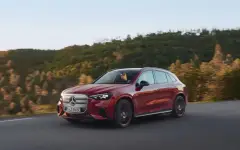
Cover photo: small red electric vehicle driving through the Alpine town of Zermatt, Switzerland, photographed by Tiia Monto / Wikimedia Commons, CC BY-SA 3.0, unmodified. The vehicle in the photo was not used for the fictional 2,000-kg example.
Sık Sorulan Sorular
How many kWh does a 2,000-kg EV need to climb 300 meters?
It gains approximately 1.635 kWh of gravitational potential energy. The actual battery energy needed is greater because propulsion and road losses add to that ideal amount.
Is 100 meters of elevation gain equal to 100 extra km of driving?
No. Vertical elevation gain and road distance measure different things. The ideal gravitational energy depends on vehicle mass and vertical height.
Does an EV recover all the uphill energy on the drive down?
No. Regeneration has conversion losses and other energy demands remain. Recovery can also be limited when the battery is full or too cold.
Can two routes with identical start and end altitudes have different energy use?
Yes. Cumulative climbing, distance, speed, rolling resistance, weather and efficiency differ even if net elevation change is zero.