Your electric car’s dashboard range is an estimate, not a promise of how far the vehicle will travel. The number can change after a full charge, during a motorway trip or when temperatures drop, even when the battery has not suddenly lost permanent capacity. What the figure means also depends on your car: some displays are based on regulatory-test efficiency while others recalculate an estimate using recent driving and operating conditions.
This guide explains estimated EV range versus battery state of charge, why the number moves, how to perform a simple energy calculation and when a change may warrant a service check.
What is the EV range estimate, or “guess-o-meter”?
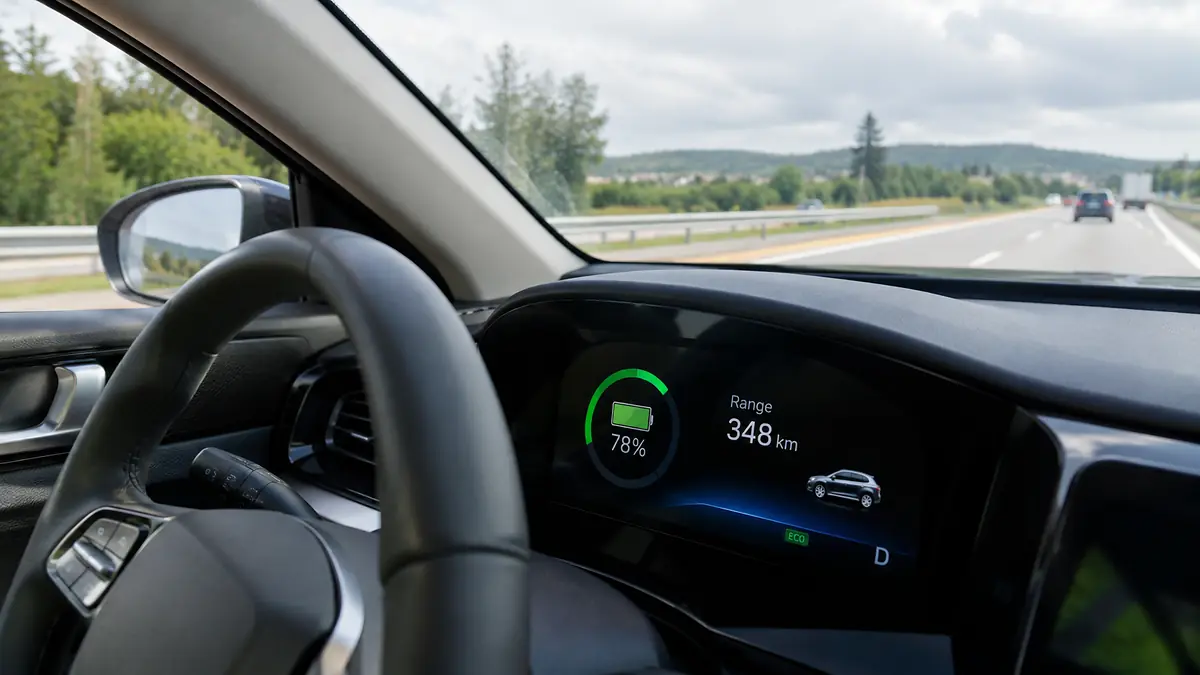
The dashboard’s estimated distance to empty is often nicknamed the guess-o-meter (GOM). It is a prediction of remaining driving distance in miles or kilometres, not a direct measurement of how much electrical energy is stored in the battery.
By contrast, state of charge (SoC), commonly shown as a battery percentage, indicates the vehicle’s estimated remaining charge relative to its managed usable charge window. A 60% reading is not the same as a guarantee of 60% of an advertised range: the energy needed for each mile depends on speed, temperature, climate control, terrain and other conditions.
The U.S. Department of Energy (DOE) explains that extreme temperatures, faster driving, rapid acceleration, heavy loads and steep climbs can all reduce the range of a battery-electric vehicle.
Why does my EV show different miles at 100% charge?
Different vehicles calculate displayed range differently. For example, Tesla’s published Range Tips say the miles figure shown in its main battery display is based on regulatory certification data rather than each driver’s personal driving style; its Energy app offers consumption-based trip projections. A Ford owner-manual explanation, by comparison, says its range estimate changes with available energy, battery temperature and recent energy use.
That distinction means there is no universal rule that every EV’s distance-to-empty display learns your last 100 miles or that a fall in the displayed number proves battery degradation. First read the instructions for your exact model year and software version.
Six reasons your displayed electric-car range changes
1. Higher speeds change real energy use
Aerodynamic resistance becomes increasingly important at higher road speeds. A vehicle that was efficient on local streets can use much more electricity on a fast motorway journey. Some dynamic prediction systems will reduce their estimate when they see higher recent consumption; others may continue to show a rated-range calculation that does not directly follow your driving pattern.
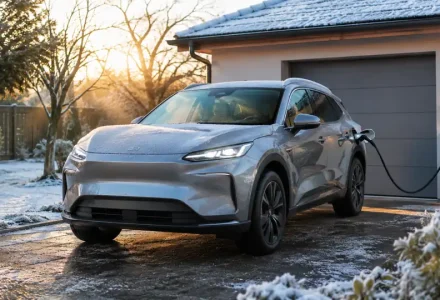
2. Cold weather makes heating and battery conditioning more demanding
Cabin heating, battery temperature management and changing battery performance can reduce practical winter range. The U.S. Environmental Protection Agency warns that cold weather, climate control and high-speed driving can materially lower real-world EV range. Check our battery preconditioning guide for a related but distinct topic: preparing for rapid charging.
3. Hills, headwinds and cargo alter consumption
Driving uphill requires additional energy; a tailwind or downhill stretch may lower consumption. Roof racks, cargo boxes and trailers may add both mass and drag. Regenerative braking can recover some energy on a descent, but it cannot undo all the energy previously spent climbing.
4. Heating, air conditioning and accessories use energy
HVAC systems, battery management and some electronics draw electrical power. Their impact on miles per charge can be especially noticeable in slow traffic or on short cold-weather trips. Preheating while plugged in, where supported, may reduce the energy used from the pack after departure.
5. The trip predictor may update its assumptions
A route-based prediction may consider destination, elevation, traffic or temperature, while a simpler display may rely on fixed rated consumption. After you enter a motorway route, a credible arrival-battery prediction can differ from the dashboard’s generic remaining miles. This does not mean one display is necessarily broken: they may answer different questions.
6. Energy use while parked is different from estimate recalculation
An estimate can change while the charge percentage barely moves because the prediction has been recalculated. A genuine decline in state of charge while parked can also happen due to battery management, monitoring or climate features. Our parked-EV battery drain explainer helps distinguish those issues. Record the percentage and conditions before assuming a fault.
How to estimate your own EV range using kWh/100 km
For a basic cross-check, use estimated usable energy remaining and an assumed energy-consumption rate:
Approximate remaining distance (km) = (usable battery capacity in kWh × state of charge as a fraction ÷ consumption in kWh/100 km) × 100.
Consider a hypothetical EV with a 64 kWh usable battery at 55% state of charge. This represents approximately 35.2 kWh of usable energy under the simplifying assumptions of the calculation. Its theoretical remaining range changes with consumption:
| Illustrative consumption | Approximate remaining distance | Example scenario |
|---|---|---|
| 16 kWh/100 km | 220 km | Efficient driving in mild conditions |
| 20 kWh/100 km | 176 km | Moderate energy use |
| 24 kWh/100 km | 147 km | Higher-speed or energy-intensive trip |
These numbers are arithmetic illustrations, not tests of a real vehicle. Usable energy, the SoC-to-energy relationship, reserve buffers, changing conditions and software strategy vary. Never plan to use the final displayed kilometre of range.
You can make a similar calculation in miles if your car shows mi/kWh: multiply the estimated energy remaining in kWh by the expected miles per kWh. Use an average relevant to the journey ahead—not only a very short or unusually efficient stretch.
Dashboard range versus EPA or WLTP range
EPA and WLTP range figures are standardised test-based comparison values, not guarantees on an individual trip. The EPA describes how it combines and adjusts laboratory test results to create a U.S. label value. Actual use can differ with weather, speed and driving conditions.
Do not subtract a percentage from the WLTP rating and present the result as a universal winter range. The vehicle, tyres, heating system, journey length and temperature all matter. When comparing cars advertised in different regions, check which test cycle produced each quoted range.
Which number should I trust on a road trip?
- Use battery percentage to monitor remaining charge, while remembering that it is still an estimate from the battery-management system.
- Use a route-based arrival estimate if your model supports it and keep it updated for changed destinations or weather.
- Track consumption across a meaningful distance, rather than judging the whole day from the last kilometre.
- Allow a buffer for unexpected conditions and an alternative charger; do not rely on arriving at 0%.
- Check speed, weather, cargo and tyre pressure if consumption is unexpectedly high. See our EV tyre-pressure guide.
For charging stops and backup options, consult our electric-car road trip planning guide.
Does falling estimated range mean my battery is degrading?
Not by itself. A lower dashboard distance at the same percentage may reflect the calculation method or changing conditions. Long-term battery health is a separate technical question involving usable capacity, diagnostics and the manufacturer’s assessment methods. If you are evaluating a used car, our battery state-of-health guide explains why a single dashboard number is insufficient.
Seek a qualified service assessment when you see persistent battery or drivetrain warnings, unexpected loss of propulsion, repeated unexplained charge-percentage drops or consistently abnormal behaviour that cannot be reconciled with the owner’s manual. If the vehicle directs you to stop or seek immediate service, follow that warning.
Bottom line
Electric-car range estimates are useful planning tools, but they are not fixed stored-distance counters. Understand your model’s prediction method, compare actual consumption with the distance left, and leave a realistic charging reserve. A changing miles or kilometres figure is normal in many circumstances; a safety warning or repeated unexplained fall in actual charge deserves attention.
Sık Sorulan Sorular
Why does my electric car show fewer miles after a full charge?
Many EV range displays can change due to battery temperature, driving conditions and calculation methods. Some are consumption-based while others use rated efficiency. Consult your model's manual; a lower estimate alone does not prove degradation.
What is the EV guess-o-meter?
A common nickname for the dashboard's estimate of remaining driving distance. It is a prediction, not the battery's actual stored energy value.
Is battery percentage more reliable than miles remaining?
Battery percentage is typically a more direct indication of estimated state of charge, but it is not a direct guarantee of any specific distance. Trip range depends on energy consumption.
Why does range drop faster on the highway?
Higher speed increases aerodynamic energy demand. Wind, weather, tyres, heating and route elevation can further change actual consumption.
Does low estimated range mean my EV battery needs replacing?
Not necessarily. Estimated range alone cannot establish battery health. Check actual energy use, conditions, manufacturer guidance and appropriate battery-health diagnostics.