Quick answer: Before purchasing a used electric vehicle (EV), request a battery state-of-health (SoH) report that identifies the car, inspect its service history, confirm remaining battery warranty, check safety recalls by vehicle identification number (VIN), and commission an independent EV-aware inspection. The dashboard’s battery percentage normally shows state of charge (SoC)—how full the pack is now—not its long-term health.
The Australian Government’s electric-vehicle buying advice recommends seeking battery-health information when considering a used EV. A transparent report and competent assessment are more useful than a seller’s unsupported claim about driving range.
What is EV battery state of health (SoH)?
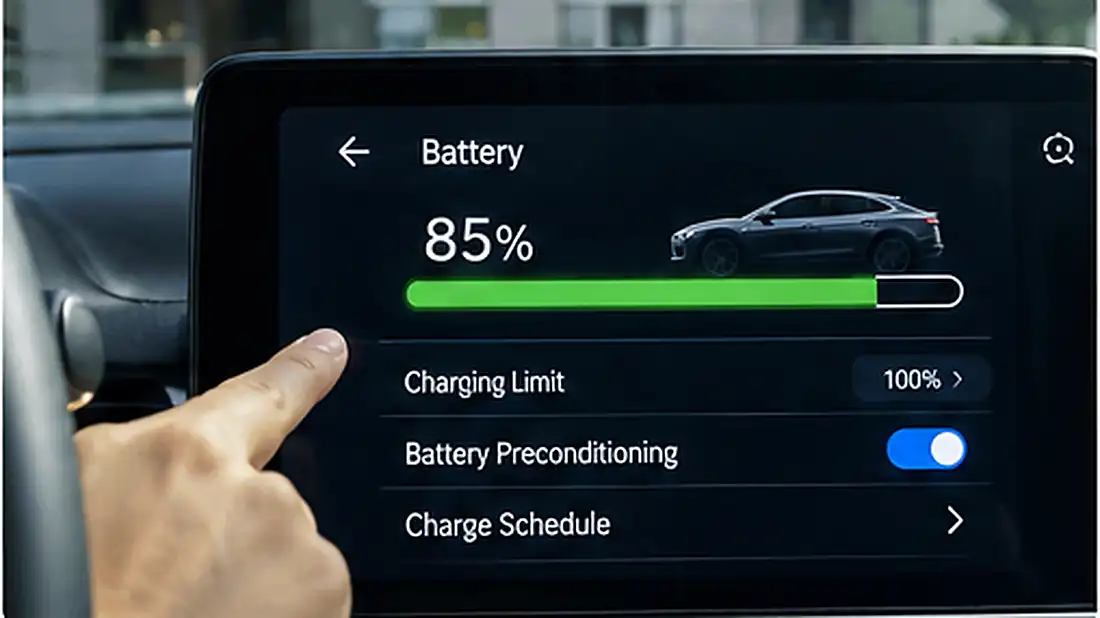
Battery SoH is an estimate of condition relative to a reference condition when the pack was new. Different diagnostic providers may estimate usable capacity, internal resistance, power or another composite metric. These methods are not necessarily interchangeable. A dashboard showing 85% battery typically means the vehicle is presently 85% charged, not that its SoH is 85%. Likewise, the range remaining displayed on the dashboard responds to driving style, temperature and consumption; it does not independently establish battery degradation.
How to check the health of a used EV battery
1. Request a VIN-linked battery report
Ask for a dated test including the VIN, odometer reading, measured metric, provider identity, method and, where possible, usable-capacity information. The report should make clear whether the displayed percentage refers to capacity retention or a different condition measure. A phone app screenshot with no vehicle identifiers is weak evidence. The TÜV SÜD battery-health overview illustrates why assessing battery condition requires an appropriate methodology.
2. Examine the original battery warranty
Battery coverage varies by manufacturer, market, model and first-registration date. The US Department of Energy notes that many manufacturers offer battery warranty coverage for around eight years or 100,000 miles, but that is not a universal promise. Verify the applicable minimum-capacity threshold if one exists, the mileage limit, the starting date, exclusions and whether the remaining coverage transfers to the buyer. Do not assume an SoH of 80% automatically triggers a warranty claim.
3. Review battery and charging repair records
Ask for invoices and records of battery-module or pack replacement, battery-management-system repairs, thermal-management faults, charging-port repairs, collision damage and water exposure. Verify repair documents through the manufacturer or an authorized service center where possible. Serious underbody damage or signs of pack intrusion need qualified assessment. Never disconnect or open high-voltage equipment yourself.
4. Check recalls using the VIN
For a US-market vehicle, use the official NHTSA recall search. This service chiefly identifies open, unrepaired safety recalls; it is not a comprehensive list of every historical repair or every recall outside the United States. In other countries, consult the responsible road-safety authority and manufacturer. Require documentation that any outstanding safety work has been completed before purchase.
5. Arrange a model-appropriate independent inspection
Choose a trained EV technician familiar with the particular model. The inspection should review relevant fault codes, battery cooling and heating, charging operation, underbody protection, warranty-eligible warnings and any cell-balance information supported by the vehicle. Have the technician interpret SoH results in the context of model year, mileage, battery chemistry and software. A short test drive can reveal issues but cannot reliably measure total available capacity.
6. Verify routine AC and DC charging operation
With the seller’s permission, try a known-compatible AC charging point and, if practical and supported by the vehicle, a DC charger. Ensure charging starts and ends normally and note any warning messages. Do not interpret a single charging-speed reading as proof of pack health: the car may throttle power because of temperature, high SoC or station conditions.
Used EV battery inspection checklist
| Evidence | What it helps show | What it does not guarantee |
|---|---|---|
| Dated SoH report with VIN and method | Battery condition under the stated assessment | Exact remaining battery life |
| Manufacturer warranty and registration records | Possible remaining coverage and exclusions | Acceptance of a future claim |
| Vehicle history and repair invoices | Documented work and potentially significant incidents | That every incident was recorded |
| Official recall lookup | Known outstanding safety work within the lookup’s scope | All historic or overseas campaigns |
| Dashboard charge and range estimate | Current energy and predicted use | Battery SoH |
What is an acceptable EV battery health percentage?
There is no single SoH threshold that determines whether every used electric car is a good purchase. Battery age, the measuring method, usable range, climate, driving habits, warranty, price and manufacturer design all matter. For an illustrative calculation, suppose a battery originally had 60 kWh of usable capacity and a reliable capacity-based test determines it retains 90% of that amount. The mathematical estimate would be 54 kWh on that measurement basis. This is not a figure for any particular model and should not be converted directly into a fixed range claim.
How long do EV batteries last?
Most EV batteries are designed for extended service, but they age and can fail. The US Department of Energy’s summary of a study covering about 15,000 plug-in vehicles from model years 2011–2023 reported battery replacement due to failure in 1.5% of the sampled vehicles, excluding recalls. That historical observation is not the failure probability of an individual used car and does not guarantee outcomes across brands, ages or markets.
Questions to ask before buying a used electric car
- What is the VIN, odometer reading and first-registration date?
- Can the seller provide a dated SoH report with its diagnostic method?
- Has the pack, a module or the battery-management system ever been repaired or replaced?
- Does the battery have outstanding warranty coverage, and what is the manufacturer’s capacity threshold?
- Are there open recalls, charging alerts or thermal-management faults?
- Has the car suffered crash damage, flooding or repairs to the battery enclosure?
- Can a competent independent inspector examine the vehicle and verify charging?
If documentation is inconsistent or an inspection is refused, avoid relying on an unsupported percentage or advertised driving range. For general battery chemistry context, consult our LFP vs NMC explainer (Turkish). For used-vehicle market context, see our used Hyundai IONIQ 5 report.
Official references and editorial scope
This is a research-based buyer checklist, not an assessment of a specific vehicle. References include the Australian Government used EV guidance, DOE maintenance and battery warranty information, NHTSA recall service and UNECE battery durability standards. Vehicle-specific decisions require the applicable warranty, the full history and an independent qualified inspection.