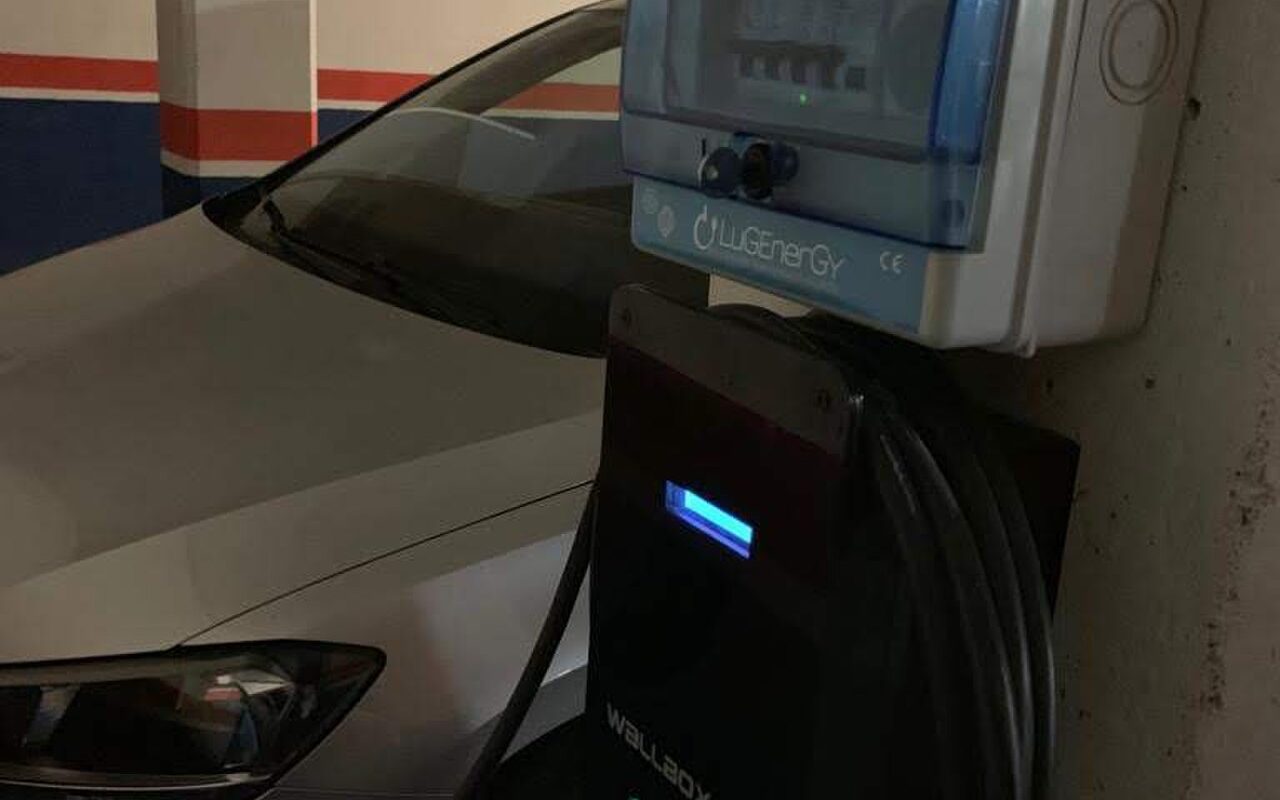
Quick answer: In a U.S. condominium or shared apartment garage, the owner, resident, association or property manager must agree how an EV charger is installed and how its electricity is paid for. Three practical accounting models are a charger on an individual unit’s electrical service, a dedicated meter or submeter for charging, and a shared charger with session-level metering and billing. The right option depends on building wiring, local rules, who owns the parking space, and the charger operator’s billing system.
A shared garage can make EV ownership convenient, but “the building has enough power” is not the same as “the building has a fair way to charge drivers.” The U.S. Joint Office of Energy and Transportation notes that responsibility for installation, operation, insurance and maintenance varies with assigned versus communal parking. This guide explains a decision process rather than promising that one state law applies everywhere.
First, identify who controls the parking space
Deeded or assigned condo space: The owner may be able to propose equipment serving that stall, subject to local law, building approvals, electrical capacity and rules covering common walls and utility pathways. Apartment parking: A tenant generally needs the property owner’s permission for permanent wiring and equipment. Open shared parking: The building may prefer common-use charging stalls with access controls, time limits and a published payment policy.
The Joint Office’s Community Charging report describes differences between condo owners, tenants and property managers and emphasizes who will own, operate, insure and maintain the equipment.
Three ways to measure electricity for shared-garage EV charging
Option A: Connect the charger to a resident’s own metered supply
Where permitted and technically feasible, an electrician can examine a circuit supplied through the resident’s utility meter. In that case charging energy is ordinarily reflected in the resident’s electricity bill, rather than appearing on the condominium’s communal meter. An electrician must evaluate service capacity, circuit protection, cable routing, permits and any building restrictions; proximity to a wall socket does not establish safety or suitability.
Option B: Use dedicated EV charging metering
A meter or submeter may isolate consumption associated with one or more chargers. Determine whether the device and billing arrangement satisfy local utility rules, whether readings can be audited, and who pays fixed charges as opposed to usage. A utility-grade meter is not automatically the same as the energy measurement built into a charger, and submeter billing rules differ by jurisdiction.
Option C: Shared-network charging with individual sessions
A building can operate multiple shared ports and identify who uses each charging session. In such systems, the charging software can generate a usage record and charge according to an agreed policy. Confirm what its “kWh” reading means, whether it measures energy from the electrical supply, whether transaction fees apply, and whether the operator is acting as a billing agent. Not every app or charger produces utility-grade billing data.
Worked example: What does one resident actually owe?
Assume, solely for illustration, a resident’s account records 180 kWh for the month and the building allocates energy at a hypothetical rate of $0.18 per kWh. The energy-only amount is 180 × $0.18 = $32.40. If the building separately charges six sessions at a hypothetical $1 each, the total becomes $38.40. This calculation does not quote an actual utility tariff and excludes potential taxes, fixed service charges, infrastructure repayment, parking costs and other fees. A real billing agreement should define those items before charging starts.
Important distinction: energy used at a meter may not be identical to energy stored in the car because charging has losses. For background, read our wall-kWh versus battery-kWh guide.
Do residents have a legal right to install a charger?
There is no single nationwide U.S. condo charger rule. The AFDC summary of Maine’s 2026 condominium charging policy, for example, describes conditions including approvals, insurance and payment responsibility. The AFDC summary for Washington describes a different set of association requirements. These are state-specific examples, not national requirements or legal advice. Verify the current law and governing documents for the particular property and obtain professional guidance before relying on any provision.
Before the condo board votes, request these six written answers
- Ownership: Who owns the charger, conduit and wiring, and who removes them if the parking assignment changes?
- Electrical capacity: Has a qualified electrician assessed panel and feeder capacity, simultaneous load and the need for managed charging?
- Metering: Which meter generates the bill and who can inspect the records?
- Costs: Who pays installation, energy, network fees, inspections, repairs and eventual replacement?
- Access: Is the parking stall dedicated or shared, and how are queuing, blocking and idle occupancy handled?
- Liability: What do the building’s insurer, property manager and local authorities require?
If several residents will use the infrastructure, ask about dynamic load sharing rather than simply multiplying each charger’s advertised maximum draw. Our EV load-balancing explainer covers the distinction. For readers who cannot install any wiring, see apartment charging without a private driveway.
Make the charging agreement understandable to the next resident
A durable arrangement documents whether the equipment stays with the parking stall, how access credentials are transferred, when rates may change, how disputed kWh readings are resolved, and what happens during repairs or outages. Agree on these details before buying equipment or hiring an installer. The charger itself is only one part of a shared-parking charging service.
Sources and scope
Primary guidance: U.S. Joint Office of Energy and Transportation: Community Charging (2024); U.S. DOE: Electric Vehicle Charging Stations; Maine charging policies; Washington charging policies. Worked figures are illustrative arithmetic, not observed charging costs.
Cover photograph: Rabbitweb / Wikimedia Commons, CC BY-SA 4.0, unmodified.
Sık Sorulan Sorular
Can a condo charge residents separately for EV charging?
It can use a suitable individually metered, submetered or session-based arrangement when permitted by local rules. Owners should check billing requirements, electricity rates and contract terms.
Does every U.S. state let condominium owners install their own EV charger?
No single nationwide rule answers this. Some states have right-to-charge provisions, and requirements and exceptions vary. Check current state and local law and association documents.
How is a monthly condo EV charging bill calculated?
An illustrative energy-only bill is charging kWh multiplied by the agreed price per kWh, plus any disclosed fees and applicable taxes. For example, 180 kWh at $0.18/kWh is $32.40 before extras.