Quick answer: A U.S. homeowner can receive a roof-insurance check that is substantially smaller than the contractor’s estimate because the claim payment may subtract depreciation and the policy deductible. An actual cash value (ACV) policy generally reflects depreciation; a replacement cost (RCV) policy may initially pay an ACV amount, with eligible withheld depreciation paid later after repairs and documentation. Coverage, timing and settlement details depend on the policy and state rules.
The National Association of Insurance Commissioners (NAIC) and state insurance departments emphasize that a roof’s original purchase price, today’s replacement estimate, depreciated value and the homeowner’s deductible are different things. Here is a transparent way to read the numbers on a claim estimate.
Read these four figures before questioning the check
- Replacement cost estimate: the insurer’s estimate of covered work using materials and labor of comparable type and quality, subject to policy terms.
- Depreciation: the insurer’s applicable reduction for the age and condition of the damaged property on an ACV calculation; whether particular components can be depreciated is subject to state law and policy language.
- Deductible: the amount the homeowner is responsible for before the insurer pays, if a covered loss exceeds it.
- Recoverable depreciation: if the policy provides replacement cost settlement and requirements are met, an amount initially withheld that may later be paid on proof of eligible repair or replacement.
The Texas Department of Insurance illustrates how different roof ages can lead to different ACV payments for the same replacement estimate. The Ohio Department of Insurance also explains how replacement cost benefits may depend on performing repair or replacement within the policy’s timeframe.
Worked example: a $12,000 roof estimate can lead to a $7,000 initial payment
Assume a completely hypothetical covered roof replacement estimate of $12,000, an applicable depreciation amount of $3,000, and a policy deductible of $2,000. The illustrative ACV before deductible would be $12,000 − $3,000 = $9,000. Subtracting the deductible would produce an initial payment of $7,000.
If the applicable settlement is ACV only: The $7,000 could be the final covered payment in this simplified example. Replacing the roof for $12,000 would leave the homeowner responsible for $5,000, including the depreciation and deductible. Actual claims may contain additional coverage provisions and limits.
If the policy allows RCV and the conditions for recovering depreciation are met: The insurer might initially pay the same $7,000, then release up to $3,000 of eligible depreciation after the roof is replaced and required proof is supplied. Total hypothetical insurer payment becomes $10,000; the homeowner’s net cost is $2,000. This is a teaching example, not a promise that every insurer pays in two stages or that all depreciation is recoverable.
Comparison of the two example outcomes
| Illustrative item | ACV policy | RCV policy (eligible work completed) |
|---|---|---|
| Estimated covered replacement | $12,000 | $12,000 |
| Applicable depreciation | $3,000 withheld permanently | $3,000 initially withheld, potentially recoverable |
| Deductible | $2,000 | $2,000 |
| Initial illustrative payment | $7,000 | $7,000 |
| Potential later insurer payment | $0 | $3,000 |
| Illustrative total insurer payment | $7,000 | $10,000 |
The example assumes the same $12,000 covered scope for both policies and no sublimits, exclusions, coinsurance adjustments or additional costs. Real claim settlements should use the insurer’s detailed written estimate and the actual policy.
A 2% wind or hail deductible might not mean 2% of the repair bill
Some homeowners policies use a percentage deductible tied to the insured value of the home instead of a fixed amount. For example, if a hypothetical policy has a 2% wind/hail deductible based on a $250,000 dwelling coverage amount, the deductible is $5,000 (0.02 × $250,000)—not 2% of a $12,000 roofing invoice. Whether a named-storm, wind, hail or other percentage deductible applies is specific to the policy and the cause of loss. Confirm the actual declaration-page value and endorsement rather than relying on an online calculator.
The NAIC’s homeowners shopping guidance explains that deductibles may be a percentage of the home’s insured value rather than a fixed-dollar amount.
What does “recoverable depreciation” mean on a roof claim?
On some RCV policies, the insurer may initially withhold depreciation and ask for a completed-repair invoice or other proof before issuing a further payment. The Tennessee Department of Commerce and Insurance explicitly describes this type of payment sequence. The Ohio Department of Insurance explains that time limits for replacement may matter. Different policies can require different documentation and may calculate the eligible second payment differently.
Do not assume “recoverable” means money that will automatically arrive on a fixed date. Check the repair deadline, allowed replacement scope, payment limit, how invoices are reviewed and whether supplements or mortgage-company endorsements are necessary. Ask the adjuster to show the calculation in writing.
Why might a contractor quote still be higher than the insurance estimate?
A contractor and adjuster might differ on damaged-area measurements, material specifications, local labor prices, code-required work, disposal costs or whether a particular component is covered. Price alone does not establish that the insurer is wrong or the contractor is right. Ask the contractor for a detailed itemized estimate and compare it line by line with the insurer’s scope. If additional covered damage is discovered during work, ask how to submit a documented supplement under your policy.
Roof condition, exclusions, wear and tear, cosmetic-damage limitations or roof-specific endorsements can change the claim result. Neither an ACV nor an RCV label means that every cause of damage is insured.
Practical checklist after receiving an unexpectedly small payment
- Confirm the claim’s coverage basis: ACV, RCV or a roof-specific endorsement.
- Read the deductible shown on the declarations page, including any separate wind/hail percentage deductible.
- Request the itemized estimate separating replacement cost, depreciation, deductible and net payment.
- Ask how any withheld depreciation can be recovered, including the deadline and evidence required.
- Obtain an itemized contractor estimate from an appropriately qualified company and reconcile differences in covered work.
- Keep photos, correspondence, invoices and inspection reports; report disagreements through the insurer’s documented claims process.
- Contact your state insurance department for consumer guidance if the dispute cannot be resolved.
Our related guides address homeowners insurance for solar panels and storm damage, hail damage to vehicles, and verifying a U.S. insurer’s license. These separate subjects should not be confused with roof settlement calculations.
Important state-law distinction: what may be depreciated?
Regulations can differ. For example, the Washington State Office of the Insurance Commissioner says insurers in Washington cannot depreciate labor costs when determining a property’s actual cash value. Do not assume the same rule applies nationwide. The coverage basis, acceptable depreciation method and claim deadlines must be verified against the contract and applicable state requirements.
Official source list and photograph attribution
NAIC: Actual Cash Value versus Replacement Cost; Texas Department of Insurance: Roof Claim Examples; Ohio Department of Insurance: Roof Repair and Replacement; Tennessee Department of Commerce and Insurance: ACV and RCV; Washington State Insurance Commissioner: Filing a Claim. This article is U.S.-focused general consumer education, not legal advice or an individual claims determination.
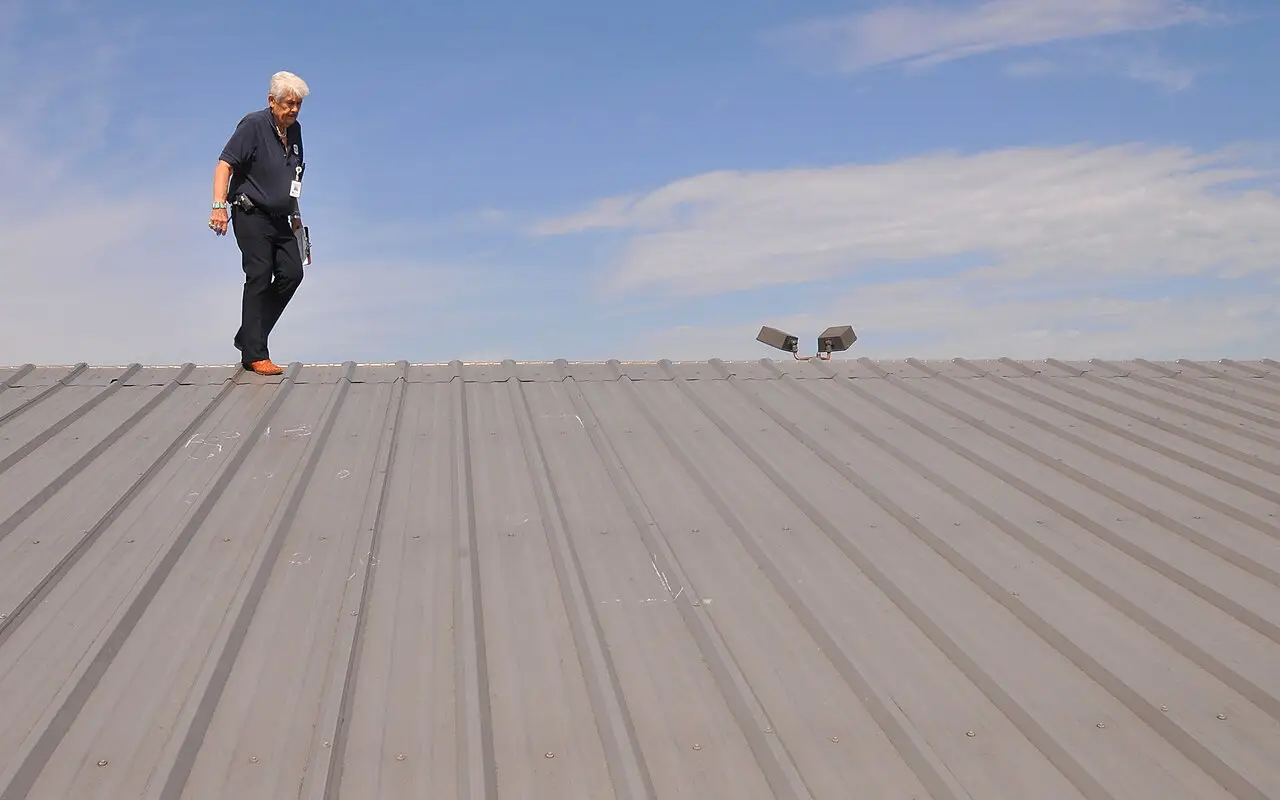
Cover photo: FEMA official examining hail damage on a municipal building roof in Moore, Oklahoma, 2010; photograph by Win Henderson / FEMA, U.S. government public domain. It illustrates roof inspection, not the example homeowner claim.
Sık Sorulan Sorular
Why did my insurer send less money than the roofer quoted?
The written settlement may subtract depreciation and your policy deductible or exclude some work. Request a line-item explanation and compare the adjuster's scope with the contractor's estimate.
What is recoverable depreciation on a roof claim?
Under some replacement-cost policies, eligible depreciation is withheld initially and may be reimbursed after completed repairs and required documents within the policy deadline.
Is a 2% homeowners deductible calculated on the repair estimate?
Not necessarily. A percentage wind or hail deductible may be based on the dwelling insured value. Check the precise policy terms and declarations page.
Does every U.S. state allow depreciation of labor costs?
No. Rules vary. Washington's insurance commissioner, for example, says insurers cannot depreciate labor costs when determining actual cash value in property claims there.