

Key facts
- Battery preconditioning adjusts high-voltage battery temperature; it is different from heating or cooling the passenger cabin.
- Tesla's Model 3 manual describes automatic battery preparation when Trip Planner navigates to a Supercharger and gives a model-specific 30–45-minute navigation recommendation.
- The 2026 Hyundai IONIQ 5 owner documentation describes automatic navigation-linked battery conditioning and, in relevant models/software, manual activation.
- Conditioning may consume energy and can reduce displayed driving range; it is not guaranteed to begin if battery charge is low or temperature is already suitable.
- Actual DC charging power still depends on vehicle charge limits, state of charge, charger capability, battery state and environmental conditions.
EV battery preconditioning is the process of warming or cooling an electric vehicle’s high-voltage battery toward the temperature range preferred for charging. It is most useful before a DC fast-charging stop when the battery is too cold or too hot. Many modern EVs can start this process automatically when the driver selects a supported fast charger in the car’s built-in navigation system, but the exact features vary by make, model, model year and software.
What does battery preconditioning actually do?
Lithium-ion batteries do not charge at their fastest rate in every temperature condition. A battery management system monitors temperature and state of charge and can limit charging current to protect the pack. A battery conditioning system uses the vehicle’s thermal-management hardware to move the battery toward a suitable temperature before the charging session. That can reduce the delay associated with charging an overly cold battery and can also help manage high-temperature conditions.
It is not a guarantee of maximum advertised charging power. Charger output, the battery’s state of charge, charging curve, pack temperature, hardware and other operating conditions all influence the actual charging rate. Even a properly conditioned EV may charge at a modest rate when its battery is nearly full.
Battery preconditioning vs. cabin preconditioning
| Feature | Battery conditioning for DC charging | Cabin preconditioning |
|---|---|---|
| Main purpose | Bring the traction battery toward charging-friendly temperature | Make passenger space comfortable before driving |
| When useful | On approach to a high-power charger when battery temperature is unsuitable | Before departure on a very cold or hot day |
| How it can start | Compatible in-car navigation or a manufacturer-provided manual function | Schedule, vehicle settings or a mobile app depending on model |
| Can both happen together? | Yes, on some vehicles | Yes, on some vehicles |
Some manufacturers use the term preconditioning for several related thermal-management functions. Before following instructions online, confirm whether they describe the high-voltage battery, the cabin or both. Turning on the cabin heater alone does not necessarily trigger fast-charging battery conditioning.
How to precondition a Tesla before Supercharging
Tesla’s official Model 3 owner documentation explains that using the built-in Trip Planner or navigating to a Supercharger prepares the battery automatically for efficient charging. It recommends setting the charging destination at least 30–45 minutes before arrival where possible to help reach optimal temperature.
- Open your Tesla’s built-in navigation or Trip Planner.
- Choose a suitable Supercharger location along your actual route.
- Drive toward it while following normal range and traffic safety precautions.
- Allow the car to manage its battery temperature automatically as required.
- At the station, connect and check the charging rate, session status and the battery percentage.
The 30–45-minute recommendation is from a specific Tesla owner manual; it is not a universal preconditioning time for every EV. Tesla also notes that certain third-party fast-charging locations can support navigation-linked preparation depending on region and software; do not assume every third-party charger automatically activates it. Check the instructions for your specific Tesla model.
How Hyundai battery conditioning works
The official 2026 Hyundai IONIQ 5 owner manual describes two ways to manage battery conditioning on supported vehicles:
- Navigation linked: Set a compatible DC charging station as a destination or waypoint in the integrated navigation. The system considers the expected arrival time when managing battery temperature.
- Manual function: The online manual describes the vehicle’s EV screen and Battery Conditioning setting. Whether manual activation is available, and the exact menu labels, depends on the vehicle’s software and market specification.
The manual also explains that the function may not operate if the battery is already at a suitable temperature or if charge level is low enough that preserving driving distance takes priority. It can require energy to change battery temperature. For other Hyundai, Kia and EV models, read the correct owner’s manual for the exact model year and market; do not assume the IONIQ 5 menu appears on every EV.
Do you need preconditioning in summer as well as winter?
Yes, it can be relevant in either season, because batteries may be too hot or too cold for preferred DC charging performance. Cold weather often makes the issue more visible, but summer heat, sustained fast driving, repeated high-power charging and the vehicle’s cooling capability can affect battery temperature too. The car—not the outside air temperature alone—determines whether conditioning is needed.
What if your EV does not have a preconditioning button?
There is no universal preconditioning command. Some cars manage temperature in the background without exposing a manual control; others may require an in-car navigation destination or offer no dedicated user-initiated function. Do not attempt to warm a high-voltage battery with external heaters, improvised electrical modifications or unsafe driving. Follow the manufacturer-approved charging and thermal-management instructions.
If you are unsure which feature your car supports, identify its full model, model year, software version and market. Read the battery/charging section of the owner’s manual or ask the manufacturer or authorized service center.
Why is DC fast charging still slow after conditioning?
- High state of charge: most EV charging curves reduce power as the battery fills. Conditioning does not override this.
- Station output: a car cannot exceed the available power of the charger or its own charging hardware.
- Battery limits: the car may constrain current based on cell temperature, pack condition, state of charge or other safety factors.
- Timing: if the charger was selected only shortly before arrival, the pack may not have had enough time to reach its preferred temperature.
- Incorrect navigation target: entering a street address instead of a recognized charging location may not trigger manufacturer-specific automatic behavior.
- Charger malfunction or power sharing: station constraints can affect performance independently of battery preparation.
To understand the difference between a charger’s rated output and actual delivered power, read our 350 kW EV charging guide. For winter driving efficiency, compare EV heat pumps and resistance heaters.
A practical fast-charging road trip checklist
- Check the manufacturer’s guide for your exact EV and identify any automatic or manual battery conditioning features.
- Find a functioning DC charging station that supports your car’s connector and charging standard.
- If supported, select the station in the car’s built-in navigation in time for temperature management.
- Maintain adequate driving range to reach the charger and a backup; do not deliberately drain the battery just to seek a faster charge rate.
- Verify current charging availability and payment rules before reaching the stop.
- After plugging in, follow your vehicle’s recommended target charge level and monitor the actual delivered energy.
Does preconditioning shorten battery life?
A properly designed, manufacturer-controlled conditioning function is part of the vehicle’s intended battery-management system. It is used to manage battery temperature, which is important for performance and battery protection. The amount of energy used and any battery-health effects depend on the vehicle and conditions; claims that using it a specific number of times will extend or shorten battery life by a guaranteed percentage are not supported by these manuals.
For routine charging choices, see our daily EV charge limit guide and the guide to paying for public charging without an app.
Official manufacturer references
Sources: Tesla Model 3: Hot Weather Best Practices, 2026 Hyundai IONIQ 5: Battery Conditioning, and Tesla Model Y: Cold Weather Best Practices. Verify the model-specific and software-specific instructions before changing vehicle settings.
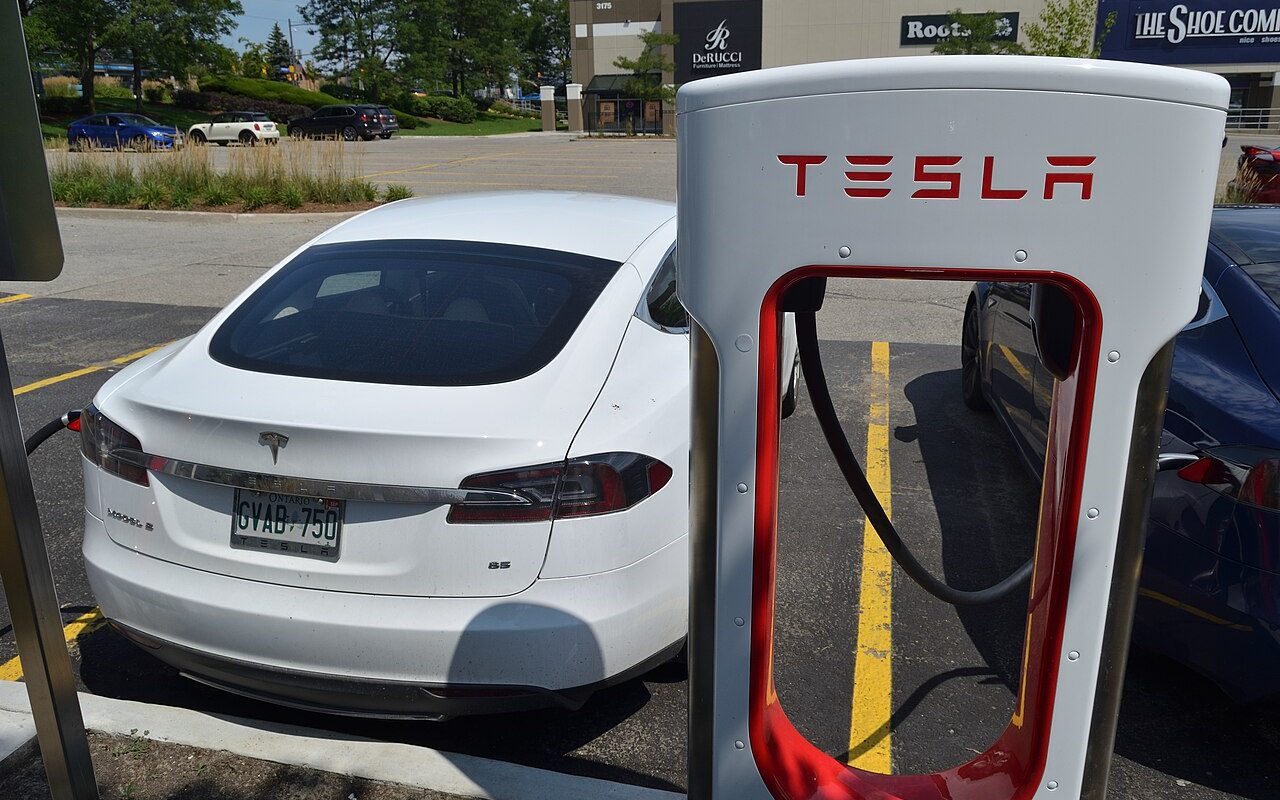
Editorial review: November 9, 2026. Featured image: a real Tesla Supercharger site in Markham, Ontario, photographed August 14, 2018 by Raysonho, Wikimedia Commons / CC0 1.0. The image illustrates a DC fast-charging location, not an in-car battery-temperature reading or measured charging performance.
Sık Sorulan Sorular
What does EV battery preconditioning do?
It adjusts high-voltage battery temperature toward the preferred operating range, often before DC fast charging, so the vehicle can charge under better thermal conditions.
Does preconditioning make every EV charge faster?
No. It helps most when the battery is too cold or too hot for optimal charging. If battery temperature is already suitable, there may be little or no benefit. Vehicle and charging-station limits still apply.
How do I precondition a Tesla before a Supercharger?
On a supported Tesla, enter a Supercharger destination using the vehicle's built-in Trip Planner/navigation. The car prepares the battery during the approach as needed. Consult your model and software-specific owner's manual.
Can I manually start battery conditioning on a 2026 Hyundai IONIQ 5?
Hyundai's 2026 IONIQ 5 online manual describes a Battery Conditioning option on the vehicle's EV screen as well as navigation-linked operation. Exact availability and screen names vary by market and vehicle software.
Does preconditioning use battery power?
Yes. Heating or cooling the battery can use energy. Hyundai's owner documentation notes conditioning may be curtailed when charge is low to preserve driving range.

2 comments