Key facts
- IEC 60529 is the enclosure-protection standard behind the IP code.
- IP55 and IP65 have the same water digit; their first digits describe different dust protection.
- An immersion rating does not by itself establish a water-jet rating or permission to operate charging equipment underwater.
- NEMA enclosure types include requirements beyond the IP code and cannot be inferred from an IP number alone.
- The exact EVSE manual, complete assembly, installed condition and local installation requirements remain essential.
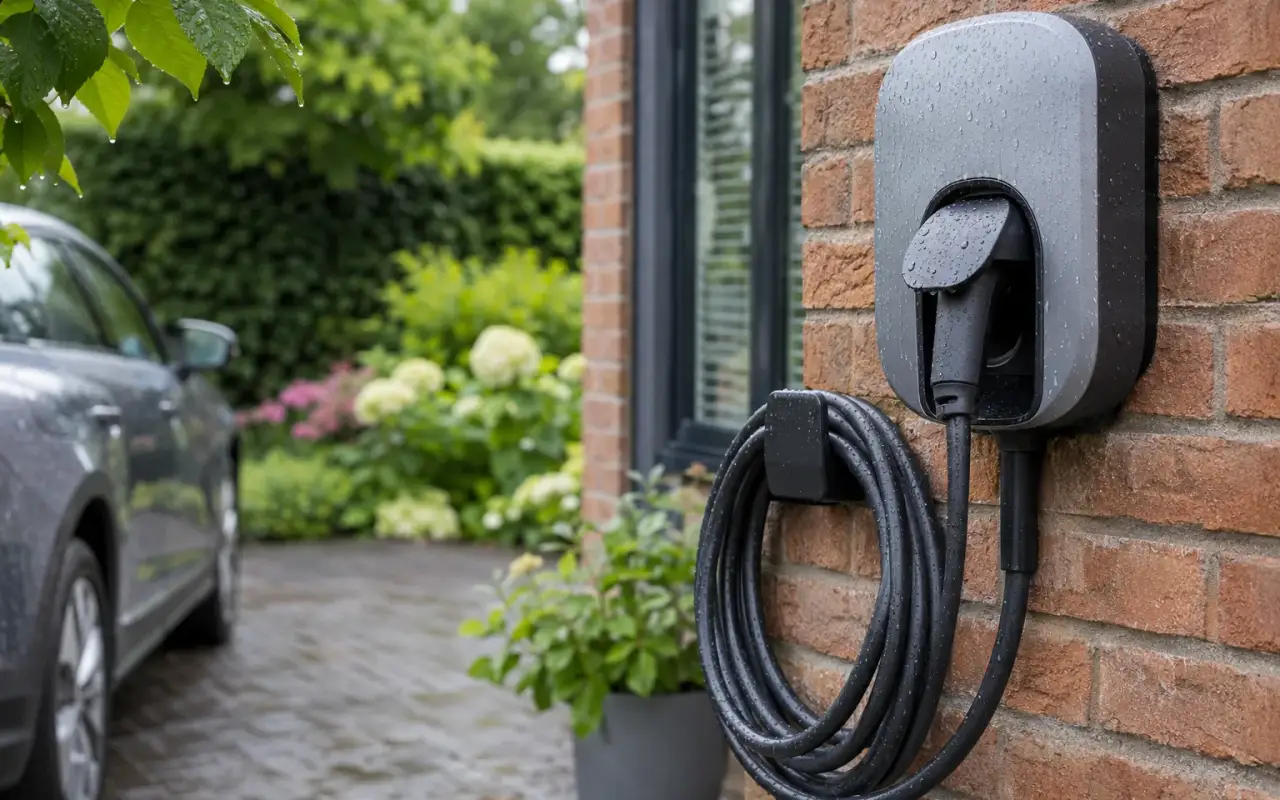
An EV charger’s IP rating describes how a particular enclosure is protected under defined test conditions. It does not mean that the whole charging setup is safe in any weather or that it can operate in floodwater. Read the code alongside the exact product manual and the requirements for the proposed installation.
The IEC 60529 standard classifies protection provided by electrical enclosures. Its code is useful when comparing equipment, but a product description such as “waterproof charger” leaves important questions unanswered: which component is rated, in what configuration, and for what use?
Read the two digits separately
The first digit concerns protection against solid objects and access to hazardous parts; the second concerns harmful water ingress. The manufacturer ADJ’s explanation of the IP system also clarifies that an X means no rating is claimed for that position. It is not a higher or lower number.
| Code | Solid-object protection | Water protection category |
|---|---|---|
| IP55 | Dust protected: limited, non-harmful ingress | Water jets under the specified test |
| IP65 | Dust tight | Water jets under the specified test |
| IP67 | Dust tight | Temporary immersion under the specified test |
These examples follow Gore’s enclosure-rating reference. IP65 does not have a higher water digit than IP55: both end in 5. Conversely, do not treat an immersion number as an all-purpose upgrade. ADJ explains that immersion ratings 7 and 8 do not automatically include the water-jet tests; products can carry multiple ratings where appropriate.
Identify exactly what carries the rating
Ask the supplier to identify the rated item in the official documentation. Is it the wall unit, a portable control box, a particular connector, or the complete equipment assembly? A rating shown beside one component cannot be assumed to describe every other component in a photograph.
Then ask which conditions apply: assembled covers, cable entries, required seals, connector caps and whether a connector is mated or unmated. ADJ’s technical explanation makes clear that the tested configuration matters and that damaged seals or unsuitable components can reduce protection. This is a documentation check, not an invitation to open the unit or modify seals yourself.
A useful purchasing record has five fields: manufacturer and part number, sales market, official manual link, declared enclosure rating and the configuration to which it applies. If the seller only provides a marketplace badge, request the product documentation before treating the claim as verified.
A real EVSE example: IP55 still comes with instructions
Tesla’s Gen 3 Wall Connector specifications for the EMEA Type 2 manual list IP55 for the enclosure and identify the covered part-number family as 1529455-**-*. This is an example for that documented product family, not a rating for every Tesla charger or a generic outdoor unit.
The associated safety instructions prohibit spraying liquid directly at the control box or charging handle and immersing the handle. They also prohibit using damaged equipment and direct repairs to Tesla. An enclosure water test therefore does not cancel the manufacturer’s operating and cleaning restrictions.
The installation guidance separately addresses location, cable reach, storage and mounting height. A photograph of a similar-looking installation cannot prove that these requirements have been met. Have the installer apply the manual for the equipment actually being fitted.
Do not convert IP into a NEMA enclosure type
North American equipment may use a NEMA enclosure type. Gore’s comparison explains that NEMA requirements include additional matters such as corrosion, gasket ageing and external icing, depending on the type. An IP rating alone cannot establish a corresponding NEMA type.
Also distinguish an enclosure type from an outlet designation. For example, the NEMA 14-50 outlet discussed in the U.S. EPA’s home-charging guide identifies an electrical connection arrangement; it is not a claim that the entire outdoor outlet installation is waterproof. Ask the installer for the appropriate equipment and protection for the location.
Compare two offers without relying on the larger number
Imagine one quotation specifies an outdoor EVSE, gives its full manual and names the approved installation components. A second advertisement displays IP67 beside a portable control box but leaves the mains plug, cable connections and conditions of use unspecified.
The second offer is not proven more suitable merely because 67 is larger than 55. The missing information has to be resolved. Compare the documented complete setup, electrical compatibility, installation requirements, support and conditions of use. A rating number cannot replace any of those answers.
Use these questions when discussing the actual site with a qualified installer:
- Is the exact product approved by its manufacturer for this outdoor location and climate?
- Which components, connectors and accessories are covered by its declared protection?
- Can the supplied cable reach the parked car without strain or an improvised extension?
- How will the handle be stored, and what restrictions apply to cleaning and exposure?
- What inspection or service is required if equipment is damaged or water enters somewhere it should not?
The EPA’s U.S. guidance supports choosing outdoor-rated, safety-certified equipment and having electrical work handled professionally. Its electrical details are U.S.-specific; other countries have their own requirements. Our extension-cord safety guide explains why cable reach should be solved as part of the charging setup.
Keep weather and damage decisions separate
An intact, correctly installed outdoor system and a damaged or water-affected system are different situations. Do not use an IP badge to dismiss a cracked enclosure, damaged cable, contaminated connector or fault warning. Follow the manufacturer and operator instructions, and have the problem assessed professionally.
Flood exposure needs its own response. NHTSA warns of shock and fire hazards in flooded EVs. Do not start charging a flood-affected vehicle or equipment to see whether it still works. Seek professional advice and follow local emergency directions.
For those situations, read our existing guides to rain, storms and EV charging, EV floodwater risks and recovery, and reporting a faulty public charger.
If you are also bringing a vehicle from a different market, keep the equipment documentation with the broader EV import and charging-compatibility checklist.
Frequently asked questions
Does IP65 mean completely waterproof?
No. It describes specified dust and water-jet protection for the rated enclosure. It does not establish unrestricted immersion, every operating condition or the suitability of an entire installation.
Can an IP67 charger be used while submerged?
Do not interpret an enclosure immersion test as approval to charge underwater. The manufacturer’s permitted use, the complete equipment and electrical installation requirements still control the application.
What IP rating should every outdoor EV charger have?
There is no universal minimum specified by this guide. Select equipment for the actual country, product, location and exposure with a qualified installer, using the official manual and applicable requirements.
Source review: 12 November 2026. Product and authority examples are identified by market; original numerical examples are illustrative calculations, not hands-on test results.