Key facts
- A rear carrier is not guaranteed to have zero range impact, and a universal roof-box percentage is not a reliable trip budget.
- Published ORNL roof-versus-rear tests cited here used two gasoline vehicles, not an EV fleet.
- Under the explicit example assumptions, a 75 kWh usable pack between 80% departure and 15% reserve provides 48.75 kWh.
- A 25% rise in energy used per distance produces a 20% reduction in distance for the same available energy.
- Carrier weight and its load count toward applicable limits; trailer towing capacity is not a rear-carrier payload rating.
Plan an EV trip with a roof box or rear carrier using consumption for that configuration, rather than subtracting a universal percentage from the advertised range. A carrier that suits one vehicle, speed and load can produce a different result on another journey.
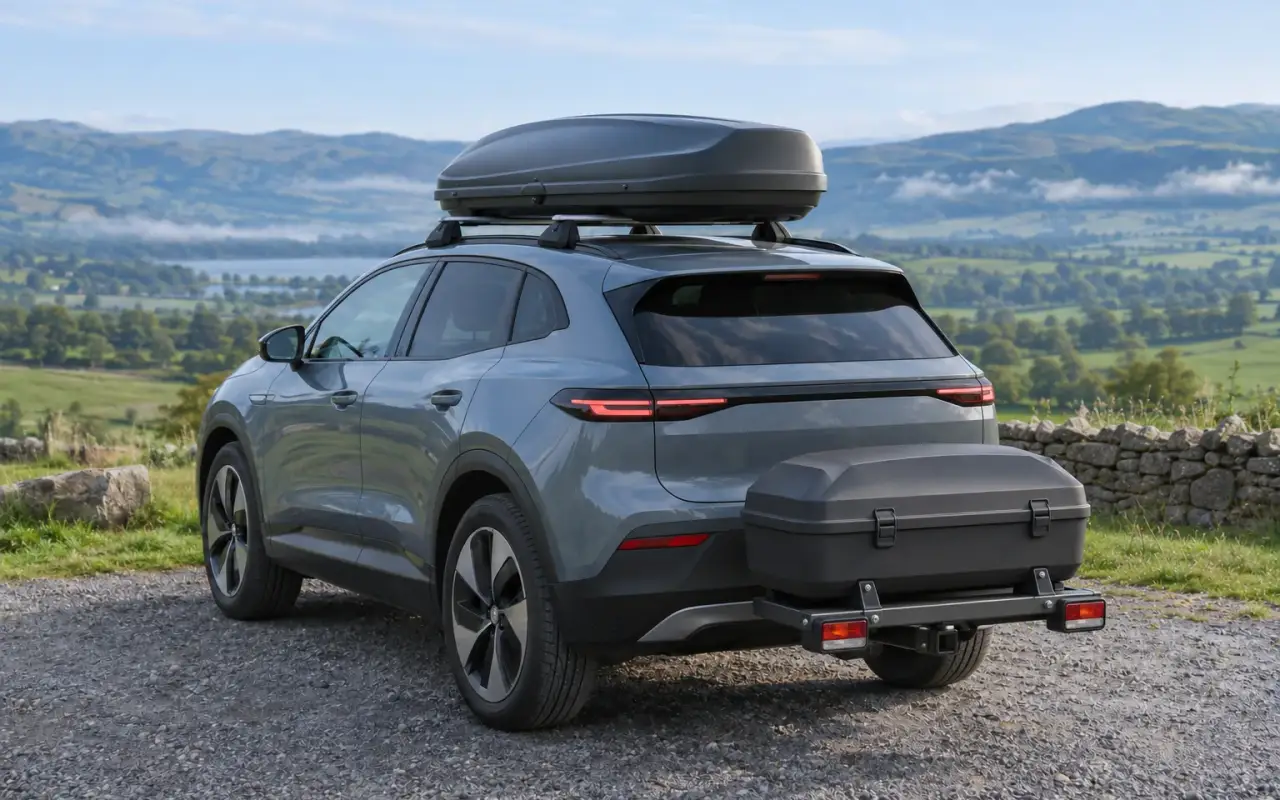
This guide compares a roof-mounted cargo box with a rear cargo carrier attached to an approved mounting system. A trailer introduces additional requirements covered in our EV towing and range guide. All numerical examples below are invented to explain the calculation, not results from a road test.
What the published evidence can and cannot tell you
FuelEconomy.gov explains that rooftop cargo increases aerodynamic drag. Its cargo guidance also distinguishes rear-mounted storage and recommends removing external containers when they are no longer needed.
The frequently cited Oak Ridge National Laboratory comparison tested a 2009 Toyota Corolla and a 2009 Ford Explorer with roof and rear loads. Those were gasoline vehicles. Their results demonstrate that placement and vehicle shape matter; they do not establish a fixed range penalty for every electric car, bike rack or cargo box.
For an EV-specific example of the variables involved, Tesla’s U.S. Model Y range guidance identifies speed, weather, cargo and roof or trunk racks among the factors affecting energy use. It also explains the value of recent consumption when estimating remaining distance. The useful question for your trip is therefore: what consumption should this loaded car be budgeted to achieve on this route?
Check permission and loading before comparing efficiency
Open the manual for the exact model year and sales market. Confirm that the vehicle supports the proposed roof rack or rear mounting system. Then check the accessory’s instructions and the applicable road rules for load projection, lighting and registration-plate visibility.
| Roof box | Rear carrier | Both |
|---|---|---|
| Approved mounting points, rack and box compatibility, permitted driving load and total vehicle height. | Approved hitch or mounting system, carrier compatibility, vertical-load limit and any restrictions on how far the load sits behind the mount. | Total vehicle payload, axle limits, accessory mass, cargo mass, secure loading and manufacturer speed instructions. |
Tesla’s U.S. Model Y loading manual, for example, requires approved roof-rack arrangements and identifies vehicle and axle weight limits. These are model-specific requirements, not permission to fit the same equipment to another EV.
Its hitch-accessory guidance also explains why a rear carrier’s permitted vertical load differs from a trailer’s tongue load: the accessory can place weight farther behind the receiver. Count the carrier itself as well as its contents. A headline trailer towing capacity is not the amount of luggage allowed on a rear rack.
Create a comparable consumption log
Record the vehicle, tyres, load, carrier position, temperature, wind, route, traffic and typical speed. Keep the cabin conditions comparable. Use the same consumption measure for each configuration, such as battery energy per 100 km shown by the car; do not compare one configuration’s charger receipt with another’s trip-computer reading.
If you can make a safe, representative comparison, record ordinary driving with no external carrier, with the loaded roof box and with the loaded rear carrier. Do not handle a phone or record readings while driving. A familiar return route can help reveal whether a one-way result benefited from the wind or elevation, but it is still an observation rather than a controlled certification test.
Keep more than one observation when conditions vary. For departure planning, use a cautious consumption assumption that reflects the actual load and expected weather, then check the car’s route prediction. The changing range-estimate guide explains why a dashboard distance can adjust as conditions change.
Worked example: the energy available between stops
Assume a hypothetical EV has 75 kWh of usable capacity, departs at 80% and aims to arrive with 15% remaining. For this simplified example, displayed charge percentage is treated as proportional to usable energy:
Driving energy budget = 75 × (0.80 − 0.15) = 48.75 kWh.
The reserve is a chosen example, not a recommended percentage for all routes. Weather, battery condition, detours and charger availability may require a different margin. Now assign the following hypothetical consumption values:
| Configuration | Consumption | Calculated distance to the chosen reserve |
|---|---|---|
| No external carrier | 18 kWh/100 km | 48.75 ÷ 18 × 100 ≈ 271 km |
| Roof box | 22.5 kWh/100 km | 48.75 ÷ 22.5 × 100 ≈ 217 km |
| Rear cargo carrier | 20 kWh/100 km | 48.75 ÷ 20 × 100 ≈ 244 km |
These distances are calculation outputs, not promised real-world range. In miles, use the same relationship with kWh per mile: available kWh divided by kWh/mile. If your display uses miles/kWh, multiply that efficiency by the available kWh instead.
Why consumption increase and range loss are different percentages
In this example, moving from 18 to 22.5 kWh/100 km increases consumption by 25%. With the same battery energy, the distance becomes 18 ÷ 22.5 = 0.80 of the baseline: a 20% reduction.
That distinction prevents a common budgeting error. Range is inversely related to energy used per distance. Do not take a percentage from a consumption comparison and automatically subtract the same percentage from range.
Apply the numbers to a real charging leg
For a hypothetical 220 km leg, the roof-box assumption requires 220 × 22.5 ÷ 100 = 49.5 kWh, exceeding the 48.75 kWh driving budget by 0.75 kWh. The rear-carrier assumption requires 44 kWh, leaving 4.75 kWh above the chosen arrival reserve.
The first configuration therefore needs a revised plan under these assumptions: an earlier charging stop, a different feasible departure charge or a shorter route. The second still needs checks for adverse conditions and a usable backup charger. Neither result justifies consuming the planned reserve to preserve an itinerary.
Check the physical stops too. A roof box changes total height; a rear carrier changes rear clearance and can affect access to luggage or the charging cable. Verify parking and charger access with the fitted load. Our road-trip charging and reserve guide helps turn the energy calculation into a route.
The efficiency unit converter helps when trip records use different distance units. If the itinerary includes a crossing, check ferry vehicle declarations and boarding-charge rules with the fitted carrier dimensions.
Frequently asked questions
Is a rear carrier always better for EV range?
No universal result is established here. Compare your compatible options with the actual vehicle, load and conditions. The sample table deliberately uses invented figures, not a recommendation for a product.
Can I use the advertised EPA or WLTP range?
Use it as context, then build the trip around the loaded vehicle’s consumption. Our EPA and WLTP comparison explains why different test labels are not interchangeable route forecasts.
What if I have no consumption data before the trip?
Avoid a tightly spaced plan built on an unsupported range guess. Seek model-and-accessory evidence, plan an earlier usable stop and reassess after a representative initial section while a safe charging alternative remains available.
Source review: 12 November 2026. Product and authority examples are identified by market; original numerical examples are illustrative calculations, not hands-on test results.