Quick answer: Electric-car charging time depends on how much energy the battery needs (kWh), the actual charging power (kW), the vehicle’s limits, the battery temperature and, for DC charging, the charging curve. A hypothetical EV with a 60 kWh usable battery needs about 36 kWh to move from 20% to 80%. At a truly constant 7.4 kW delivered to the battery, the ideal calculation is 4.9 hours. Actual charging takes longer when power varies or losses occur.
This guide shows the formula, realistic limitations and how to compare home AC and public DC charging. Its general principles reflect official guidance from the US Department of Energy, US Department of Transportation and US Environmental Protection Agency.
How to calculate EV charging time
First determine the car’s usable battery capacity, which may be lower than its gross advertised capacity. Then calculate the energy needed for the desired change in state of charge:
Energy added to battery (kWh) ≈ usable battery capacity (kWh) × (target % − starting %) / 100
For a constant-power ideal calculation:
Time (hours) ≈ energy added to battery (kWh) / average power actually delivered to battery (kW)
Do not substitute a charger’s advertised peak rating for verified average power and expect a reliable real-world prediction. AC conversion losses and changing DC power can make the session longer.
Charging time example: 60 kWh battery, 20% to 80%
Energy needed is 60 × 0.60 = 36 kWh. These illustrations assume power is constant and actually reaches the battery. They are not tested vehicle results or manufacturer charging claims.
| Hypothetical average power | Ideal time | Important qualification |
|---|---|---|
| 1.4 kW | 25.7 hours | Actual time increases with losses and possible current restrictions. |
| 7.4 kW | 4.9 hours | The EV and circuit must support the power; AC losses matter. |
| 11 kW | 3.3 hours | Requires compatible vehicle onboard AC charger and supply. |
| 50 kW | 43.2 minutes | The car may not sustain this rate throughout a DC session. |
| 150 kW | 14.4 minutes | Theoretical constant-power arithmetic only; not a real charging-time promise. |
Level 1 vs Level 2 vs DC fast charging
Level 1: US 120-volt charging
In North America, Level 1 generally means 120 V AC charging. It can suit modest daily mileage where the electrical circuit, equipment and vehicle are compatible. The US Department of Transportation provides a broad example of roughly 40–50 hours to charge a battery-electric vehicle to 80% from empty using Level 1. That figure is not universal and is not applicable to every car or country. Socket voltage and charging classifications differ internationally.
Level 2: suitable for longer parking sessions
Level 2 AC charging is commonly used at home, work and destination parking. US DOT gives a broad 4–10 hour example to reach 80% from empty in a BEV, with actual results dependent on vehicle and installation. A 22 kW AC post cannot force 22 kW into a vehicle with an 11 kW onboard charger. See our Opel Grandland Electric AC charging report for a model-specific example of optional AC charging hardware.
DC fast charging: look at the charging curve
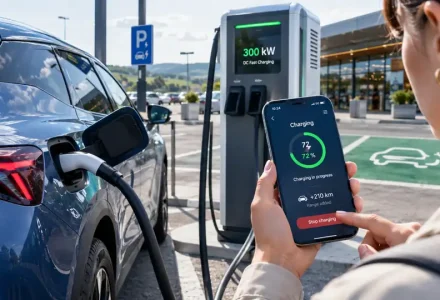
DC fast charging can shorten journey stops but is managed by the battery system. A 150 kW charger indicates a possible equipment rating, not a promise that the vehicle will receive 150 kW throughout a session. Battery temperature, state of charge, power sharing, vehicle configuration and the station affect actual output. The DOT cites a broad example of approximately 20 minutes to one hour to reach 80% with DC fast charging; this is not a vehicle-specific guarantee.
Why does fast charging slow down after 80%?
Battery charging is not a fixed-rate process. Many vehicles taper current at higher state of charge to manage cells and safety limits. That makes a manufacturer’s 10%–80% claim more useful for estimating many road stops than simply scaling a 0%–100% time. Check the exact model year and stated test conditions. Our charging-curve explainer (Turkish) gives additional background.
Five reasons your car charges slower than expected
- Onboard AC limit: The vehicle cannot accept all power offered by the wallbox or destination charger.
- Cold or hot battery: The vehicle’s management system may limit charging current.
- High starting charge: Charging at 80% may be slower than at 20%, depending on the model.
- Station or installation constraints: Power sharing, hardware issues or electrical limits can restrict output.
- Charging losses: AC-to-DC conversion and thermal management mean electricity bought at the meter is not identical to energy stored in the battery.
How to estimate charging time for a road trip
- Look up the vehicle’s exact usable battery capacity and supported connector standards.
- Calculate the energy you need for the next leg, allowing an appropriate reserve for the conditions.
- Check the vehicle’s published or independently measured 10%–80% charging curve, not just its peak kW.
- Confirm station access, opening restrictions, payment methods and live availability where possible.
- Budget extra time for a charging queue, connection start-up and temperature-related reductions.
Is a faster home EV charger worth buying?
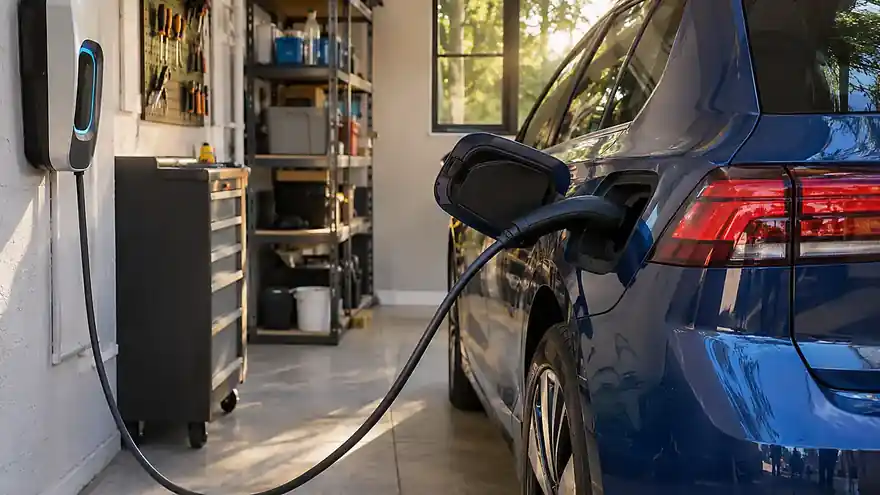
Start with how many kWh you drive each day and how many hours the vehicle stays parked. A modest charger may replenish daily driving needs overnight without requiring maximum installed power. The EPA Home EV Charger Calculator illustrates how mileage and parked hours affect a US driver’s home charging needs. Have a qualified electrician assess circuit capacity, protective devices, local permits and the charging equipment; follow EPA installation guidance and local code.
Source notes
This article is a calculation-based consumer guide, not a test of one electric car. All tabulated times deliberately assume constant battery-delivered power and therefore should not be interpreted as actual expected session durations. Official references: DOE charging stations, DOT charging speeds and EPA charging details. Visit our EV Guides archive for related coverage.