

Yes. Home electric vehicle charging equipment can use a small amount of electricity even when it is not actively charging a car. The EV charging station—technically called electric vehicle supply equipment (EVSE)—may keep its controller, status lights, Wi-Fi connection, display or other electronics powered while waiting for a vehicle. Standby electricity use is not the same as charging energy transferred to a car. The exact wattage depends on the equipment, settings and whether a vehicle remains connected.
As a transparent calculation, a charger using an assumed 5 watts for 24 hours a day over 30 days would consume 3.6 kilowatt-hours (kWh). At an illustrative $0.18 per kWh, the energy portion costs approximately $0.65 per month. That is not a measured reading for a particular charger or a quoted 2026 U.S. electricity rate.
Does an EV charger use electricity without a connected car?
ENERGY STAR identifies several operating states for Level 1 and Level 2 charging equipment. In No Vehicle Mode, the device has access to electricity but no vehicle is connected. In Partial On Mode, the car is connected, but the charging equipment is not actively delivering a charge. These states are not equivalent: a connected vehicle, charger controls or communications features can affect energy use. ENERGY STAR’s official EVSE product criteria specifies separate tests and power limits for the two modes.
A third state is active charging, when electric power is delivered through the equipment to the vehicle. In a typical home AC charging setup, the charger in the car converts AC power into DC power for the high-voltage battery; the wall-mounted EVSE controls and safely supplies power. A 7.2-kW or 11-kW AC charge rating describes an active-delivery capability—not the amount used by the idle display.
EV charger standby electricity cost calculator
Use this straightforward formula:
Standby energy (kWh) = average standby power (W) ÷ 1,000 × hours in standby
Standby electricity cost = standby energy (kWh) × your energy rate ($/kWh)
For a full 30-day illustration, 24 hours × 30 days = 720 hours. The table below assumes each charger draws the indicated power continuously for the full 720 hours and electricity costs hypothetically $0.18/kWh. It is a set of mathematical scenarios, not a product test or an actual utility price.
| Assumed standby power | Monthly electricity use (720 hours) | Energy cost at $0.18/kWh |
|---|---|---|
| 2 W | 1.44 kWh | $0.26 |
| 5 W | 3.60 kWh | $0.65 |
| 6 W | 4.32 kWh | $0.78 |
| 10 W | 7.20 kWh | $1.30 |
For example, 6 W ÷ 1,000 × 720 = 4.32 kWh; 4.32 × $0.18 = $0.7776, or about $0.78. If your charger is actively charging for several hours most nights, it will not be in the same idle mode for all 720 hours. Multiply each operating mode’s measured wattage by the time spent in that mode rather than counting all hours twice.
How much energy do ENERGY STAR EV chargers save in standby?
The U.S. EPA’s ENERGY STAR EV Chargers consumer guidance says charging equipment is typically in standby—meaning not actively charging a vehicle—about 85% of the time. The program says certified chargers use approximately 40% less electricity in standby mode than comparable noncertified products while providing equivalent functionality. These are program-level descriptions, not guaranteed savings for every pair of models.
For a purchase decision, confirm that the specific model number is ENERGY STAR certified. A brand may sell multiple chargers with different features and different certifications. ENERGY STAR also requires an eligible charger to be safety-listed by a Nationally Recognized Testing Laboratory, but do not assume that every product advertised online has a valid listing.
Is an ENERGY STAR charger limited to four watts?
No. Under the ENERGY STAR Level 1 and Level 2 EVSE criteria, the no-vehicle mode power limit is calculated using a 4-watt base plus defined allowances for qualifying network functions and other auxiliary features. For example, the criteria include separate treatment for active Wi-Fi/Ethernet interfaces and displays. It would be misleading to say all certified EV chargers must use exactly four watts—or that every charger drawing more than four watts automatically fails certification.
The precise limit depends on the applicable edition of the requirements, the product configuration and the enabled features during standardized testing. Review ENERGY STAR Electric Vehicle Supply Equipment Key Product Criteria and the EVSE specifications for program partners before comparing technical claims.
Why one EV charging station may use more standby power than another
Standby demand depends on the electronics that remain active. Features that can change the energy draw include a communications module, Wi-Fi or cellular networking, a screen, status lights, measurement hardware and remote control functions. A home Level 2 unit with an always-on color display may use more energy than a simple unit, but the actual measured values must come from that model’s data. Neither the size of its case nor its maximum charge speed proves a particular standby wattage.
A connected but fully charged car can also differ from an unplugged car. The vehicle may wake periodically for checking, scheduling, thermal management or communication, according to its own design. Do not attribute all observed household electricity use to the wall charger without separating vehicle and equipment consumption.
Does a 7-kW, 9.6-kW or 11-kW home charger always draw that much power?
No. These are rated charging-output levels and describe what the equipment may deliver when the vehicle and circuit permit it. If no car is connected, there is no 7-kW or 11-kW traction-battery load. The wall unit can nonetheless consume relatively low power to stay ready. During active charging, actual power can be limited by the car’s onboard charger, the electrical circuit and dynamic load management.
When comparing a product’s idle watts with its active kilowatts, remember that 1 kW = 1,000 W. A charging station drawing 6 W in a waiting mode is using 0.006 kW—not 6 kW.
How to find out how much standby energy your charger really uses
- Locate the exact charger model. Check the model number on the installed unit and in its owner’s manual.
- Look for manufacturer or certified energy data. Search the actual model’s standby or no-vehicle power value, together with the operating conditions used in testing.
- Identify which state you mean. Is the vehicle unplugged, connected but waiting, or fully charged and still connected? Results can differ.
- Use safe energy monitoring. Where provided, review charging-system or circuit-level data from an approved monitoring device or a qualified electrician.
- Measure representative periods. A single instantaneous number may not represent devices that periodically wake up to communicate or update.
- Apply your utility rate. Calculate kWh for the actual hours and multiply by the relevant electricity price and applicable billing terms.
Electrical safety warning: Do not connect a standard household 120 V plug-in watt meter to a 240 V EVSE circuit unless it is explicitly approved and correctly rated for that use. Do not improvise plug adapters, bypass protective devices or open a hardwired charging station to insert a meter. Ask a licensed electrician to assess appropriate circuit monitoring if the manufacturer’s data is unavailable. The ENERGY STAR buying guide likewise recommends a qualified electrical contractor to assess home wiring and installation requirements.
Should you turn off the EV charger breaker to save money?
Not as an automatic everyday rule. A smart home charger may be designed to remain energized for charging schedules, software communication, fault monitoring or utility-managed charging programs. Routine use of a circuit breaker as an on/off switch may not be the intended operating method, and an unattended charging setup should follow manufacturer and electrician instructions.
Even at the assumed 5 W example, the entire 30-day energy cost is about $0.65 at $0.18/kWh. The potential saving from cutting power therefore may be modest compared with the inconvenience and any risks of disabling a connected smart charger. If the manufacturer provides an approved low-power standby function, that may be preferable to unapproved electrical changes. Never disconnect power while charging without following the equipment’s stop-session procedure.
What is the difference between charging losses and EVSE standby use?
Charging losses occur while energy moves through electrical equipment and into the vehicle’s battery, including power conversion and battery management. Standby use is electricity the equipment draws when it is not actively delivering energy. These are different components of household electricity consumption.
If your car’s energy monitor reports only battery energy, the billed grid energy may be higher because of charging losses. If you are using the U.S. EPA’s official kWh per 100 miles estimate, standardized charging losses are already included in that window-label metric. For a clear distinction, read our EV charging-loss explanation and energy cost comparison between EVs and gasoline cars.
Does a Wi-Fi charger use more electricity than a basic charger?
Sometimes. An active Wi-Fi or cellular connection can require additional power in waiting modes, but the difference is model-specific. ENERGY STAR’s EVSE rules include allowances for qualifying network and display functions. A connected charger can also offer remote monitoring, scheduled off-peak charging and demand-management features, which may be financially useful even if its standby watts are slightly higher. Compare the overall installation, energy use and actual utility prices, not standby power alone.
Our hardwired versus plug-in Level 2 charger guide explains installation differences. ENERGY STAR’s EVSE buying guidance also discusses smart functions and electric utility programs that may help shift charging to lower-cost periods.
Why a public charging station’s status panel is not a home standby meter
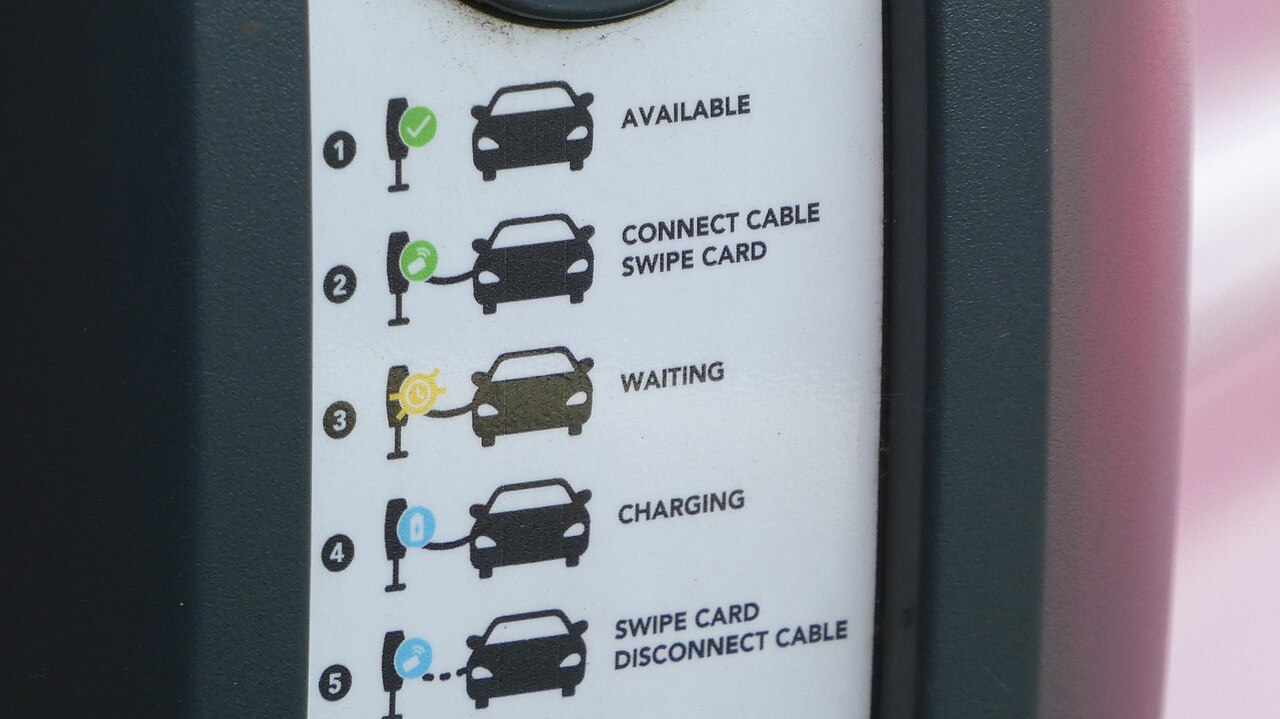
The article’s featured photograph is a real public EV charging-station instruction and status panel showing labels such as “Available,” “Waiting” and “Charging.” It illustrates that a charging station has distinct operating states, but it does not provide a wattage reading, and a public DC charging site may use more auxiliary energy than a residential AC wall box. Do not use the pictured panel to estimate home-charger standby consumption.
Five common mistakes in standby-cost calculations
- Confusing W with kWh: watts measure instantaneous power; kWh measures energy over time.
- Treating the EVSE’s active 7-kW rating as its 24-hour idle draw: the charging output is not always used.
- Assuming 4 W is a universal ENERGY STAR limit: the standard specifies extra allowances for particular features.
- Forgetting other modes: plugged-in and waiting power can differ from no-vehicle mode.
- Using a national electricity price as your exact bill: your utility tariff, timing and additional charges matter.
Practical homeowner checklist
- Identify the precise EVSE model and whether it has current ENERGY STAR certification.
- Look up its specified no-vehicle and connected-idle power where available.
- Estimate actual standby hours rather than assuming 24 hours every day.
- Calculate kWh from watts and hours using your own electricity price.
- Keep firmware and settings consistent with the manufacturer’s instructions.
- Use an electrician for any hardwired measurements or installation changes.
- Do not bypass electrical protection or interrupt the charger unsafely merely to save a small amount of standby electricity.
Official references and related guides
Primary references: ENERGY STAR: Electric Vehicle Chargers, ENERGY STAR EVSE Efficiency Criteria, U.S. Department of Energy: Efficient EVSE Procurement, and DOE: Estimating Appliance and Home Electronic Energy Use. For equipment protection questions, also see our home EV charger insurance guide.
Reviewed November 9, 2026. The table’s standby powers and electricity rate are illustrative assumptions, not product test results or national average prices. Featured image: actual public EV charging-station status panel by Pamsimhaho, Wikimedia Commons, CC0 1.0 (2025), shown to explain waiting versus charging modes; not a residential meter reading.
Sık Sorulan Sorular
Does an EV charger use power when no car is plugged in?
Often yes. EVSE electronics, lights or networking can consume standby power even without a connected vehicle. The actual draw depends on the exact charger model and its idle settings.
How much does 5 W of EV charger standby power cost per month?
At a constant 5 W for 24 hours daily over a 30-day month, use is 3.6 kWh. At a hypothetical $0.18/kWh, the energy-only cost is $0.648, or about $0.65. Use your own tariff.
Are all ENERGY STAR home EV chargers limited to 4 watts at idle?
No. The standard's no-vehicle power ceiling starts at 4 W and adds defined allowances for functions such as networking or displays. Consult a product's certified test data rather than assuming an exact wattage.
Should I turn off the breaker when the EV charger is not in use?
Not as a routine savings tactic without manufacturer or electrician guidance. Hardwired charging equipment and some smart systems are designed to remain energized; repeated switching can interfere with schedules or monitoring and may not be an approved operating method.
Can I measure a Level 2 EV charger's idle electricity with a normal plug-in energy meter?
Do not assume a standard 120 V plug-in meter is rated for 240 V EVSE equipment or charging current. Use manufacturer energy data, approved circuit monitoring, or a licensed electrician for safe measurement.

1 comment