Quick answer: U.S. homeowners comparing a hardwired vs plug-in Level 2 EV charger should choose based on electrical capacity, how permanently the unit will be installed, circuit protection, local code and the manufacturer’s instructions. A hardwired charger connects directly to a dedicated circuit. A plug-in model connects through a correctly specified, installed and maintained receptacle, commonly NEMA 14-50. Both options need an electrical-safety review.
What is a hardwired Level 2 EV charger?
Hardwired electric vehicle supply equipment (EVSE) is connected directly to the building’s fixed wiring by a qualified installer. It does not use a detachable household receptacle as its source. The installer must still provide the required circuit, conductors, overcurrent protection, disconnecting means if applicable, grounding and other safeguards.
This option may be appropriate for an owner who expects to leave a charger in one location. However, hardwiring does not make an undersized panel, incorrect circuit breaker or damaged wiring safe.
What is a NEMA 14-50 plug-in charger?
A plug-in EVSE uses a compatible supply cord and receptacle. In the United States, the NEMA 14-50 configuration is frequently associated with Level 2 charging. The receptacle, wiring, breaker and charging unit must be specified together. Household dryer outlets or old garage receptacles should never be assumed suitable simply because an adapter fits.
Important: A 50-amp receptacle rating is not a promise that a vehicle can draw 50 amps continuously. EV charging is a continuous electrical load and circuit sizing must reflect applicable electrical rules. A typical 40-amp charging setting requires a properly sized 50-amp circuit, but the electrician must apply the code adopted locally.
Hardwired vs plug-in: practical differences
| Factor | Hardwired EVSE | Plug-in EVSE |
|---|---|---|
| Power connection | Direct permanent wiring | Compatible dedicated receptacle and plug |
| Relocation | Requires electrical disconnection | Unit may be unplugged, following manufacturer instructions |
| Extra connection | No receptacle contacts | Receptacle and plug add a contact point requiring correct installation |
| Cost | Depends on wiring, labor and panel work | Depends on receptacle quality, wiring, circuit protection and labor |
| Professional review | Required for permanent installation | Required for new or evaluated EV charging circuit |
Installation and inspection checklist for U.S. homes
- Check your vehicle’s onboard AC charging acceptance and the EVSE’s rated output.
- Ask an appropriately licensed electrician for a load calculation and site inspection.
- Choose listed equipment compatible with the actual installation environment, such as a garage or outdoor wall.
- Confirm the adopted electrical code, permit rules and inspection requirements with the local authority having jurisdiction.
- Verify circuit sizing, conductor ratings, grounding and any required GFCI protection; never defeat protective devices to stop nuisance trips.
- If using a plug-in device, confirm a suitable receptacle is installed correctly, is intended for the load and is not worn or loose.
- Follow the charging unit and vehicle manuals for settings, mounting and use.
How much does installation cost?
There is no responsible single U.S. price. A nearby electrical panel with adequate spare capacity can make the job simpler; long cable runs, finished walls, trenching, service upgrades, permitting and labor rates can make it more expensive. Request an itemized estimate that separates the EVSE hardware, circuit installation, permit and any panel changes. Compare quotes for equivalent, code-compliant scopes instead of selecting solely by the charger sticker price.
What should you avoid?
Do not daisy-chain extension cords, use improvised adapters, increase circuit breaker size to stop tripping, or continue charging through hot, discolored or damaged plugs. If a breaker trips or a connector becomes unusually hot, stop use and have the system examined. See our related EV charger breaker troubleshooting guide and extension cord safety guide.
Official references
The U.S. Department of Energy Alternative Fuels Data Center outlines charging levels and infrastructure. The DOE Energy Saver EV charging resource explains home charging. For legally binding electrical requirements, consult the locally adopted edition of NFPA 70, equipment documentation and the local inspector; NFPA maintains the National Electrical Code.
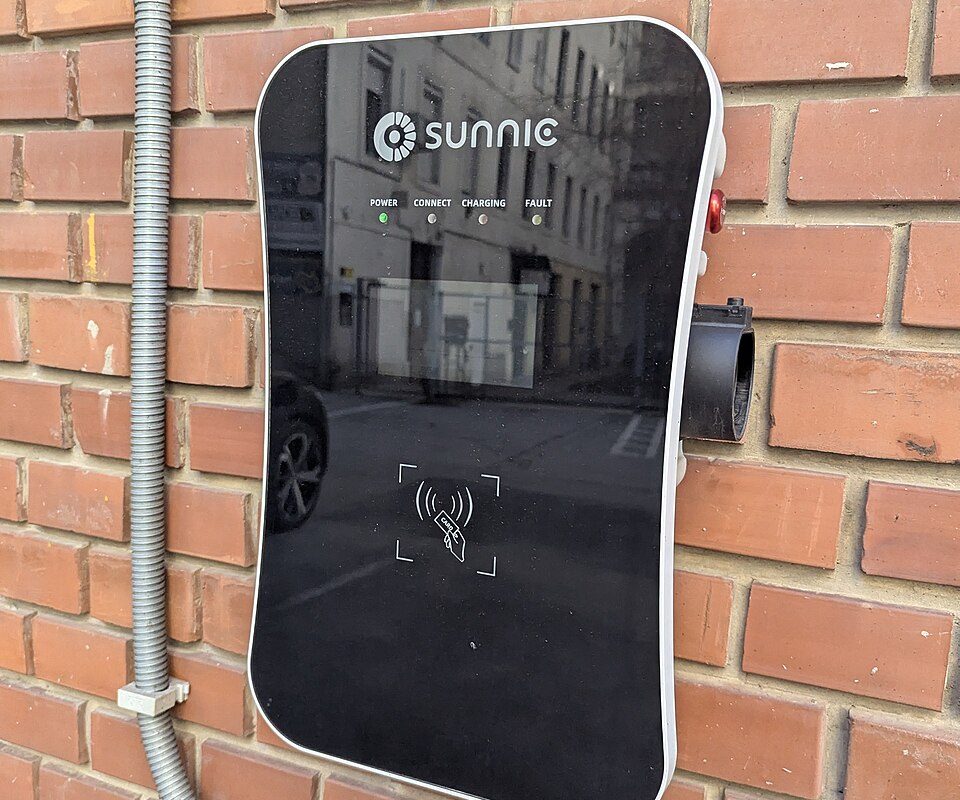
Photo: Wall-mounted charging equipment in Hungary, illustrative of EVSE hardware rather than a U.S. electrical installation. PinTweaks / Wikimedia Commons, CC0 1.0.
Sık Sorulan Sorular
Is a hardwired Level 2 EV charger safer than a plug-in unit?
Both can be safe when listed equipment is installed correctly to the manufacturer's instructions and applicable electrical codes. Hardwiring avoids an additional receptacle-and-plug connection, but does not eliminate the need for professional installation and protection.
Can a 50-amp receptacle continuously deliver 50 amps to an EV?
No. A common 50-amp branch circuit serving continuous EV charging is typically limited to a 40-amp charging load; equipment and local code determine the actual permitted setting.