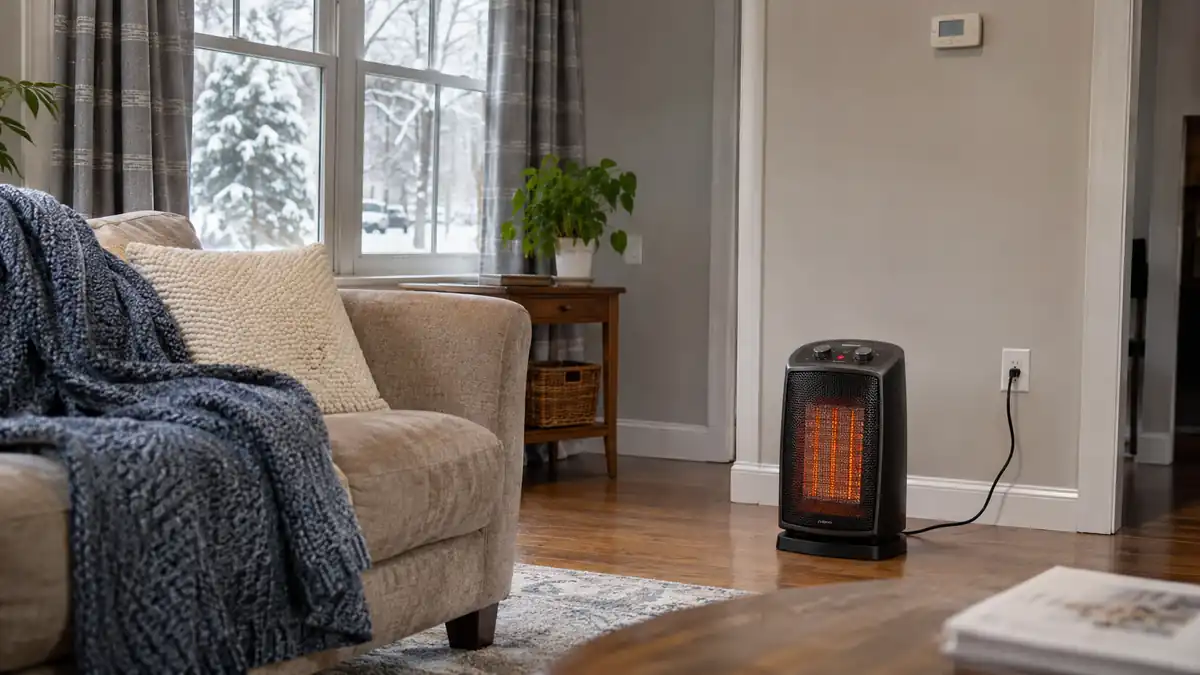
Quick answer: A 1,500-watt space heater consumes 1.5 kilowatt-hours (kWh) of electricity for each hour it operates continuously at full power. At an example price of $0.20 per kWh, that is $0.30 per hour. Four full-power hours a day for 30 days would cost $36; eight hours a day would cost $72. Your actual cost depends on local pricing and how often the heater’s thermostat switches its heating element off.
How to calculate 1,500-watt space heater electricity cost
Start with the heater’s rated output in watts and your utility’s electricity price. The basic energy formula is kilowatt-hours = (watts ÷ 1,000) × hours in use. Then multiply the result by the price per kWh. For a heater rated 1,500 watts, divide by 1,000 to obtain 1.5 kilowatts. One hour at full power therefore uses 1.5 kWh. The U.S. Department of Energy explains this calculation for household appliances.
Cost per hour, per day and per month
| Example electricity rate | One hour at full power | Four hours/day for 30 days | Eight hours/day for 30 days |
|---|---|---|---|
| $0.12/kWh | $0.18 | $21.60 | $43.20 |
| $0.20/kWh | $0.30 | $36.00 | $72.00 |
| $0.30/kWh | $0.45 | $54.00 | $108.00 |
These prices are hypothetical illustrations, not current national or state electricity averages. The table assumes the heater draws its full rated power for all stated hours. Utility fixed fees, time-of-use schedules, taxes and thermostat cycling can change the actual bill.
Does a thermostat reduce a space heater’s electricity use?
Yes, if the heater actually stops energizing its heating element while maintaining the desired room temperature. For example, four hours powered on with a heating element active for only two of those hours would use approximately 3 kWh rather than 6 kWh, plus any small fan or control consumption. The fraction of time the heater actively heats depends on the room, insulation, outside temperature and temperature setting. A heater’s 1,500-watt label describes its nominal full-power demand, not necessarily its average demand across the day.
Are ceramic and oil-filled heaters cheaper to operate?
At equal resistance-heating power and run time, a ceramic electric heater and an oil-filled electric radiator use approximately the same amount of electrical energy. The difference is heat distribution, controls and comfort, not extra energy creation. Compare the room-heating task rather than simply the wattage label. The Department of Energy’s portable heater guidance explains practical selection issues. Heat pumps are a different technology and may use less electricity to deliver comparable heating.
How to read your own utility bill
- Find the cost per kWh for the hours when you typically run the heater. If you have peak and off-peak pricing, calculate those periods separately.
- Multiply 1.5 kWh by the relevant price to estimate one hour of continuous full-power operation.
- Estimate how many hours the heating element actually stays energized, not just how long the unit is switched on.
- Compare with your bill’s recent kWh readings. Some utilities break out generation, distribution, taxes and other charges separately.
Space heater safety rules from the CPSC
The U.S. Consumer Product Safety Commission recommends keeping portable heaters at least three feet away from bedding, furniture, curtains and other combustibles. Plug electric portable heaters directly into a wall outlet, not an extension cord or power strip. Turn the heater off when sleeping. Keep the appliance stable and avoid locations where it could be knocked over or obstruct an exit.
What can increase your cost?
A poorly insulated room, cold weather, an excessively high thermostat setting and frequent door openings can all increase heat loss and the heater’s run time. Conversely, limiting heating to the occupied space and fixing drafts can reduce the required running time. Do not sacrifice safe operating clearance to move the heater closer to bedding or furniture.
Related home energy guides
If you are planning for emergencies rather than everyday electricity bills, see our guide to home backup power from electric vehicles. You can also review our food safety guidance for refrigerator outages to prepare for interruptions.
Frequently asked questions
How much does a 1,500W space heater cost for eight hours?
At $0.20/kWh, eight hours at full power uses 12 kWh and costs $2.40 for the electricity. A thermostat cycling off reduces the heating element’s energy use.
Do all 1,500W heaters cost the same to run?
At equal actual power draw and operating time, they consume about the same electricity. Different controls and thermostat behavior can change total run time.
Can I use a power strip with an electric heater?
No. The CPSC advises plugging portable electric heaters directly into wall outlets and keeping them away from combustibles.
Editorial review: November 8, 2026. Illustrative costs should not be interpreted as a current utility tariff or savings guarantee.