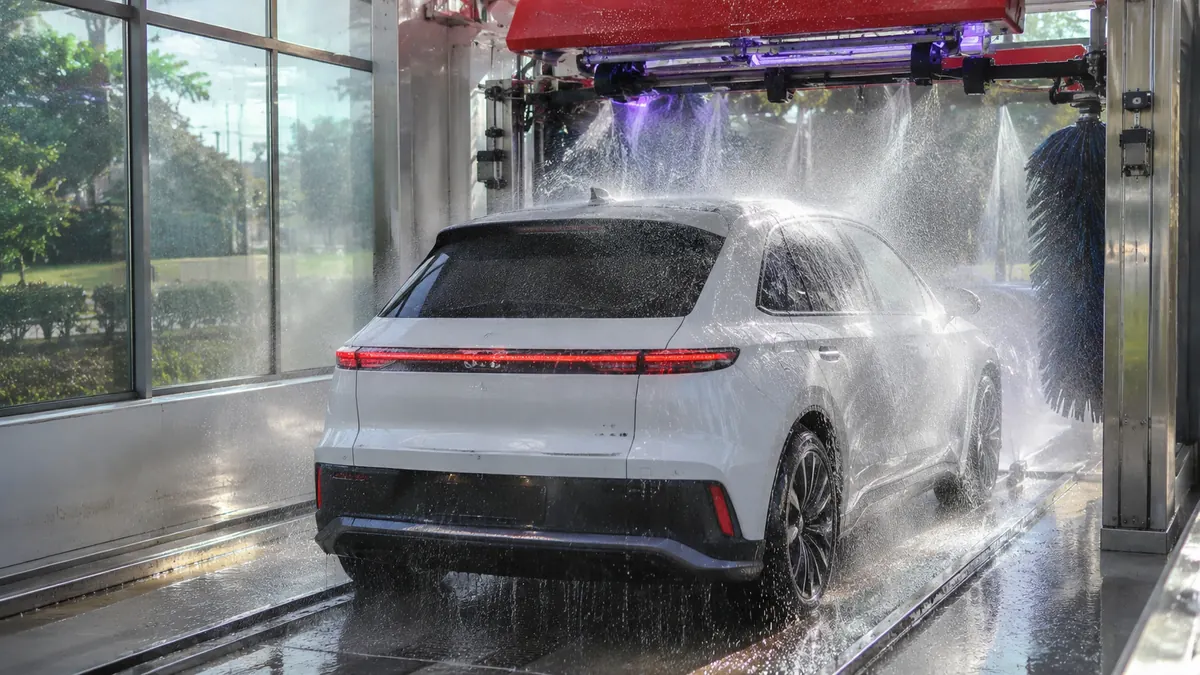
Quick answer: Yes, many electric cars can go through an automatic car wash, but the correct settings depend on both the car and the type of wash. A stationary wash where the equipment moves around a parked vehicle is different from a conveyor wash that rolls the car forward. Some EVs have a dedicated Car Wash Mode; others require a specific Neutral Hold or Free Roll procedure. Do not assume selecting N (Neutral) alone will prevent a modern EV from automatically applying the parking brake or shifting into Park.
Three manufacturer examples show why instructions must be model-specific: Tesla Model 3 includes Car Wash Mode and Free Roll and recommends touchless automatic washes; a 2026 Hyundai EV manual details how to hold Neutral and manually release its electronic parking brake; and Ford’s F-150 Lightning manual describes a temporary Neutral mode for certain car-wash situations. The steps below help owners avoid mixing up these very different systems.
Are automatic car washes safe for electric vehicles?
Washing a correctly maintained EV is not inherently unsafe merely because the vehicle has a high-voltage battery. EVs are designed to operate outdoors in everyday weather. However, a safe car wash still depends on the manufacturer’s body-care instructions, the condition of doors and charging-port seals, permitted pressure-washing methods and whether the vehicle is allowed to roll. Do not wash a vehicle with obvious electrical damage, flood exposure or open high-voltage components; seek specialist advice instead.
Use the exact model year and region’s owner manual for vehicle controls. A named feature on one brand may not exist, or may work differently, on another.
Two automatic car wash types—and why they require different settings
| Wash type | What moves? | What to check in the EV manual |
|---|---|---|
| Stationary/in-bay automatic wash | Vehicle stays in one place; equipment moves around it. | Required Park/brake settings, wipers, windows, charging port, mirrors and any Car Wash Mode. |
| Conveyor/tunnel automatic wash | Vehicle rolls through the wash on a conveyor. | Neutral Hold or Free Roll, auto-Park behavior, parking-brake release, Auto Hold and whether the driver must remain inside. |
| Self-service hand or pressure wash | The driver controls the water and cleaning tools. | Permitted washing products, nozzle distance, charging-port precautions, sensors and paint care. |
Do not select Neutral or disable the parking brake solely because a wash is automatic. The necessary setup follows the facility’s wash type and manufacturer instructions. For a stationary wash, the vehicle may need to remain stationary. For a conveyor wash, an unintended shift into Park can damage the car or wash equipment.
Before entering any EV car wash: eight practical checks
- Read the car’s washing instructions in the current owner’s manual, not an online guide for a different year or trim.
- Confirm the charge cable is disconnected and the charging-port door is closed and latched as specified by the manufacturer.
- Close windows, sunroof, doors, front trunk and tailgate. Check that no open trim or seals could be caught.
- Turn off automatic windshield wipers or enable the manufacturer’s Car Wash Mode if available.
- Follow mirror instructions where folding is recommended or required by the facility and vehicle maker.
- For conveyor washes, prepare the documented Neutral Hold or Free Roll setting, including parking-brake and Auto Hold behavior.
- Check roof racks, antennas and accessories against the wash operator’s clearance and attachment restrictions.
- Keep your attention on staff instructions and exit controls. If you cannot operate the necessary mode confidently, choose a different wash.
How Tesla Car Wash Mode works: Model 3 example
The Tesla Model 3 owner’s manual says Car Wash Mode closes windows, locks the charging port and disables functions including wipers, Sentry Mode, walk-away locking and parking-sensor chimes. In the cited documentation, the touchscreen menu is Controls → Service → Car Wash Mode; the car must be stationary and not actively charging to enable it.
For a conveyor wash, Tesla’s Enable Free Roll function allows Neutral/free rolling and prevents an automatic parking-brake application under the described conditions. Tesla’s manual also states the mode exits when the car’s speed exceeds 15 km/h or when the driver selects Exit. This speed setting applies to the cited Model 3 instructions, not a universal car-wash speed limit.
Important paint-care difference: Tesla’s cited Model 3 manual says to use touchless automatic washes only—ones without brushes contacting the bodywork. Its instructions also warn that car-wash damage may not be warranty-covered. Therefore, a generic automatic brush wash should not be treated as Tesla-approved just because the vehicle has a Car Wash Mode.
Hyundai example: Neutral alone may not release the parking brake
A Hyundai 2026 EV gear-shift manual describes a procedure to keep N engaged when switching the vehicle to the appropriate accessory state. It says the driver must manually release the electronic parking brake before entering an automatic car wash, because the brake does not necessarily release merely when N is selected. The manual also describes situations in which opening a door or powering off can cause the transmission to select Park automatically.
That is one particular Hyundai powertrain/shift design. Do not copy the exact button sequence to other Hyundai models, years or vehicle makes. A driver should learn the required mode while safely parked before the wash queue, not try to troubleshoot a rolling conveyor.
Ford F-150 Lightning example: Temporary Neutral Mode
Ford’s F-150 Lightning Temporary Neutral Mode documentation describes a temporary setting to keep the truck in Neutral if the driver exits the vehicle or turns it off, including certain automatic car washes. The cited instructions note that a vehicle can automatically return to Park after a limited time or because of low battery conditions, and emphasize that this mode must not be used for vehicle towing.
It is a good example of why two modes that both sound like Neutral can serve very different purposes. For safe vehicle recovery rules, refer to manufacturer towing instructions rather than a wash-related Neutral setting.
Can you pressure-wash an EV’s charging port, cameras or sensors?
Do not direct a high-pressure jet into the charging port, exposed wiring or electronic connections. Exterior camera lenses, parking sensors, door seals, paint and glass also have model-specific cleaning cautions. For example, Tesla’s Model 3 manual specifies keeping a pressure-washer nozzle at least 30 cm from the body surface, avoiding direct jets at parking sensors and keeping the nozzle moving. That distance is a Tesla-specific instruction, not a universal number for every vehicle.
The same Tesla manual warns against spraying liquid at high velocity toward its charge port while charging, and recommends cleaning cameras with appropriate gentle methods. Avoid harsh cleaning chemicals or abrasive brushes if the manufacturer’s care guide forbids them. When in doubt, select gentle hand washing or a manufacturer-permitted touchless system.
What if the car automatically shifts into Park during the wash?
Do not fight the gear selector or force the vehicle to move. If safe and permitted by the operator, stop the process and follow the facility’s emergency guidance. The correct response depends on whether the conveyor is moving, which interlock has engaged and the precise vehicle design. Attempting to force free rolling may damage the drivetrain or conveyor. Seek the car-wash operator’s assistance before restarting. Hyundai and Ford both document conditions in which Neutral retention can end or Park can re-engage.
Should the parking brake be on in an automatic car wash?
There is no one-size-fits-all answer. A stationary wash can have different holding requirements from a conveyor that needs the wheels to roll freely. The key is to use the setting specifically documented for the car and wash type, including electronic parking brake and Auto Hold. Misapplying “turn off the parking brake” to every automatic wash is unsafe and misleading.
What to check after leaving a car wash
- Exit the wash only after its signals or staff indicate it is safe to do so.
- Return the car to normal driving mode and verify the gear selector responds as expected.
- Check wiper, camera, parking sensor and mirror operation once safely parked.
- Confirm the charging-port cover and all doors remain closed and undamaged.
- If required by the owner’s manual, dry wet friction brakes by gentle, safe braking under appropriate conditions.
- Investigate unusual electrical messages, warning indicators or water intrusion before further use.
For regular vehicle-care tasks, see our electric-car maintenance checklist. Our guide to EV charging in the rain explains why normal exterior water exposure should not be confused with flood damage or unsafe electrical equipment.
Frequently Asked Questions
Can all electric cars go through a conveyor car wash?
No universal approval exists. The EV must be compatible with the facility’s conveyor requirements and able to hold its manufacturer-approved free-rolling or Neutral state throughout the wash.
Do I need to put an electric car into Neutral for every wash?
No. Conveyor washes and stationary in-bay washes differ. Use Neutral only when the facility and your vehicle’s manual call for it, and confirm parking-brake behavior.
Does every electric car have Car Wash Mode?
No. Some EVs have dedicated modes; others use manual wiper settings and a separate Neutral Hold or Free Roll function. Refer to the exact owner’s manual.
Are brush car washes recommended for Tesla Model 3?
The cited Tesla Model 3 manual recommends touchless automatic washes rather than equipment with brushes contacting the vehicle. Follow the guidance for your model and region.
Can I use Neutral Hold to tow an electric car?
Do not assume so. Ford specifically warns that its cited F-150 Lightning Temporary Neutral Mode must not be used for towing. Vehicle recovery requires a separate manufacturer-approved procedure.
Official references and editorial notes
The recommendations distinguish wash types and specific vehicle instructions rather than claiming every EV uses the same controls. Official sources: Tesla Model 3 cleaning and Car Wash Mode, Hyundai 2026 EV Neutral and parking-brake instructions and Ford F-150 Lightning Temporary Neutral Mode. This article is not an endorsement of every car-wash process. Browse the Guides archive for related EV operation and safety topics.