Quick answer: Electric vehicle batteries are usually not the main place rare-earth metals are used. Lithium, nickel, cobalt, manganese and graphite—materials commonly discussed in relation to EV batteries—are not rare-earth elements. Rare earths such as neodymium and praseodymium are primarily associated with permanent magnets in some EV traction motors. Other electric motor designs can operate without rare-earth permanent magnets.
Confusing battery minerals with rare-earth magnet materials makes it harder to understand EV supply chains, manufacturing emissions and recycling. The distinction matters to shoppers, investors and readers comparing battery technologies.
What are rare-earth elements?
Rare-earth elements are a specific group of chemical elements, generally comprising the lanthanide series plus scandium and yttrium. In an EV context, the materials most often discussed are neodymium (Nd), praseodymium (Pr), dysprosium (Dy) and terbium (Tb), which can be used in high-performance permanent magnets.
The term does not mean that every mineral used in an electric car is a rare earth. Lithium belongs to the alkali metals; cobalt, nickel and manganese are transition metals, while graphite is a form of carbon. These distinctions are set out in the material supply-chain categories used by the International Energy Agency (IEA).
Do lithium-ion EV batteries contain rare-earth metals?
Most mainstream lithium-ion EV battery chemistries do not depend on rare-earth elements as their principal active battery materials. Their main components differ by chemistry and cell design:
- LFP (lithium iron phosphate): Its cathode uses lithium, iron and phosphate, not nickel or cobalt. Common graphite-based anodes are also separate from rare-earth magnet materials.
- NMC (nickel manganese cobalt): Its cathode uses lithium plus nickel, manganese and cobalt in varying proportions. None of those names refers to a rare-earth element.
- Other battery architectures: Variants can employ different cathodes, anodes and additives. A precise material declaration should be checked for each cell design; this overview describes mainstream chemistries rather than a claim about every trace component.
The IEA’s Global EV Outlook 2026 battery analysis discusses LFP and nickel-containing batteries as distinct chemistries. For a deeper look at the recent LFP market shift, see our LFP battery market-share explainer.
Where are rare-earth elements used inside an electric car?
The clearest application is the traction motor, the component that converts electric power into mechanical movement. Some motors use strong permanent magnets made with neodymium-iron-boron (NdFeB). Praseodymium can be part of the magnet mixture, while dysprosium or terbium may be used to improve high-temperature performance in specific designs.
A magnet is not a battery. A car can have an LFP battery that contains no nickel or cobalt and, separately, a rare-earth permanent-magnet motor. Conversely, a car with an NMC battery could use a magnet-free induction motor. Battery chemistry alone does not tell you whether the drive motor uses rare earths.
The US Department of Energy’s 2023 Critical Materials Assessment identifies rare-earth permanent magnets as an important materials issue for electric motors. This is different from the raw-material requirements of lithium-ion cells.
Do all electric cars need rare-earth magnets?
No. Permanent-magnet synchronous motors are common because of their performance and efficiency advantages, but there are viable alternatives:
- Induction motors: They generate rotor magnetic fields electromagnetically and need no rare-earth permanent magnets in the rotor.
- Separately excited or wound-rotor synchronous motors: These use electrically energised windings instead of permanent-magnet rotor materials.
- Hybrid motor arrangements: A vehicle with two motors can use different motor types for the front and rear axles.
Trade-offs include efficiency across operating points, electrical losses, complexity, cooling, cost and control electronics. Our permanent magnet vs induction motor guide explains these technical differences in more detail.
Why does the rare-earth supply chain matter for sustainability?
Mining, chemical separation, refining and magnet production all require energy and produce environmental impacts that vary by facility and region. The IEA’s Global Critical Minerals Outlook 2026 highlights concentration in refining and downstream magnet manufacturing, as well as risks arising from trade restrictions and supply disruptions.
Supply-chain concentration is not the same as a universal claim that one specific EV is unsustainable. A credible environmental assessment considers the full vehicle life cycle, electricity generation, manufacturing and end-of-life treatment. See our electric vs gasoline life-cycle emissions guide for that broader context.
Can rare-earth magnets be recycled?
Yes, several approaches can recover magnet material or its constituent rare-earth elements, but collection, disassembly, sorting and processing economics can be challenging. The IEA expects end-of-life volumes from early generations of electric vehicles and wind turbines to support future recycling growth. Battery cell recycling and permanent-magnet recycling are different material streams, so a facility that recovers lithium from cells does not necessarily recycle drive-motor magnets.
Our battery recycling guide deals with battery packs, whereas rare-earth magnet recovery often involves the motor or other magnetic components.
How can you find out whether a particular EV uses rare earths?
- Identify the exact model, model year and drive configuration.
- Consult the manufacturer’s official technical specification for the traction-motor type.
- Look for terms such as permanent-magnet synchronous motor, induction motor or electrically excited synchronous motor.
- Do not infer the motor type from the words “LFP battery” or “NMC battery.”
- If the manufacturer does not disclose magnet composition, avoid assuming a particular rare-earth content.
Which EV battery is free of rare-earth elements?
This question is often based on the wrong comparison. Most mainstream LFP and NMC traction cells are not designed around rare-earth active materials in the first place. The more useful questions are whether the motor contains rare-earth permanent magnets, which materials the chosen battery chemistry actually uses, and how the manufacturer manages responsible sourcing and end-of-life recovery.
Sources and image note
Primary references: IEA critical minerals; IEA Global EV Outlook 2026 battery report; IEA Global Critical Minerals Outlook 2026; US Department of Energy Critical Materials Assessment.
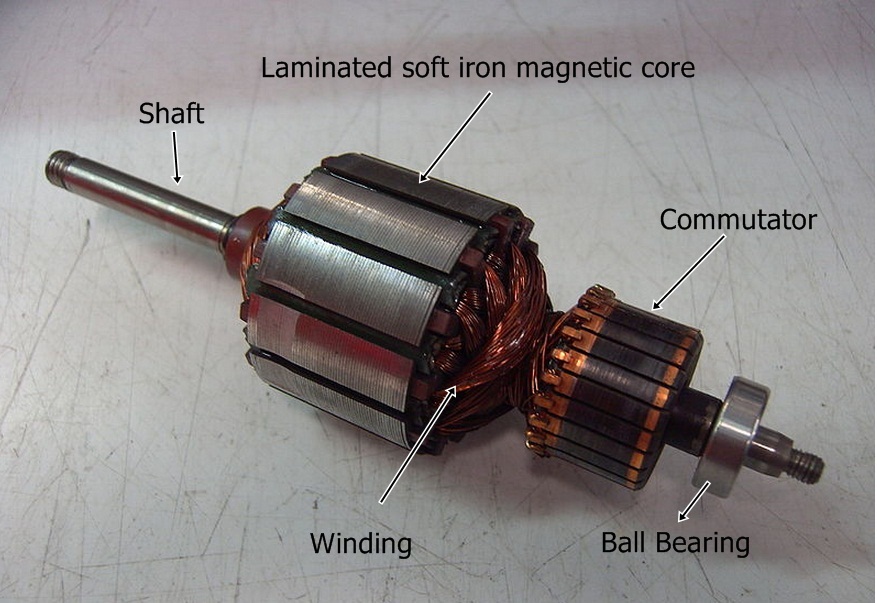
Featured photo: an illustrative generic electric-motor rotor, not a verified model-specific EV rare-earth magnet assembly. Photo by Roonie.02 / Wikimedia Commons, CC0 1.0 public-domain dedication.
Sık Sorulan Sorular
Is lithium a rare-earth metal?
No. Lithium is an alkali metal, not a rare-earth element.
Do LFP EV batteries contain rare earths?
The mainstream LFP cathode chemistry uses lithium, iron and phosphate, not rare-earth elements. Battery chemistry does not reveal whether the car's motor uses rare-earth magnets.
Why do EV manufacturers use neodymium magnets?
Neodymium-iron-boron magnets support compact, high-performance permanent-magnet motors, although they create specific supply-chain considerations.
Can an EV run without rare-earth magnets?
Yes. Induction and separately excited wound-rotor motors do not require rare-earth permanent magnets.