

Key facts
- Tesla separates Tesla-only, Magic Dock/all-EV, and manufacturer-eligible NACS Supercharger access.
- Tesla prohibits unapproved third-party NACS DC adapters at its Superchargers; the manufacturer or Tesla must approve the adapter.
- A native NACS port or adapter alone does not guarantee a particular station accepts a vehicle or can deliver its maximum stated power.
Quick answer: In North America, a NACS (SAE J3400) charging port or a CCS1-to-NACS DC adapter does not guarantee that an electric vehicle can use every Tesla Supercharger. Drivers must check the vehicle’s approved charging hardware, whether the specific station is open to that model, the correct AC-versus-DC adapter type and any authentication or app requirement. The connector is only one part of a working charging session. Tesla’s official guidance explicitly distinguishes Tesla-only stations, all-EV stations with an integrated Magic Dock and NACS stations available to eligible manufacturers.
Changing U.S. connector standards has created a confusing situation: a 2026 vehicle may have native NACS hardware while a nearby fast charger still uses CCS1, and an older CCS1 car may need a manufacturer-approved NACS DC adapter at an eligible Supercharger. This 2026 compatibility guide explains how to identify the right setup without treating all adapters, chargers or networks as interchangeable.
North American EV connectors: three distinct charging families
| Connector | Common role | What to check |
|---|---|---|
| J1772 | AC charging, commonly Level 1 or Level 2 | Vehicle inlet or a compatible AC adapter; vehicle’s AC charging limit |
| CCS1 (J1772 Combo) | North American DC fast charging | Vehicle’s DC inlet or manufacturer-approved adapter; site access |
| NACS / SAE J3400 | Can support AC and DC charging, depending on equipment | Station’s AC or DC function, model eligibility, connector and adapter approval |
| CHAdeMO | Separate DC fast-charging system found on some vehicles and chargers | Vehicle-specific support; do not assume a simple cable changes protocols |
The U.S. Department of Energy’s Alternative Fuels Data Center lists CCS, CHAdeMO and J3400/NACS as North American DC fast-charge connector types. J1772 is widely used for AC charging. The correct answer to “Which connector does my EV use?” therefore depends on both the vehicle and the type of charging session.
The important distinction: physical fit versus actual authorization
Seeing the NACS connector on a vehicle is not enough to conclude that every Supercharger can deliver energy to it. Tesla describes three access models:
- Tesla-only Superchargers: Intended for Tesla vehicles, not for every other EV that happens to carry a compatible-shaped plug.
- All-EV Superchargers with Magic Dock: Selected stations supply an integrated adapter, enabling compatible CCS-equipped vehicles under the network’s stated conditions.
- NACS Superchargers opened to other makes: Access is rolled out by manufacturer and vehicle eligibility. A supported native-NACS vehicle or an approved DC adapter may be necessary.
These categories come directly from Tesla’s own Supercharging Other EVs support page. Available makes and individual sites can change; before a trip, enter your exact vehicle in the Tesla app or in the manufacturer’s recommended route-planning system. Do not treat a static list of makes on a third-party blog as proof that the exact connector in front of you will work.
Which EV adapter is right? Answer four questions first
1. Are you charging with AC or DC?
Many plugs and adapters are designed for slower AC charging. DC fast charging uses different power delivery and safety communication requirements. A J1772 AC adapter or a household charging accessory must never be assumed suitable for a DC Supercharger. Check the actual adapter designation and the vehicle maker’s documentation; stop if you cannot verify the hardware type.
2. What port does the actual vehicle have?
Model name alone can be insufficient: connector arrangements can vary by model year, market and version. For example, Hyundai’s U.S.-market 2026 IONIQ 5 specification table separately lists NACS and a CCS-adapter charging scenario. Kia’s 2026 EV6 specifications identify a standard NACS port while explaining that an adapter may be required for some compatible charging equipment.
Do not assume these details apply unchanged to an EV6 or IONIQ 5 originally manufactured for Europe, Turkey or another market. Always consult the actual vehicle’s manual and charging-port labelling.
3. Has the adapter been explicitly approved for that model and use?
Tesla’s North American support instructions allow approved adapters supplied by Tesla or an eligible vehicle manufacturer and prohibit third-party adapters for Supercharging. A physically similar connector purchased from an online marketplace may therefore be unsuitable even if it appears to latch. The relevant questions are approval, rating, communication, locking and compatibility — not just price or physical shape. Source: Tesla charging policy.
4. Does the specific station admit the car?
Check the live station information using the Tesla app, the manufacturer’s charging app or another source explicitly supported by the network. Eligibility can differ by location; also verify whether a stall is in service, whether the connector can reach the car’s port safely and how payment is initiated. Tesla notes that cable reach depends on port placement and station layout, and asks users not to obstruct adjacent charging stalls.
2026 Hyundai IONIQ 5 and Kia EV6: practical examples
A buyer looking at an American 2026 IONIQ 5 may see a native NACS port and conclude that there is no reason to consider CCS equipment. That conclusion is incomplete: Hyundai provides separate, specified charge times for NACS 150-kW/400-volt equipment and higher-power 800-volt CCS scenarios using a suitable adapter. The long-range 2026 IONIQ 5 is listed at about 30 minutes from 10% to 80% in the specified 150-kW NACS case and about 20 minutes under its compatible higher-power CCS case. These are conditional manufacturer figures, not universal speed ratings for the connector shapes themselves.
Similarly, the U.S. 2026 EV6 has a NACS port, but Kia’s own published long-range charging times distinguish compatible 50-, 150- and 350-kW equipment. A given NACS or CCS station may not provide the same effective voltage and power under the same conditions. See our separate DC fast-charging article for an explanation of state of charge, temperature and charging curves.
Important: NACS, CCS or CHAdeMO describes the charging interface. These labels alone do not indicate whether a car can provide vehicle-to-load power or perform approved vehicle-to-home/grid backup functions. Those are different capabilities and may require additional vehicle and home electrical hardware.
What about CHAdeMO-equipped older EVs?
CHAdeMO remains relevant to certain existing EVs and charging networks. Drivers should search for compatible CHAdeMO-equipped fast-charging equipment where supported and check the maker’s exact guidance. An advertised NACS-to-CCS adapter does not establish CHAdeMO protocol compatibility. Newer models can have different port designs from older versions even where the model name is familiar: for example, the U.S.-market 2026 Nissan LEAF has its own manufacturer-published AC and DC charging-port configuration, which should be checked separately from information about older LEAF models.
When buying a used EV, physically inspect and identify the port, verify the model year and charge inlet using the manual, and then check the networks serving the routes you actually drive. An older vehicle with limited fast-charge network access may still meet local commuting needs but be less convenient for long routes.
Why North American advice may be wrong for Europe or Turkey
In much of Europe, AC Type 2 and DC CCS2 are common infrastructure standards, and plug geometry differs from North American CCS1/J1772. This article’s NACS/CCS1 guidance is U.S. and North America focused. A driver should not buy a North American adapter solely because a search result says their car is “CCS compatible”. Regional vehicle hardware, homologation, manufacturer advice and charging-network policies must be checked. For local charging-network topics see our Turkey EV coverage and World EV coverage.
A pre-trip checklist that prevents common charging mistakes
- Identify your exact model year, vehicle market, AC inlet and DC inlet from official owner documents.
- Check which charging networks list that particular vehicle as eligible at the intended location.
- Separate AC adapter requirements from DC fast-charging adapter requirements.
- Use only a manufacturer-approved DC adapter under conditions explicitly permitted by the vehicle and charging network.
- Verify the expected charger output, voltage compatibility and connector reach rather than relying only on an advertised maximum kW label.
- Confirm the required app, account, payment method and live station availability before departure.
- Keep a second compatible stop in the route plan, especially where network coverage is thin.
- Never stack or improvise adapters, bypass safety interlocks or use visibly damaged/high-temperature connectors; consult a qualified service provider.
Frequently asked questions
Does a NACS car automatically work at all Tesla Superchargers?
No. Tesla differentiates Tesla-only, Magic Dock/all-EV and eligible NACS stations. Verify the precise station and vehicle in the Tesla app or the maker’s supported system.
Can a CCS1 car use a Tesla Supercharger with an adapter?
Selected eligible cars can, using the applicable Tesla or manufacturer-approved NACS DC adapter and a station open to that vehicle. The adapter alone does not guarantee access.
Are AC NACS adapters interchangeable with DC fast-charge adapters?
No. Equipment designed for AC Level 1/2 charging should never be presumed suitable for high-power DC charging. Follow manufacturer specifications.
Is CHAdeMO the same as CCS?
No. They are different DC charging systems with different connector and communication requirements. A CCS adapter should not be assumed to work with CHAdeMO.
Does a charger port dictate the maximum charging speed?
No. Maximum and sustained power depend on the car, battery SOC, temperature, voltage/current limits and actual equipment performance as well as the connector.
Can a U.S. NACS-to-CCS adapter be used in Turkey?
No such assumption should be made. European and Turkish systems differ from North American CCS1 standards. Check the approved regional hardware and local manufacturer instructions.
Official references, scope and visual disclosure
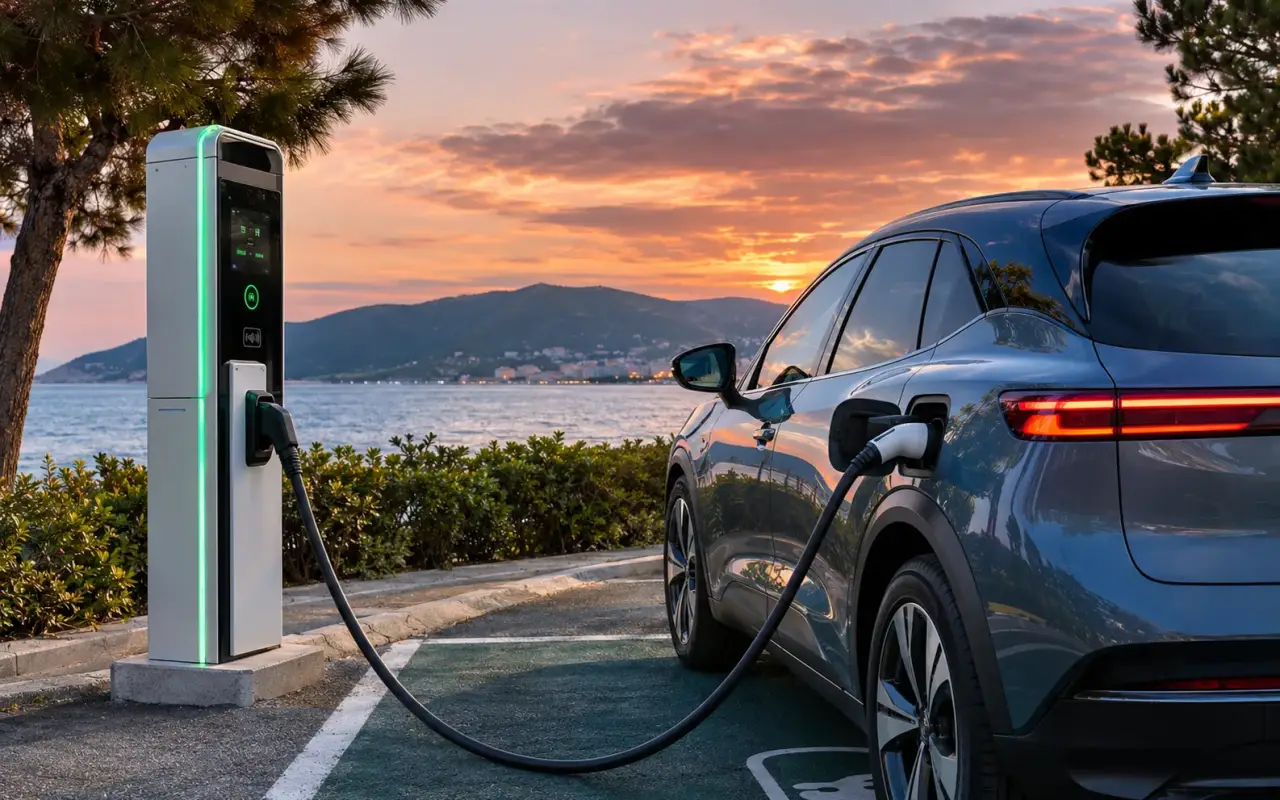
Primary evidence: U.S. DOE AFDC connector and charging-station definitions; Tesla’s current eligibility and adapter guidance; Hyundai USA’s 2026 IONIQ 5 specifications; Kia America’s 2026 EV6 specifications; and Nissan USA’s 2026 LEAF configurations. Network lists and supported models can change after publication. The cover is an original AI-generated photorealistic EV charging scene, not documentation of a particular station’s compatibility or performance. For related material, explore EV Technology, Charging & Batteries and EV Guides. Reviewed November 11, 2026.


1 comment