To check the tread on an electric vehicle’s tires, measure the depth of the main grooves with a tread-depth gauge or use the U.S. penny test, and inspect multiple points on every tire. The National Highway Traffic Safety Administration (NHTSA) states that tires should be replaced when their tread is worn to 2/32 inch (about 1.6 mm). A tire can also be unsafe before reaching that depth if it has damage, uneven wear or inadequate performance for the conditions.
What tire tread depth is too low on an EV?
| Remaining tread | Approximate depth in millimeters | What it tells you |
|---|---|---|
| 6/32 inch | 4.8 mm | More remaining tread than the minimum; still inspect condition and suitability |
| 4/32 inch | 3.2 mm | Above the NHTSA replacement threshold, but declining wet-weather capability may justify earlier replacement |
| 3/32 inch | 2.4 mm | Approaching the minimum; arrange a professional assessment and plan replacement |
| 2/32 inch | 1.6 mm | NHTSA’s tire-replacement threshold |
| Less than 2/32 inch | Less than 1.6 mm | Unsafe tread wear; replace rather than continuing to drive |
The figures are unit conversions, not a claim that every road, tire or weather condition has the same stopping distance. NHTSA’s TireWise safety guide says tread helps grip the road, especially in wet and icy conditions, and recommends replacing tires at the 2/32-inch wear limit. Legal minimums can vary by state and vehicle use; treat the federal agency’s threshold as a safety check, not a complete review of local regulations.
Method 1: use a tire tread depth gauge
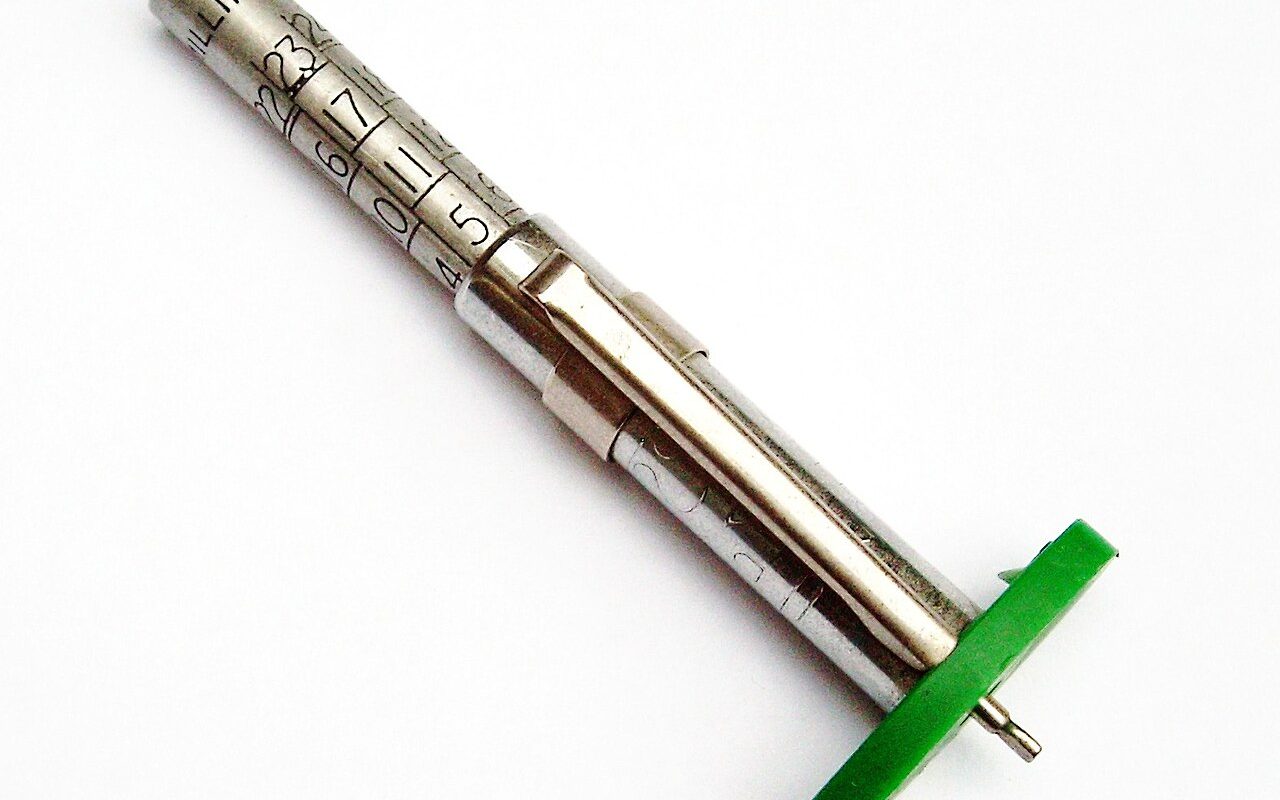
A dedicated gauge is a useful way to record tread depth instead of just making a visual guess. The featured photograph shows a real mechanical tire tread-depth gauge photographed separately on a white background. It is an illustration of the measuring tool, not a reading taken from any specific vehicle.
- Park on level ground, secure the vehicle and switch it off. Never put your hands near a rotating wheel or try to take readings while the car moves.
- Locate the main tread grooves between the raised tread blocks, not a sidewall or tiny decorative groove.
- Place the gauge’s probe at the bottom of a main groove and rest its reference surface on adjacent tread blocks, following the gauge’s instructions.
- Avoid a raised treadwear indicator. The wear bar would make the groove appear artificially shallow if you measure directly on it.
- Record the result in 32nds of an inch or millimeters, checking the gauge’s unit scale.
- Repeat at several positions across the tire, including the center region and both accessible shoulder regions, then at multiple positions around the circumference where safely accessible.
- Check the other tires. A single deeper reading does not mean every tire or tread location is safe.
If you see markedly different readings across one tire, ask a qualified tire technician to investigate. Inflation, alignment, suspension conditions, driving behavior and tire rotation history can affect wear. A depth measurement cannot diagnose all possible causes on its own.
Method 2: do the penny test
NHTSA describes a quick check using a U.S. one-cent coin:
- Place a penny into one of the tire’s main grooves with Abraham Lincoln’s head upside down and facing you.
- If you can see the top of Lincoln’s head above the tread, NHTSA advises replacing the tire.
- Repeat the check in several grooves and at more than one point around each tire.
The penny test is a fast screening method and does not provide a precise numerical measurement. For a more detailed inspection, use a gauge or a tire professional. If the coin appears to show adequate depth but you observe exposed cords, cracks, bulges, puncture damage or uneven wear, do not treat the penny result as permission to ignore those hazards. NHTSA explains the penny test in its tire maintenance and tread section.
Method 3: find the built-in treadwear bars
Modern road tires have raised treadwear indicators molded across their main grooves. When the surrounding tread is worn down until it is level with the raised indicator, the tire has reached about 2/32 inch remaining tread. You may see a small symbol or marking on the tire sidewall indicating where these bars lie.
Do not confuse the wear bar with a groove’s full original depth. A bar across the bottom of a channel is intended as a warning, not as a decorative tire feature. If it is nearly flush or level with the running surface, arrange replacement. The NHTSA Tire Safety brochure describes built-in indicators and their relationship to the tread surface.
Why EV owners should pay attention to uneven tread wear
Electric vehicles often have different weight distributions and driving characteristics than some gasoline vehicles, but there is no universal rule that every EV wears every tire faster. Tire compound, load, alignment, road conditions, acceleration, inflation and maintenance affect the outcome. NHTSA’s seasonal driving guidance specifically discusses EV tire selection and the need for regular maintenance regardless of powertrain.
Check the center of the tire and both shoulders. A low reading on just one shoulder can be as important as a low center reading; it may indicate an underlying problem requiring inspection. If two tires have very different depths or wear patterns, check your vehicle’s manual before changing tire positions, particularly with directional, staggered-size or other special tire setups.
Why 2/32 inch is not a promise of good wet-road grip
Tread channels help move water away from the tire’s contact area. The amount of water, road speed and pavement condition influence hydroplaning and traction risk, so a tire above 2/32 inch is not guaranteed to perform well in heavy rain or winter driving. A driver in frequent wet or snowy conditions may benefit from replacing tires before they reach the absolute wear limit, based on a tire professional’s recommendation and the manufacturer’s guidance.
NHTSA’s winter driving advice recommends checking tread depth and condition before severe conditions and considering suitable winter tires where needed. Do not assume a worn all-season tire will provide the same grip as a properly maintained, appropriate winter tire.
Does the TPMS warning light measure tread depth?
No. A tire pressure monitoring system (TPMS) monitors inflation pressure and may warn of significant underinflation. It does not measure the remaining depth of a tread groove, detect every kind of tire damage or replace a visual inspection. Your tire could be correctly inflated but worn to the replacement threshold, or have thick tread but dangerously low inflation pressure.
For checking the correct cold inflation pressure, see our tire pressure and TPMS guide. The correct pressure is generally specified on the vehicle’s tire placard or in its owner’s manual; do not use the sidewall’s maximum pressure marking as a default recommendation.
Do EV tires need different load ratings or rotation intervals?
Tread-depth checking is fundamentally similar on electric and combustion vehicles, but replacement tire specifications are vehicle-specific. Confirm the correct tire size, load index, speed rating and any original-equipment or manufacturer requirements for your exact EV and wheels. Never assume that a tire fitting the rim automatically satisfies the vehicle’s load requirements.
See our guide to EV tire types and load ratings and EV tire rotation intervals. Rotation schedules and patterns differ by manufacturer and tire configuration; this tread guide does not prescribe one universal interval.
When to stop driving and request professional help
Do not continue driving on a tire that has exposed cord, a sidewall bulge, structural damage, severe tread separation or a dangerously worn tread. If a tire is losing pressure rapidly or your vehicle behaves abnormally, stop in a safe location and request assistance. NHTSA cautions that unsafe tires may need replacement even when they have not reached the expected mileage or age.
Read the tire’s date code and any visible damage separately. Our DOT tire date code guide explains manufacturing-week labels; a recent tire can still be unsafe if damaged or worn.
Monthly EV tire inspection checklist
- Measure several main grooves on each tire; record the lowest reliable reading.
- Check for unusually different center and shoulder measurements.
- Look for wear bars becoming level with the tread blocks.
- Inspect for sidewall bulges, cuts, cracks, punctures, debris and visible cord.
- Check cold inflation pressure against the correct vehicle placard or manual.
- Follow manufacturer tire rotation and load-rating specifications.
- Arrange replacement at the 2/32-inch threshold and earlier if conditions or damage require it.
Quick practice: interpreting tread measurements
Example 1: One groove measures 4/32 inch (3.2 mm) and another shoulder groove measures 2/32 inch (1.6 mm). The tire has a dangerously worn area and should be professionally assessed for replacement; using only the deeper reading is misleading.
Example 2: A tire has 6/32 inch remaining tread but a visible sidewall bulge. The tire is still potentially unsafe. Adequate tread depth does not excuse structural damage.
Example 3: A tire has 3/32 inch tread and the owner is preparing for frequent snow. The tire is already near the NHTSA replacement point; the driver should seek a professional evaluation of suitability and plan replacement rather than waiting for the wear bars to become completely flush.
Official references and image credit
Primary references: NHTSA TireWise, Summer Driving Tire Checks, Winter Driving Tire Safety and the NHTSA Tire Safety brochure. Always follow the tire and vehicle manufacturer instructions and any applicable state requirements.
Guide reviewed November 9, 2026. Featured image: real tire tread-depth gauge photographed by Simon Speed, 2012, Wikimedia Commons CC0 1.0. The gauge is not shown measuring a particular car or providing a verified numerical result.
Sık Sorulan Sorular
What is the minimum tire tread depth recommended by NHTSA?
NHTSA says tires should be replaced at 2/32 inch of remaining tread (approximately 1.6 mm). Local minimum legal limits may vary by jurisdiction and use.
How do I do the penny test on an EV tire?
Insert a U.S. penny into a main tread groove with Lincoln's head upside down. If you can see the very top of his head, the tread is at or near the 2/32-inch replacement threshold. Check multiple locations.
Can I check tire tread depth with a gauge?
Yes. On a safely parked vehicle, place a suitable tread depth gauge in a main groove, away from wear bars, and read the remaining depth. Repeat across each tire and look for uneven results.
Does the tire pressure warning light tell me tread depth?
No. TPMS monitors tire inflation pressure, not how much tread remains. A tire may have correct pressure but dangerous tread wear, or adequate tread with unsafe inflation.
Do electric vehicles need a special tread-depth rule?
NHTSA's basic tread and damage checks apply to EVs as well as gasoline cars. Follow the particular EV manufacturer's tire size, load rating, rotation and replacement instructions.