Quick answer: Public electric-car charging prices vary substantially across Europe. A May 2026 study commissioned by the European Parliament’s transport committee reported AC charging market-average rates ranging from approximately €0.27 to €0.65 per kWh, and DC charging market-average rates ranging from approximately €0.32 to €0.85 per kWh. These are study findings across markets, not live tariffs or a Europe-wide price guarantee.
For EV drivers planning a European trip or comparing home, workplace and public charging costs, the amount shown on a charger can be only one part of the final bill. This guide explains what the 2026 research actually measured, how to calculate an example session, and which fees to check before connecting a car.
2026 Europe EV charging prices: AC vs. DC
The study Pricing of E-Charging for Electric Cars and Onshore Power Supply in Ports, prepared by FIER Sustainable Mobility & Sustainable Ships and published in May 2026 at the request of the European Parliament’s Committee on Transport and Tourism, reported substantial price variation. Its concise research summary distinguishes ranges of average prices observed across markets from the wider spread of individual tariffs.
| Public charging type | Range of market-average prices in study | Broader observed spread |
|---|---|---|
| AC charging | About €0.27–€0.65/kWh | About €0.10–€0.90/kWh |
| DC charging | About €0.32–€0.85/kWh | About €0.15–€1.35/kWh |
How to interpret this table: The price ranges represent findings in a May 2026 study, not official national price ceilings, fixed retail offers or a prediction for November 2026. A particular charger may be cheaper or more expensive, and rates can change at any time. The study authors’ analysis should not be treated as an official policy position of the European Parliament.
Source: European Parliament Think Tank — study page, May 27, 2026; At a Glance summary with published price ranges.
How to calculate the cost of a public charging session
For a straightforward charger billed only by energy, the approximate session cost is:
Energy delivered in kWh × posted €/kWh tariff = energy charge.
For example, suppose your charging receipt shows that the charger delivered 30 kWh and the operator bills €0.60/kWh. The energy charge is 30 × €0.60 = €18.00. If a separate €2.00 session fee applies, the total rises to €20.00 before any additional parking, idle or other charges.
| Illustrative 30 kWh session | Energy-only cost |
|---|---|
| €0.27/kWh | €8.10 |
| €0.65/kWh | €19.50 |
| €0.32/kWh | €9.60 |
| €0.85/kWh | €25.50 |
These calculations are mathematical examples using tariffs inside the study’s reported ranges; they do not identify a provider or advertise an actual charging price. The meter measures electricity supplied by the charger, which may differ from the net energy stored in the battery because of charging losses and vehicle power consumption.
Why can the same charger cost different amounts?
The 2026 parliamentary study identifies a layered market. The charge-point operator (CPO) controls the station and its underlying charging conditions. A separate mobility service provider (MSP) may sell access through a roaming card or app and apply a different tariff. Subscription discounts and access arrangements can further alter the amount paid by two drivers using the same hardware.
Before using a public EV charger, check whether the posted offer includes the following:
- Energy price: euros per kilowatt-hour delivered.
- Start or connection fee: a flat amount when the charging session begins.
- Time-based fee: a cost per minute, potentially alongside an energy charge.
- Idle or occupancy fee: a charge after the car finishes or spends too long at a plug.
- Roaming or app markup: a different rate if you use an intermediary charging service.
- Parking and applicable taxes: whether the charging offer includes all mandatory costs and whether an unrelated parking charge is payable.
For more on why time-based fees matter, see our EV charging idle and congestion fees guide, which explains a related pricing problem in U.S. networks.
Is DC fast charging always more expensive?
Not always, but it can carry a higher energy tariff than slower AC service. High-power DC equipment generally requires greater infrastructure investment, grid capacity and maintenance. The parliamentary research cautions, however, that the size of the DC price premium is not always transparently explained by those costs. Comparing charging options therefore means examining the all-in price and practical travel time, not assuming that every DC price is justified or that every AC site is cheap.
What are the EU rules for charging-price transparency?
The EU’s Alternative Fuels Infrastructure Regulation (AFIR), Regulation (EU) 2023/1804, established requirements for publicly accessible charging, including ad hoc access and price transparency. Operators must enable charging without forcing drivers to enter a long-term subscription; the acceptable payment equipment depends partly on the charging point’s power and when it was deployed. Not all pre-existing installations have identical technology obligations at the same time.
The applicable legal text is available on EUR-Lex, Regulation (EU) 2023/1804. The European Commission also publishes official AFIR implementation questions and answers. The existence of legal requirements does not mean a particular local charger is compliant or that every invoice is free of disputed charges.
To understand payment-card access and highway-network targets in more detail, read our EU AFIR public-charging rules explainer.
How to compare charging costs before a European road trip
- Map your likely charging stops using an up-to-date charging network and verify the actual connector, power and live availability before departure.
- Check the operator’s direct tariff for the relevant location and compare it with any roaming-app offer.
- Calculate the expected energy bill using the approximate amount you intend to purchase, not the total battery capacity unless you expect to charge that much.
- Read the full fee schedule for session starts, minutes, idle occupancy and parking. Check whether taxes are included.
- Confirm how payment works and whether the charger accepts an ad hoc method you can use.
- Keep a receipt and compare it with the displayed tariff. If a discrepancy appears, contact the operator with the timestamp, location and session ID.
Does public charging still save money compared with gasoline?
It depends on electricity tariffs, the vehicle’s efficiency, gasoline prices, taxes and driving conditions. For a simple example, an EV consuming 18 kWh/100 km with an energy tariff of €0.60/kWh has an energy-only driving cost of 18 × €0.60 = €10.80 per 100 km, before extra charger fees or losses. With a hypothetical €0.30/kWh home tariff, the same on-road energy figure yields €5.40 per 100 km. Neither example is a published nationwide household or public charging price, and a fair gasoline comparison would need a separate fuel price and efficiency assumption.
Key takeaways and evidence
Europe does not have one standard EV charging price. The May 2026 European Parliament-commissioned research documents large differences between providers, countries and payment methods. Compare the total price of the session, not simply the headline €/kWh rate. For more global EV coverage, visit our Dünya / World EV news category.
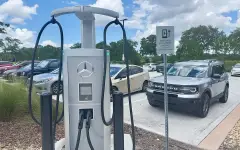
Sources: European Parliament — commissioned study, May 2026; research summary and tariff ranges; AFIR legal text. Photo: Aschroet / Wikimedia Commons, CC0 1.0. It depicts an actual AC charging point in Plaue, Germany (November 2021), not a currently priced charging service.
Sık Sorulan Sorular
How much does public EV charging cost per kWh in Europe?
A May 2026 EU parliamentary study reports average market AC rates of roughly €0.27–€0.65/kWh and average DC rates of €0.32–€0.85/kWh, with much wider individual tariffs. These are not real-time prices.
Is DC fast charging more expensive than AC charging?
It often is, because fast-charging infrastructure and service characteristics can cost more, but rates differ across sites, operators, plans and countries.
Can I pay for a public EV charge in Europe without a subscription?
The EU AFIR framework requires ad hoc payment access at publicly accessible chargers, with specific payment technology rules that vary with charger age and power; check the station before visiting.
What extra EV charging fees should I look for?
Look for connection or session charges, per-minute fees, occupancy and idle charges, roaming-provider markups, applicable taxes and parking fees.