Quick answer: To find an accessible public EV charger in the United States, do not rely on a charging-map pin or an accessibility symbol alone. Confirm the space beside the vehicle, a step-free route to the dispenser, reachability of the connector and payment controls, cable length, and whether the particular charger is working. These checks are especially important for wheelchair users and drivers with limited hand dexterity.
Public charging can look accessible in a map but fail at the last few feet: a curb separates the car from the dispenser, a protective bollard blocks wheelchair approach, or a heavy cable cannot reach the car’s charging port. The U.S. Access Board’s EV charging design recommendations explain these problems in detail. The Board calls its document technical assistance, not a universal, legally binding nationwide EV-station specification. Applicable ADA, ABA, federal procurement, and state/local requirements depend on the site.
Accessible EV charging: the five things to check
| What to check | Why it matters | What to ask the operator |
|---|---|---|
| Space beside the car | Room to open the door, transfer, deploy a ramp, or maneuver with a mobility device | Which charging bay has an unobstructed access aisle, and on which side? |
| Step-free path | A raised curb, steep slope, snow or landscaping can block the route | Can I move from the driver-side door to the charger without crossing a curb? |
| Connector and cable | The cable must reach the vehicle inlet without blocking a safe path | How far does the connector reach, and can someone with limited grip operate it? |
| Screen and payment | Controls may be too high, hard to reach, visually inaccessible or require a phone | Are card payment, screen controls and assistance available in accessible formats? |
| Current operating status | Even a well-designed stall cannot help when blocked or out of service | Is the specific accessible charging port in service and unobstructed now? |
Step 1: Find possible locations, then verify the actual stall
Start with the U.S. Department of Energy’s Alternative Fueling Station Locator or a charging network’s own station listings. Filter by connector type, charging speed, and other available station details. An EV charging location appearing in a directory does not establish that its particular stall is usable by a wheelchair user. Accessibility details and site photos may be incomplete or absent.
Check the precise vehicle-inlet location on your EV as well. A driver-side rear port can require a completely different parking orientation from a front or passenger-side port. The U.S. Access Board identifies vehicle-inlet position and short DC fast-charging cables as a major accessibility challenge. For more on connector compatibility, read our EV charging plug types guide.
Ask these six questions before driving there
- Which exact charging port has accessible mobility features?
- Is the access aisle on the driver side or passenger side, and is it unobstructed?
- Can I reach the charger without a raised curb or stairs?
- Will the cable reach my vehicle’s inlet in a parking position I can use safely?
- Can I operate the connector, screen and payment system independently?
- Is the port currently operational, and what is the help number if it fails?
When a network cannot confirm these details, identify a backup station rather than treating the location as verified. Our U.S. EV road-trip charging checklist explains how to plan alternatives and preserve range.
Step 2: Understand the physical design numbers
The Access Board’s technical assistance describes a recommended accessible vehicle-charging-space layout of at least 11 feet wide by 20 feet long, with an adjacent 5-foot-wide access aisle. It also discusses a clear floor or ground space at the charger of at least 30 by 48 inches, with accessible reach to operable parts. An unobstructed side reach is generally no higher than 48 inches and should not be more than 10 inches from the accessible space. These are helpful benchmarks when examining a layout, not proof that every existing public charger nationwide is legally required to have exactly that geometry.
A useful inspection question is not merely “Is the bay wide?” but “Can I get from the vehicle to the screen and charging connector on a firm, stable, slip-resistant, unobstructed surface?” A curb between the car and a charger can defeat accessibility even when the parking space is wide. The Board also highlights slopes, bollards, wheel stops, and the importance of a safe, continuous accessible route.
Step 3: Check the cable and payment interface separately
Three installations with identical charger power ratings can have very different practical accessibility. One may offer a relatively manageable connector and long cable, another a heavy, short cable, and the third a touchscreen that cannot be reached from the clear ground area. A charger advertised as 150 kW or 350 kW tells you nothing by itself about independent usability.
The Access Board distinguishes mobility features (space, access aisle, approach and reach) from communication features (screen, audio/tactile feedback, payment and support). This distinction matters to drivers who are blind or have low vision, deaf or hard of hearing, or who have limited dexterity. For EV chargers developed, procured, maintained or used by federal agencies, applicable Section 508 requirements add specific accessibility obligations for covered information and communication technology.
For a broader guide to payment methods, see how to pay at a U.S. EV charging station without an app. An app-only checkout, inaccessible card reader, or poorly designed phone interaction can make an otherwise reachable stall difficult to use.
Step 4: Understand “Use Last” and accessible parking signs
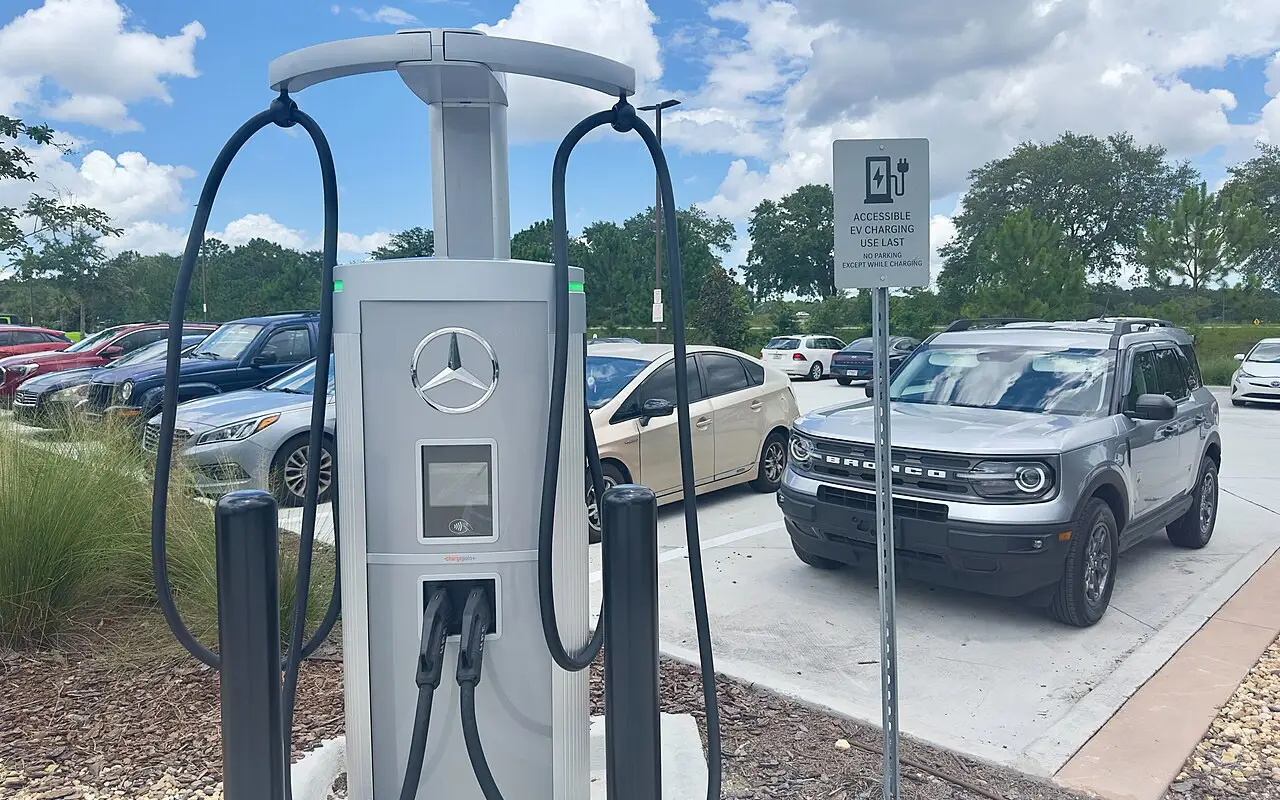
Some EV charging bays use a “Use Last” notice to encourage drivers who do not need mobility features to select other available chargers first. This is different from assuming every accessible-looking EV charging space is legally reserved exclusively for vehicles with disability placards. The Access Board discusses this approach because site conditions, signage, and state/local rules vary. Always obey posted signs and applicable local law. Do not occupy a signed reserved accessible space without the required authorization.
The “Use Last” approach can work only when drivers respect the intended priority and the accessible option remains available to those who need it. The Access Board guidance explains why unambiguous signage and suitable charger numbers matter. The featured photograph shows one real-world “Use Last” example; it is not evidence that the photographed charger meets every accessibility criterion.
Step 5: Make an accessible charging backup plan
Before leaving home, save the station operator’s support phone number and a backup charging destination compatible with your car. If the network provides station photos, inspect curb edges, aisle placement, cable routing and the payment interface. Check both the network listing and recent reports when available, but treat unverified reviews as leads rather than certification.
On arrival, if a charging cable, vehicle, ice, snow, bollard or equipment blocks the route, do not attempt an unsafe maneuver or force an electrical connector. Contact the operator; if you cannot access the charger, record the station name, port number, date, barrier and support case number. If access is systematically denied, consider contacting the site owner or the relevant state or local accessibility authority for guidance.
How to document an inaccessible EV charging station
A useful report says what prevents use, not just “not ADA compliant.” For example: “The DC fast charger is placed behind a raised curb with no step-free route from the driver-side access aisle,” or “The handle and screen cannot be reached from the level ground space.” Include a photo only when it can be taken safely and without exposing other drivers’ personal information. This makes it easier for operators to investigate and remedy the obstruction.
Frequently asked questions about accessible EV charging
Can I trust an accessibility icon on a charging map?
No icon alone verifies the layout, cable reach, accessible payment interface or live condition of a particular port. Confirm the site-specific features with the charging operator.
Must every public charging stall have an access aisle?
There is no safe universal yes-or-no answer for every U.S. site. Requirements vary with jurisdiction, construction, funding and facility type. The Access Board’s technical assistance recommends accessible mobility features for a reasonable number of chargers and accessible communication at chargers. Applicable law and code must be checked separately.
What if a charger is usable from a wheelchair but its cable cannot reach my car?
The charging space may still be practically unusable for that vehicle. Verify port location, cable reach and parking orientation before relying on the site. Do not stretch or force the cable across a route.
Does “Use Last” mean a bay is reserved for disability placard holders only?
Not necessarily. “Use Last” is a priority-use approach discussed in federal technical guidance; reserved parking requirements are determined by posted signs and applicable state or local rules.
Official sources and further reading
- U.S. Access Board — Design Recommendations for Accessible Electric Vehicle Charging Stations (technical assistance and design criteria)
- U.S. Department of Energy — ADA Compliance for EV Charging Infrastructure (overview of accessibility obligations and considerations)
- U.S. Department of Transportation — Accessible EV Charging Station Design Resource
- DOE Alternative Fueling Station Locator (find candidate charging sites; verify accessibility directly)
Editorial note (November 11, 2026): This guide is for U.S. drivers and distinguishes federal technical recommendations from location-specific legal requirements. It is not a certification or legal determination for an individual charging site.