Drivers at public EV chargers in the European Union have rights to ad hoc charging and clear pricing under the Alternative Fuels Infrastructure Regulation (AFIR), Regulation (EU) 2023/1804. But the rules do not mean that every existing charger must already accept a bank card, or that a high-power station must exist every 60 km on every road. The requirements depend on charging power, installation date, road network and future deadlines.
This English-language explainer distinguishes what applies in 2026 from the additional requirements due in 2027 and later, with practical instructions for EV drivers travelling across EU countries.
What is AFIR and when did it take effect?
AFIR is the EU regulation on deployment of alternative fuels infrastructure. It sets minimum requirements for public charging availability, payment, pricing information, technical standards and data. The regulation began to apply on 13 April 2024, with some obligations phased in later. The operative source is the consolidated text of Regulation (EU) 2023/1804; the European Commission’s technical questions and answers help explain implementation details.
AFIR principally applies within the EU. It should not be presented as automatically imposing identical obligations in Türkiye, the United Kingdom or every other European country. For Turkey specifically, see our official Şarj@TR charging-station guide.
Can you charge without joining a network?
AFIR requires operators of publicly accessible charging points to offer ad hoc recharging: the user should be able to buy a charging session without a broader contractual relationship with the charge-point operator or mobility service provider. A requirement to register for an ongoing operator account or accept additional membership terms is not the same as a simple ad hoc transaction. The Commission’s Article 5 FAQ addresses this distinction.
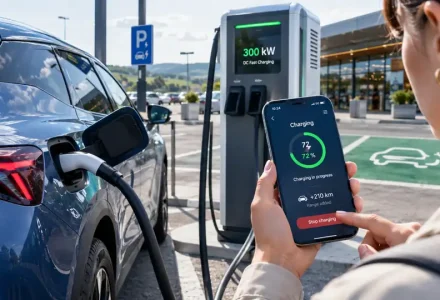
Ad hoc does not mean no payment, no identification for a secure transaction, or no instructions. A compliant process might use a payment terminal, contactless card or, where allowed, a secure web payment after scanning a QR code.
Does every EU EV charger need a credit-card reader?
No. The regulation differentiates installations and power ratings. At publicly accessible points deployed from 13 April 2024, operators must accept widely used electronic payments using a qualifying solution. For chargers with an output below 50 kW, AFIR allows a secure internet-based payment method, such as a QR code linked to a payment webpage, as one option. For newly deployed points rated 50 kW or higher, the specified methods include a payment-card reader or a contactless device able to read payment cards.
The Commission FAQ under Article 5(1) states that secure QR payment can be allowed below 50 kW. This does not mean any untrusted static QR sticker is automatically safe. Verify the genuine operator, domain and payable amount before entering payment information.
What changes on 1 January 2027?
AFIR Article 5(1) adds a specific 1 January 2027 deadline for publicly accessible charging points with an output of at least 50 kW on the TEN-T road network or at designated safe and secure parking areas. The qualifying payment-card or contactless-card arrangements must be in place including for points installed before 13 April 2024. This is not an assertion that all pre-existing 22 kW AC stations throughout the EU must be retrofitted with physical card readers on that date.
How must the price be displayed?
AFIR requires transparent, comparable and non-discriminatory pricing for publicly accessible recharging. For charging points rated 50 kW or above, the ad hoc charging price must be based on the price per kWh delivered. A separate occupancy fee may be applicable within the regulation’s framework, but extra components should be made clear to users before the charging session.
For contract-based sessions through mobility service providers or roaming apps, all applicable price components, including any relevant roaming or additional charges, must be disclosed to the user before the intended session. The European Commission’s answers to Article 5(4) and (5) distinguish the operator’s ad hoc price rules from contract-based service pricing.
Illustration, not a market price: if a charger displays a hypothetical ad hoc tariff of €0.55/kWh and a session supplies 32 kWh, the energy component is 32 × €0.55 = €17.60. The total could differ if clearly applicable non-energy fees or taxes are added under the relevant charging terms. Always check what the displayed tariff includes.
Does AFIR require EV chargers every 60 km?
It sets specific minimum deployment targets for the Trans-European Transport Network (TEN-T), not every road in the EU. Along the TEN-T core network, the regulation sets a maximum 60 km separation between qualifying light-duty recharging pools in each direction of travel, alongside minimum site power requirements. A recharging pool means a location with one or more recharging stations; its aggregate power is not the same as the power available from every individual plug.
| Network and deadline | Minimum light-duty charging-pool requirement | Coverage qualification |
|---|---|---|
| TEN-T core, by 31 December 2025 | At least 400 kW combined power, including at least one 150 kW point | Maximum 60 km between qualifying pools in each direction, subject to the regulation’s detailed network rules |
| TEN-T core, by 31 December 2027 | At least 600 kW combined power, including at least two 150 kW points | Same core-network spacing concept and applicable exceptions |
| TEN-T comprehensive network, by 31 December 2027 | At least 300 kW combined power, including one 150 kW point | 60 km concept applies along at least 50% of relevant comprehensive-network length at that phase |
Reference: AFIR Article 3. This is a simplified summary of minimum legal targets, not proof that every required site is operational. The regulation includes detailed treatment of network geography and permitted variations.
That distinction matters for drivers. A regulation that requires infrastructure does not guarantee a currently open connector on your route, and a compliant 400 kW pool does not mean an EV can receive 400 kW through one cable.
Why is “400 kW site” different from “400 kW charging speed”?
Pool power is aggregate site capacity. For example, a hypothetical site could meet a 400 kW combined-capacity threshold through multiple charging points whose individual ratings are lower than 400 kW. Vehicle speed is determined by the car’s own charging capability, the actual charger used, battery temperature and charge level. A vehicle that accepts a maximum of 100 kW does not charge at 400 kW merely because the site is capable of supplying 400 kW in total.
Our EV charging-time guide explains how power and energy influence stop duration. Check the socket’s individual kW rating rather than the largest sign at a service area.
Are all public EV chargers required to be open 24/7?
Not automatically. The Commission’s FAQ explains that a charger may count as publicly accessible even if the car park or premises have limited opening hours. A private office charger limited to specifically authorised employees is a different case. Thus, publicly accessible is a regulatory accessibility category, not a promise that every charging space is usable at midnight.
Drivers should confirm the station’s hours, parking rules and live availability independently. Our hotel EV charging guide explains why a charger on a property does not automatically ensure overnight access.
What does AFIR mean for crossing EU borders?
The regulation supports interoperability, payment options and price transparency, but it does not create a universal one-price subscription or make every connector compatible with every car. An EU road trip still requires checks for the vehicle’s inlet, charger standard, current operational status and the terms of the individual charging operator.
- Confirm your car’s connector and maximum AC/DC power before departure.
- Use current charging-network maps to identify individual usable stalls along your route.
- Check ad hoc payment, including the secure payment domain or card reader used.
- Compare the operator’s ad hoc €/kWh price with any applicable roaming-app price and other fees.
- Verify parking access and operating hours even where a site is classified as public.
- Save a second station in case the first is unavailable or below its intended output.
For route design and a practical reserve, use our EV road-trip planning guide.
How can you tell whether a particular charger complies?
The law establishes obligations but does not certify individual sites in this article. If you encounter an apparent discrepancy, record the station identifier, location, displayed price, charging power and date. Then contact the operator or the relevant national enforcement authority. Do not assume non-compliance solely because a 22 kW charger uses a QR payment page; output and deployment date matter.
For the legal text and technical clarification, consult the AFIR consolidated regulation and the Commission’s AFIR questions and answers. Only the competent courts and authorities can conclusively determine how the law applies to a specific dispute.
The bottom line
AFIR makes public EV charging easier to access and compare in the EU, but its requirements are phased and specific. Ad hoc charging and clear pricing apply under the regulation; new high-power charging points have card-payment obligations, and older qualifying high-power points on designated routes face a further 2027 deadline. TEN-T coverage targets refer to qualifying site power and network sections—not a charger every 60 km on every road.
Regulatory position checked as of 6 November 2026. This article provides general information, not jurisdiction-specific legal advice or a certification of any charging station.
Sık Sorulan Sorular
Do EU EV charging stations have to accept credit cards in 2026?
The rules depend on station power and deployment date. New public points of at least 50 kW must accept a specified card or contactless payment method; secure internet/QR payment is one permitted option for new points below 50 kW.
Can I charge without registering an app in the EU?
AFIR requires publicly accessible operators to offer ad hoc charging without a broader service contract, subject to the regulation's applicable payment arrangements.
Do EU fast chargers have to price electricity per kWh?
For ad hoc charging at publicly accessible points rated at least 50 kW, the operator's price must be based on kWh delivered. Other applicable charges must follow transparency rules.
Will every highway in Europe have an EV charger every 60 km?
No. AFIR specifies 60 km spacing and capacity targets for certain TEN-T networks and phases, with detailed qualifications. It is not a blanket promise for every road or non-EU country.
What changes for older charging stations in January 2027?
From 1 January 2027, qualifying 50 kW-and-above public points on TEN-T road routes or designated safe and secure parking areas must satisfy specified payment card/contactless requirements, including older installations.