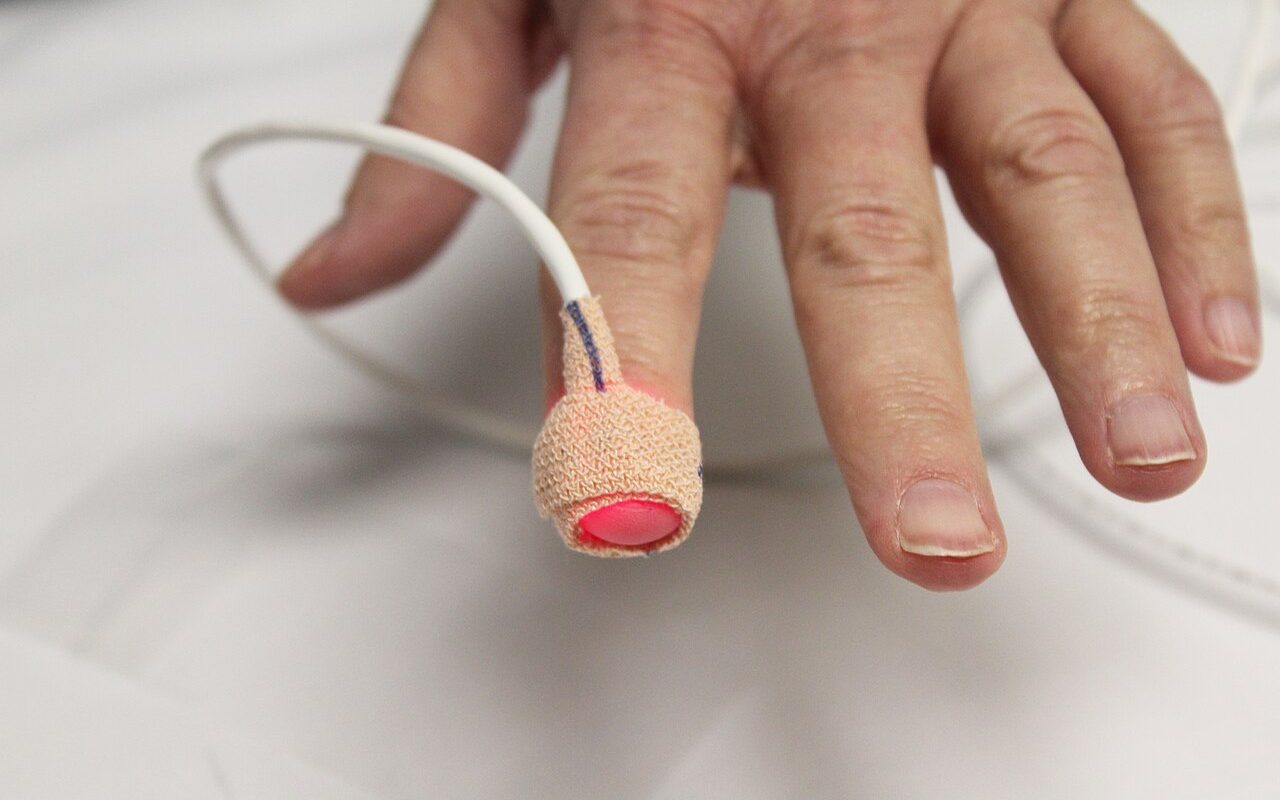
Quick answer: A home pulse oximeter may give changing or misleading oxygen saturation (SpO₂) readings because of cold hands, poor circulation, movement, nail polish, device limitations and other factors. The U.S. Food and Drug Administration (FDA) recommends using a warm, relaxed hand, removing nail polish from the tested finger, keeping still and waiting until the reading becomes steady. A displayed oxygen percentage must always be interpreted alongside symptoms and medical advice—it is not a diagnosis.
A fingertip pulse oximeter uses light to estimate the proportion of hemoglobin carrying oxygen. It does not directly sample arterial blood, and a single number cannot identify the cause of breathing symptoms. The FDA notes that not all pulse oximeters sold to consumers are reviewed for clinical decision-making.
How to take a more consistent fingertip oxygen reading
- Follow your clinician’s monitoring plan. If you have been instructed to track oxygen levels for a health condition, use the device and schedule they recommend.
- Read the device instructions. Check battery power, proper finger placement and the manufacturer’s intended users and measurement conditions.
- Warm and relax your hand. The FDA recommends a warm, relaxed hand held below heart level. Cold or poorly perfused fingers can affect readings.
- Remove nail polish from the test finger. Polish can interfere with the optical measurement; follow the manufacturer’s additional instructions for nail coverings or artificial nails.
- Sit still. Avoid moving the hand or finger while the device is calculating the estimate.
- Wait for a steady number. Do not record the first flickering value; follow FDA guidance to wait until the reading stops changing.
- Record the context. Note the displayed SpO₂, pulse, date, time, symptoms and anything unusual, then share your log with your health professional if needed.
This checklist follows the FDA’s consumer guidance for home pulse oximeters. It helps improve measurement conditions but cannot guarantee a precise or clinically accurate result.
Why can a cold finger change an oxygen reading?
The sensor must detect light passing through or reflecting from blood in tissue. Poor peripheral blood flow can reduce the quality of that signal, particularly when a hand is cold. The FDA explicitly lists poor circulation and skin temperature among factors affecting accuracy. Warm your hand in a normal, comfortable way and repeat the measurement according to the device instructions. If symptoms are severe, do not delay medical care in order to retest.
Does nail polish affect pulse oximeter accuracy?
It can. Certain nail polishes or coverings may alter how light travels through a fingertip. The FDA specifically recommends removing fingernail polish from the finger being measured. The effect depends on the product, device and conditions; do not assume a particular color or type of polish is always harmless or always makes the number lower.
Can skin pigmentation affect pulse oximeter readings?
Yes. The FDA says scientific evidence has identified performance differences among people with different skin pigmentation. These concerns are particularly important because a displayed reading can appear reassuring even if the true oxygen level is lower. The FDA announced draft recommendations on January 6, 2025 aimed at improving medical-purpose device performance across skin tones. Those recommendations were presented as a draft at that time; a draft is not the same as a universally applicable final device standard.
Skin pigmentation is not the only variable. The FDA also identifies skin thickness, tobacco use and other factors as possible sources of inaccuracy. The important safety principle is to avoid making clinical decisions from a single fingertip percentage without considering symptoms, context and professional advice.
Why do readings jump when I move my hand?
Movement can disrupt a pulse-based optical signal. A reading taken while walking, shaking the hand or adjusting the sensor may fluctuate. Sit still, place the device correctly and allow the displayed values to settle. If a device repeatedly fails to produce a stable signal under proper conditions, follow its troubleshooting instructions or discuss the issue with a healthcare professional.
Medical-grade device versus wellness gadget: why the distinction matters
According to the FDA, some pulse oximeters are medical devices intended to help clinicians monitor patients; certain medical-purpose products have been cleared for over-the-counter use. Other products sold for sport, aviation or general wellness are not evaluated by the FDA for clinical decisions. An online listing that displays an SpO₂ number is not, by itself, evidence that a product has received FDA clearance for the medical purpose you have in mind.
Check the manufacturer’s intended-use statement and consult a healthcare professional if you are buying a device to monitor an illness. Do not treat a wearable’s oxygen-saturation feature as interchangeable with a medically intended pulse oximeter.
What does a 95%, 96%, 97% or 98% display mean?
These percentages are the device’s estimated oxygen saturation, not a direct blood-test value. Whether any result requires action depends on the individual, their usual readings, their medical conditions, altitude, symptoms and their clinician’s instructions. There is no safe universal at-home “ignore everything above this number” rule. Some people who need medical evaluation may display apparently reassuring readings; others may have clinician-defined targets that differ from what an online chart calls typical.
Instead of relying on an anonymous chart, follow the thresholds and action plan your own healthcare team gave you. If you have no monitoring plan and the reading concerns you, contact a healthcare professional.
When should symptoms override the display?
The FDA warns that a pulse oximeter should never be the sole basis for deciding whether someone needs medical care. Severe trouble breathing, chest pain or tightness, blue or gray discoloration of the face or lips, or other severe or rapidly worsening symptoms warrant urgent medical evaluation regardless of the number shown. If an emergency is suspected, call your local emergency number rather than repeatedly checking the device. An oxygen reading cannot rule out all dangerous illnesses.
Make a simple oxygen-reading log that a clinician can interpret
A useful log records the time, displayed SpO₂, pulse, symptoms, whether you were resting and any relevant conditions (for example, cold fingers or an unstable reading). Record the original values without “correcting” them by a guessed amount. A series of readings taken under consistent conditions may help a clinician evaluate a concern, but even a consistent series does not replace medical assessment.
For a separate example of using a home measurement tool with proper positioning and technique, see our home blood-pressure measurement guide. Environmental context is also important for respiratory health: our U.S. Air Quality Index explainer covers pollution alerts, while the wildfire-smoke vehicle guide discusses exposure reduction while traveling.
Sources, scope and medical limitations
Facts about measurement technique and possible inaccuracies are based on the FDA Pulse Oximeter Basics, FDA device overview and January 2025 FDA proposed guidance announcement. This is general health information, not individualized diagnosis or treatment advice. People using oxygen therapy or with diagnosed lung or heart disease should follow their medical team’s instructions.
Cover photo: a pulse oximeter sensor by Quinn Dombrowski / Wikimedia Commons, CC BY-SA 2.0, unmodified. The photo illustrates the device, not a patient’s clinical status.
Sık Sorulan Sorular
Can cold fingers cause a false pulse oximeter reading?
Yes. Cold fingers and poor circulation can reduce the quality of the signal. The FDA recommends checking with a warm, relaxed hand and following the device instructions.
Should I remove nail polish before using a pulse oximeter?
Yes. The FDA specifically advises removing fingernail polish from the tested finger because it may interfere with accuracy.
Can a pulse oximeter show a normal result even when someone is ill?
Yes. Pulse oximeters have limitations. Symptoms and clinical assessment matter even if the screen looks reassuring.
Are all home pulse oximeters FDA-cleared for medical use?
No. Some products marketed for general wellness or sport are not evaluated by FDA for medical decision-making. Check the manufacturer's intended use and regulatory status.