

Key facts
- 350 kW usually describes the charging equipment maximum, not guaranteed constant battery intake.
- For selected U.S. 2026 Kia EV6 long-range trims Kia quotes 10%-80% in 81 minutes at 50 kW, 29 minutes at 150 kW and 20 minutes at 350 kW under specified conditions.
- DOE notes that many EVs reduce charging power in the 80%-100% battery charge interval.
Quick answer: A 350-kW DC fast charger does not deliver 350 kW continuously to every electric car. The figure usually describes the station’s maximum rated output under compatible conditions. The vehicle’s charge-acceptance capability, battery state of charge (SOC), battery temperature, available voltage and actual station output determine the power delivered during a particular session. For most journeys, the useful comparison is time from 10% to 80% at a stated charger type, not the charger’s biggest advertised number.
The U.S. Department of Energy’s Alternative Fuels Data Center (AFDC) explains that charging time depends on battery capacity, SOC, battery type, on-board limits and the charging equipment. Separately, DOE cold-weather guidance notes that many batteries accept reduced DC charging power at 80%–100% SOC. This guide translates those principles into decisions a driver can use at a charging stop.
Peak power, average power and total time are three different measurements
Peak charging power is the highest instantaneous electrical power recorded during part of a session. Average power is total electrical energy added divided by elapsed charging time. Total charging time is what matters when choosing between a longer stop and continuing to another charger. An EV can briefly approach a high power level without maintaining it for the whole session.
For a simplified example, suppose a car with a nominal 84-kWh pack were to add exactly 70% of that nominal capacity in 20 minutes. The arithmetic would be 84 kWh × 0.70 = 58.8 kWh and 58.8 kWh ÷ (20/60 hours) = 176.4 kW of illustrative average battery energy transfer. This is not a measured charging figure for a real model: stated battery capacity may differ from usable capacity, SOC calibration is not a precise external energy meter, and charging losses and battery thermal-management loads matter. The example illustrates why a car completing an idealized 10%-to-80% charge in 20 minutes does not need to average 350 kW.
A real manufacturer example: 2026 Kia EV6 at three chargers
Kia publishes approximate 10%-to-80% DC charging times for its U.S.-market 2026 EV6. For the 84-kWh long-range versions, the manufacturer’s comparison table gives:
| DC equipment rating | Approximate 10%-to-80% time | Interpretation |
|---|---|---|
| 50-kW DC equipment | 81 minutes | Lower-power equipment limits the potential charging speed |
| 150-kW DC equipment | 29 minutes | Faster, but not the same as the fastest compatible high-voltage charger |
| 350-kW DC equipment | 20 minutes | High-power, compatible conditions bring the shortest quoted stop |
Source: Kia America’s official 2026 EV6 specification comparison. The table also shows different times for a smaller-battery base model. Kia bases the fastest result on controlled manufacturer testing, including a particular battery temperature; it does not promise that every public session will match it. Depending on the station, an adapter sold separately may be necessary.
The 350-kW hardware reduces the manufacturer’s stated long-range EV6 stop time by nine minutes versus its 150-kW example, not by the 350-to-150 power ratio. That is a useful demonstration of charging behavior in practice: a station nameplate is not a linear stopwatch.
Five reasons a DC charging session can be slower than the charger’s label
1. The battery’s state of charge changes during the session
Early in a compatible DC fast-charging session, the battery may accept more power than when approaching full. Vehicle and battery-control systems gradually reduce the requested power according to cell condition and safety limits. There is no universal rule that all EVs begin tapering at one exact SOC, and individual charge curves differ. DOE explains that most batteries reduce charging power as they approach the upper 80%–100% range.
That is why a published 10%-to-80% time cannot simply be extrapolated to a 10%-to-100% time. The final 20 percentage points may require disproportionately more minutes. If the route does not require a full charge, check whether stopping near your vehicle’s manufacturer-recommended level is more time-efficient.
2. A cold or overheated battery may request less current
Battery chemistry operates within a managed temperature window. In cold weather, a vehicle may reduce DC charge acceptance until the battery warms. In hot conditions, cooling demands and protective controls may also affect charging. Hyundai describes its Battery Conditioning Mode as a way to optimize battery temperature in very cold weather or before Level 3 charging, subject to system limitations.
Practical check: If your car supports conditioning, follow the exact instructions in its owner manual. Some navigation systems activate the relevant preparation when a compatible charging stop is set as the destination; others require different settings. Do not assume that remotely warming the passenger cabin is identical to preheating the high-voltage battery.
3. A charger has electrical limits beyond its headline kW value
Power in kilowatts depends on electrical voltage and current. A battery’s required voltage profile, cable and connector limits, and the charger’s operating envelope can prevent a station from delivering its headline number. Manufacturers of 800-volt-capable vehicles may publish different charge times at 400-volt and higher-voltage equipment; these are not interchangeable test conditions.
For example, Hyundai’s U.S. 2026 IONIQ 5 specifications quote approximately 30 minutes for long-range 10%-to-80% charging in a specified 150-kW/400-volt NACS scenario, versus 20 minutes with a compatible higher-power 800-volt arrangement via the appropriate CCS adapter. This is a manufacturer specification for those configurations; it does not mean all NACS stations operate at 400 volts or that every CCS station is 800-volt capable.
4. The station may be subject to operational limits
Actual available output can be affected by shared electrical capacity, cable temperatures, station configuration, electrical faults and site operating conditions. A driver’s charging app may report stall availability without guaranteeing sustained power at a given plug. The AFDC station guide separates a station location, a port and a physical connector, which helps explain why not every plug at a location necessarily represents independently available maximum equipment power.
5. Connector and adapter compatibility can restrict the usable station
North American DC stations commonly use CCS1, NACS/J3400 or, on some equipment, CHAdeMO. Connector type and vehicle/network access should be verified before a trip. An electrical adapter must be approved for the particular vehicle and charging use: an AC-only plug adapter is not automatically suitable for high-power DC charging. Visit our EV Technology coverage for standards and compatibility guidance.
Why 80% is a planning milestone, not a universal battery-health command
On a road trip, 80% is commonly used in published rapid-charge comparisons because the final segment is often slower. That is distinct from a vehicle maker’s daily charging-limit guidance, which can depend on pack chemistry, model year, climate and use pattern. Do not apply an internet-wide daily 80% rule to every EV without checking its owner manual. There are legitimate cases where a longer stop and higher charge are useful, for example reaching a remote destination with limited charging.
A better question is: How much usable energy do you need to reach the next dependable charger with a suitable reserve? Time, route and reliability matter alongside battery care. If a station is heavily used, unnecessarily occupying a DC stall to reach 100% can also reduce access for other drivers.
A five-step charging-stop decision process
- Check arrival SOC: Start your plan with the battery percentage you expect to have, not with full battery capacity alone.
- Confirm the plug and station: Verify the vehicle’s actual DC port, network eligibility, adapter approval and station working status.
- Look at the vehicle’s published charge time: Use manufacturer 10%-to-80% figures for a genuinely comparable charger, voltage and model variant.
- Use battery conditioning when appropriate: Follow the vehicle manual and set the charging location in the required way, if supported.
- Make a departure decision: Leave when you have enough for the next reliable stop with an appropriate buffer, not merely when a displayed percentage reaches a round number.
For example, if two usable stations are available, the closest 350-kW unit is not automatically the better option if it is occupied or inaccessible while a lower-rated charger nearby is open and compatible. Route reliability and dwell time depend on more than the cabinet’s maximum number.
What to record if you want to compare real charging sessions accurately
Record the vehicle trim and battery variant, charger location and connector, initial and final SOC, time connected, total energy delivered as reported by the station, ambient conditions, whether preconditioning was active, and any station power limitation message. Those observations support a meaningful personal comparison; a single dashboard screenshot of peak kW is not a complete charging-speed test.
If a session fails instead of merely charging slowly, see our public charger troubleshooting guide. For home charging decisions, start with the EV Guides section rather than buying a larger AC wall unit without verifying the car and the home’s electrical system.
Frequently asked questions
Is a 350-kW charger always faster than a 150-kW charger?
No. It can be faster for a vehicle that can take advantage of the extra compatible power, but if the car’s limits or actual site output are lower, the benefit may be smaller or absent.
Why does my EV slow down above 80%?
Battery-management controls commonly reduce charge acceptance at high SOC to protect the pack and manage cell conditions. The exact charging curve is vehicle- and condition-dependent.
Can preconditioning make fast charging quicker?
For supported vehicles in relevant conditions, preparing battery temperature before DC charging can improve performance. Follow manufacturer instructions; it is not a guarantee of peak power.
Does a NACS plug mean the station will deliver its maximum power?
No. Plug shape is only one requirement. Vehicle, station, voltage, current and network access must all be compatible.
Should I always stop charging at 80%?
No. 80% is often a good road-trip time comparison point, but your route and your specific vehicle maker’s charging guidance determine what makes sense for an individual session.
Official sources and editorial disclosure
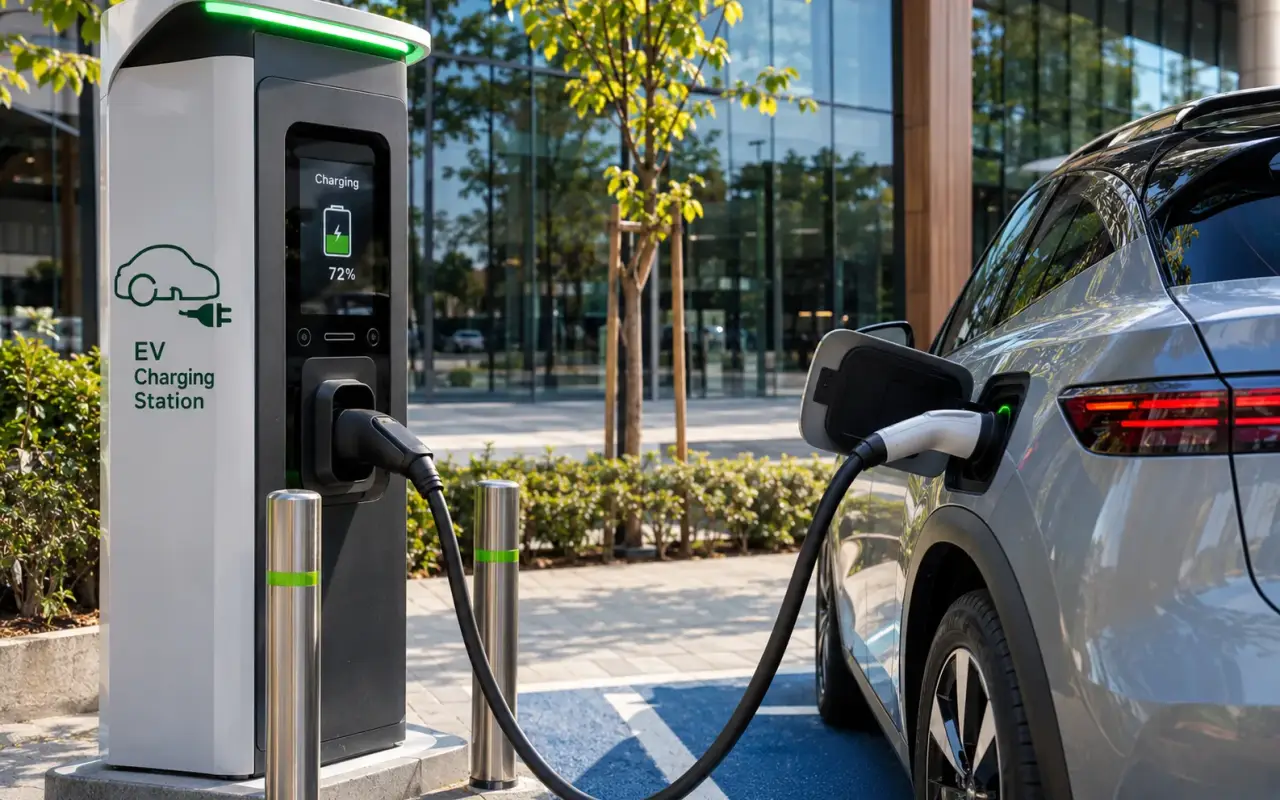
Source documents: DOE AFDC charging infrastructure and power limits; DOE winter EV guidance; Kia EV6 charge-time specifications; Hyundai IONIQ 5 charge-time specifications; Hyundai conditioning instructions. No private vehicle testing is claimed, and the arithmetic example is explicitly hypothetical. The cover is a custom AI-generated photorealistic editorial charging scene, not an actual documented charging test. Explore more in Charging & Batteries and Reviews & Tests. Reviewed November 11, 2026.

1 comment