Key facts
- Compare the same later destination and planned arrival reserve, including additional route energy.
- Charging minutes equal battery energy to add divided by average battery charging power, multiplied by 60.
- The original assumed example totals 38 minutes at station A and 34 minutes at station B; a 6-minute B queue reverses the result.
- Charger peak power is not a guaranteed average for a specific charging interval.
A faster EV charger is worth a detour when the charging time it saves exceeds the extra driving, queuing and connection time. Compare routes that reach the same later destination with the same planned battery reserve. A higher number on the charger does not, by itself, establish which route gets you there first.
The worked example below shows a faster station saving four minutes, then losing its advantage when a six-minute queue appears. Every number in that example is an assumed planning input, not a road test or a claim about a particular car. Keep the related EV charging planning tools alongside your route plan.
Compare the whole route to the same destination
Start with two stations that are compatible with your vehicle and any approved adapter, reachable with your chosen reserve, and currently reported as operational. Check access hours and payment arrangements. The EV road-trip planning checklist covers these checks. A time calculation cannot make an incompatible or unreachable charger a useful option.
Then compare both routes from the same starting point to the same later waypoint or destination. Include the drive back from each station. If one route consumes more energy, its charging target may need to be higher to preserve the same arrival reserve. Do not compare a short stop that leaves you needing another charge with a longer stop that completes the journey.
This approach reflects a real planning objective: Tesla’s Model Y navigation manual describes selecting routes and charging durations to minimize driving plus charging time. It also provides estimated arrival energy and adjusts later charging requirements when an earlier stop changes. Features and availability depend on the vehicle and region.
Use an average for the actual charging window
For an arithmetic estimate, use the average power over the charging interval you intend to use. The relevant interval might be 15% to 55%, rather than a published 10% to 80% test. Electrify America explains that the vehicle requests power, with battery temperature, health and charge level affecting that request; charging can slow as the battery fills. A station’s advertised maximum is therefore unsuitable as an automatic average.
The calculation below uses energy added to the battery and average power actually adding that energy to the battery. Keep those two quantities at the same measurement point. DOE explains that charging involves conversion and battery losses, so charger-delivered power need not equal the rate of stored-energy gain. Our charging-losses guide explains the distinction.
If you have no credible battery-side average for the intended interval, compare the charging-duration estimates from your vehicle’s route planner instead. Do not quietly substitute a charger display’s peak power. For more on this limitation, see why a 350-kW charger is not always faster.
The time calculation
Charging minutes = battery energy to add (kWh) ÷ average battery charging power (kW) × 60.
Added journey minutes = extra driving minutes + queue minutes + connection/parking minutes + charging minutes.
Here, extra driving means time added compared with the same underlying route, including leaving and rejoining it. Connection/parking time includes the non-charging time needed to park, start the session, disconnect and leave. Common driving time cancels out of the comparison; if the routes differ more extensively, compare their complete driving times instead.
Worked example: the faster charger wins by four minutes
Hypothetical scenario: two compatible, working stations can supply enough energy to reach the same later waypoint with the same reserve. Station B’s longer route requires an assumed additional 3 kWh of battery energy. Its 33-kWh target already includes that difference. Neither station initially has a queue.
| Planning input | Station A: nearer | Station B: faster |
|---|---|---|
| Battery energy to add | 30 kWh | 33 kWh |
| Assumed average battery charging power | 60 kW | 110 kW |
| Charging time | 30 ÷ 60 × 60 = 30 min | 33 ÷ 110 × 60 = 18 min |
| Extra driving, including return | 4 min | 12 min |
| Queue | 0 min | 0 min |
| Connection/parking allowance | 4 min | 4 min |
| Total added journey time | 38 min | 34 min |
B saves 12 charging minutes but adds eight more driving minutes than A. Its net advantage is four minutes. The result depends on the assumed averages and energy targets; it is not a prediction for an unnamed production vehicle.
Where those minutes go
For this illustration, split A’s extra driving into two minutes out and two back, and B’s into six minutes out and six back. Put the four-minute setup allowance before charging; this is bookkeeping, with any unplugging time included in that allowance.
- A: two minutes to leave the route, four minutes of setup, 30 minutes charging and two minutes to return: 2 + 4 + 30 + 2 = 38.
- B: six minutes to leave the route, four minutes of setup, 18 minutes charging and six minutes to return: 6 + 4 + 18 + 6 = 34.
A stop with a required meal or rest break needs another check: some activities can overlap charging. Count the elapsed time once, then compare the actual arrival times. Adding a 20-minute meal to a charging interval that already contains that meal would overstate the delay.
Find the queue that reverses the result
With all other inputs unchanged, B can absorb four more queue minutes than A before the options tie. A six-minute queue at B increases its total to 40 minutes, while A remains at 38. A is now two minutes quicker.
| Assumed scenario | A total | B total | Result |
|---|---|---|---|
| B averages 110 kW; no queues | 38 min | 34 min | B saves 4 min |
| B averages 110 kW; B queues 4 min | 38 min | 38 min | Tie |
| B averages 110 kW; B queues 6 min | 38 min | 40 min | A saves 2 min |
| B averages 90 kW; no queues | 38 min | 38 min | Tie: B needs 22 min charging |
The last row changes charging performance instead of the queue: 33 ÷ 90 × 60 = 22 minutes. It removes B’s four-minute advantage even without waiting. Run a favorable and a slower scenario rather than treating an uncertain average as a guaranteed outcome.
Charging decision tool
Is the faster charger worth the detour?
Compare the added journey time for two compatible charging stops. Plan both routes to reach the same later waypoint with the same reserve. Include extra route energy in each charging estimate.
Worked example and method
Added journey time = extra driving + parking/connection + assumed delay + charging. When using battery-side energy and average power, charging minutes = 60 × kWh ÷ kW.
Example A: 4 + 4 + 0 + 30 = 38 minutes. Example B: 12 + 4 + 0 + 18 = 34 minutes. B saves four minutes. Six additional queue minutes at B would make it 40 minutes, so A would then save two minutes.
These are hypothetical planning inputs. The battery calculation uses 30 kWh at 60 kW for A and 33 kWh at 110 kW for B; B's extra energy is an assumed route allowance. Compatibility, live availability, weather and vehicle limits still need checking. A time comparison does not establish that a route is reachable.
Use the result as a decision threshold
Check the operator’s current status near departure, allow for uncertainty and keep a reachable alternative. A four-minute modeled advantage offers little margin if the faster site is difficult to enter or its queue is unknown. If both options fit your energy plan, amenities, accessibility and price can reasonably decide a close result.
Apply the same calculation to your two stops, then change one uncertain input at a time. The EV charging planning tools provide related planning help. For costs, use the station’s actual tariff and billed energy separately: a battery-energy estimate is not automatically the number of kWh on the receipt.
Frequently asked questions
Is a 350-kW station worth a longer drive than a 150-kW station?
Only if your vehicle saves enough charging time to offset the extra driving and other delays. Compare the intended charging interval and total journey, not the two maximum power labels.
How many detour minutes can a faster charger justify?
At most the charging minutes it saves, reduced by any additional queue or connection time, when both routes achieve the same arrival reserve. In our assumed example, 12 minutes saved charging leaves four minutes after eight additional driving minutes.
Can I make a charger look faster by lowering the departure charge target?
That changes the comparison. Both options must still reach the same later destination with the same planned reserve; include any additional stop needed by the lower target.
Methodology: Official manufacturer and charging-operator information checked on November 12, 2026. Calculations are original hypothetical scenarios. No vehicle or charger was tested for this guide.
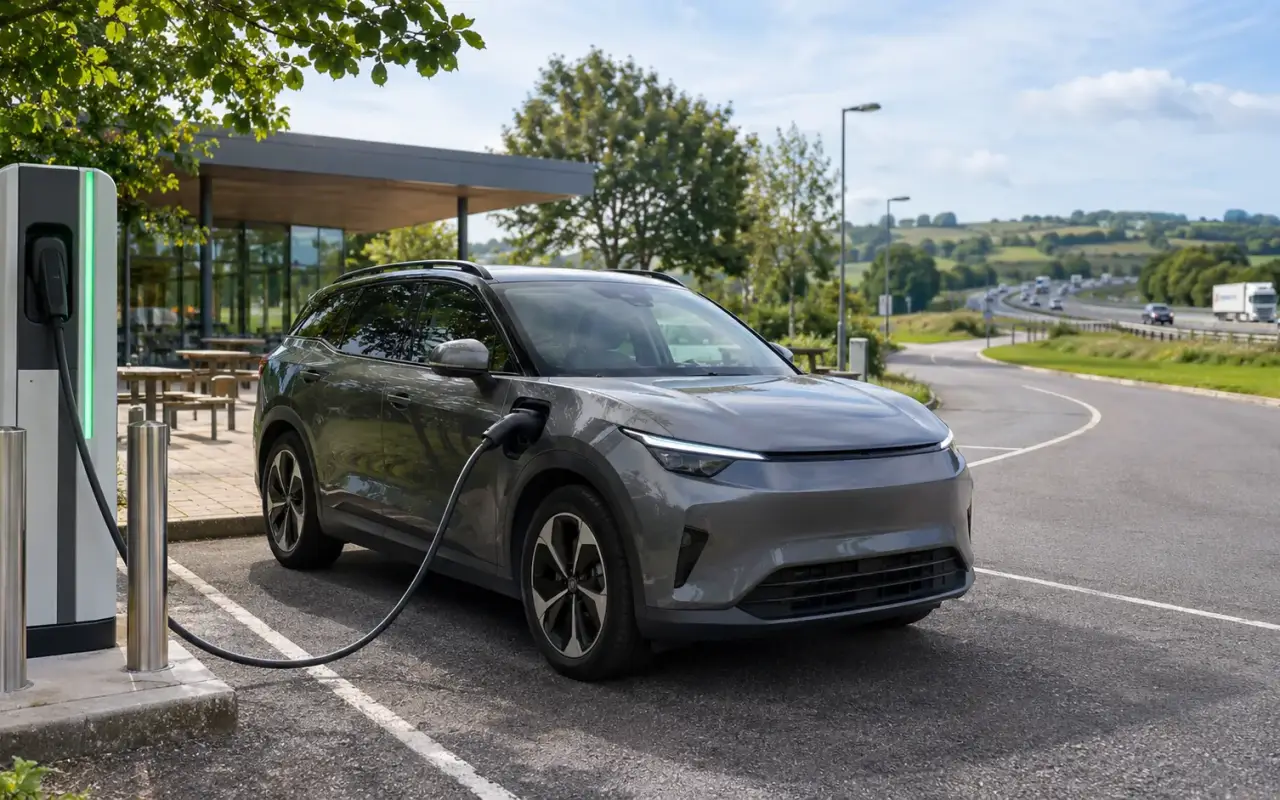
Cover image: AI-generated scene for illustration.