Key facts
- With no other fee differences, break-even kWh equals the monthly membership fee divided by the saving per eligible kWh.
- An illustrative $8 monthly fee and $0.12/kWh discount break even at 66.67 eligible kWh; these are hypothetical inputs, not a provider tariff.
- Electrify America lists Pass+ at $7 per month and describes charging savings of about 25%; actual station pricing must be checked.
- EVgo lists monthly subscription and session-fee differences; its paid-plan monthly fee is not charging credit.
- Tesla membership discounts for eligible non-Tesla EVs depend on using the Tesla app; third-party app prices may differ.
An EV charging membership is worth paying for when the discounts you actually use exceed the subscription fee. The decisive figure is eligible charging on that plan during its billing period. Your total monthly mileage, battery size or spending across unrelated networks cannot establish the answer on its own.
This U.S.-focused guide shows how to calculate a charging subscription’s break-even point, including session fees and mixed-network travel. The worked examples use invented prices to demonstrate the method. Provider information was checked on 12 November 2026; confirm the current offer and station price before subscribing.
The simplest break-even calculation
Start with three inputs: the monthly subscription fee, the nonmember price per kilowatt-hour and the member price per kilowatt-hour. Compare prices for the same station, charging period and payment method, with taxes treated consistently.
Saving per kWh = nonmember price − member price.
Break-even kWh = monthly subscription fee ÷ saving per kWh.
This simplified formula applies when all other charges are identical. At the threshold, the two options cost the same. Above it, the membership produces a positive saving; below it, its monthly fee is larger than the energy discount. If the member energy price is equal to or higher than the alternative, there is no positive energy-only break-even point.
A worked example using hypothetical prices
Assume a fictional plan charges $8 per month. The same station costs $0.56/kWh without the plan and $0.44/kWh with it. The difference is $0.12/kWh, so $8 ÷ $0.12 = 66.67 kWh.
At 40 eligible kWh, pay-as-you-go charging costs $22.40. Membership charging costs $17.60 plus the $8 subscription, or $25.60. The membership costs $3.20 more.
At 100 eligible kWh, pay-as-you-go costs $56. The member pays $44 plus $8, or $52, saving $4. These calculations exclude taxes and assume no session, parking or other fee differences. They are not Electrify America, Tesla or EVgo price quotations.
Count the right electricity
Suppose you buy 300 kWh during a month, but 230 kWh comes from home charging, an employer or competing networks. Only 70 kWh qualifies for the fictional plan. The calculation is 70 × $0.12 − $8 = $0.40 saved, not 300 × $0.12 − $8.
Use billed energy from relevant receipts. Do not estimate it by multiplying battery capacity by the number of visits: a short top-up and a long charging session can be very different purchases. Our charging-losses guide explains why purchased energy and the increase stored in the battery are different measures.
Add session-fee savings separately
A plan may also remove a fixed charge each time you plug in. For a uniform tariff, use this fuller comparison:
Monthly net saving = eligible kWh × energy-price difference + eligible sessions × session-fee difference − monthly subscription fee.
For another hypothetical example, assume an $8 fee, a $0.10/kWh discount, four eligible sessions and a $1 fee waived on each session. Buying 50 kWh produces $5 of energy savings plus $4 of session savings. After the subscription, the net saving is $1.
If stations have different prices, calculate each session’s energy saving separately and add the results. Subtract any extra charges that differ between plans. A per-minute tariff needs a comparison using minutes and the relevant pricing rules; substituting kWh into a per-minute price gives an incorrect result.
What the official U.S. plans show
Electrify America lists a free Pass membership and Pass+ at $7 per month, describing Pass+ charging savings as about 25%. Its pricing page says charging prices depend on location, plan and delivered energy; selected stations also use time-of-use pricing. Use the actual pair of prices shown for your station rather than treating the advertised percentage as a fixed nationwide tariff.
EVgo’s pricing page lists Plus at $6.99 per month and PlusMax at $12.99 per month, both without session fees. Its registered Pay As You Go plan has no monthly fee and lists a $0.99 session fee. EVgo states that the subscription is not charging credit and that actual savings depend on usage and station pricing. Compare the payment route you will really use; direct card payment can have different charges.
Tesla says eligible non-Tesla vehicles can use accessible Superchargers without buying a membership. Its optional membership applies Tesla vehicle pricing when charging through the Tesla app at eligible sites. Tesla vehicles do not need that membership for their own pricing. Check the app for the current fee and your vehicle’s compatible sites; Tesla notes that third-party app pricing can differ.
Match the decision to the billing period
A road trip can create enough eligible charging to justify one billing period without justifying every subsequent month. Compare the expected charging between the subscription’s actual renewal dates, then repeat the calculation for a normal month at home.
Check how cancellation works before relying on a one-month strategy. Electrify America’s subscription terms say a switch to the free plan takes effect at the next billing cycle and already-paid monthly fees are non-refundable. Tesla’s support page also identifies its monthly membership fee as non-refundable.
A small calculated saving can disappear if it requires a longer journey or a paid parking stay. Use the network where it fits your route and charging needs. Our EV road-trip planning guide covers backup charging stops, while the idle and congestion fees guide explains another cost to check.
Compare your own subscription fee and charging prices with our EV charging planning tools. Inputs are adjustable and results depend on the assumptions you choose.
Questions about charging memberships
Can one charging session pay for a membership?
It can, if that session’s eligible energy discount and waived fees exceed the entire subscription fee. Use the planned billed kWh and actual tariff; a session count alone cannot answer the question.
Does a 25% charging discount mean my total bill falls by 25%?
No. The subscription fee and any nondiscounted charges remain in the total. Compare the complete cost of the same charging activity under both plans.
Should I subscribe to several networks?
Calculate each network separately using only its eligible usage. Two subscriptions with small discounts can cost more than one subscription or pay-as-you-go charging, even when your overall monthly charging demand is high.
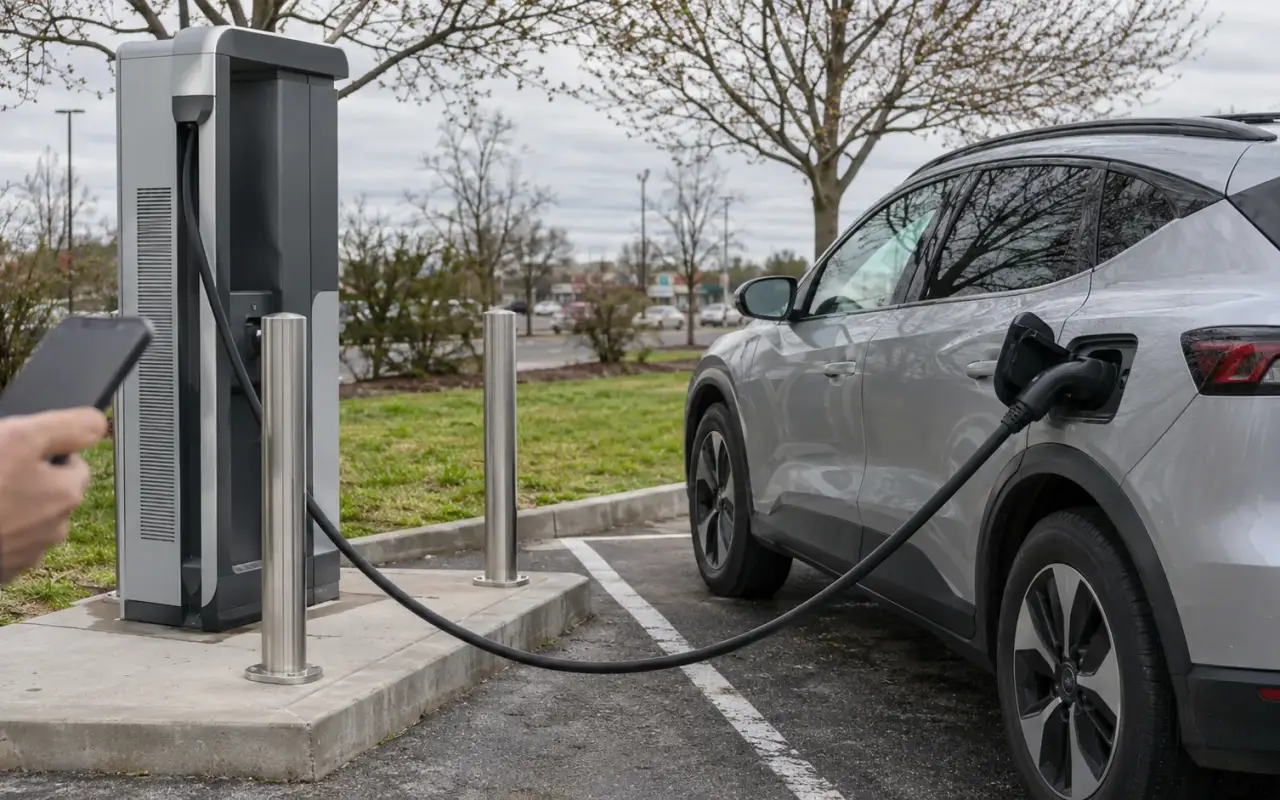
Featured image: an AI-generated, photo-style scene for illustration; it does not document a specific vehicle or installation.