Quick answer: To write a five-paragraph essay, make an outline with one introduction that presents your thesis, three body paragraphs that each develop a different supporting point, and one conclusion that explains what your argument means. Strengthen every body paragraph with credible evidence and analysis, then revise for clear sentences and logical transitions.
The five-paragraph structure is a familiar starting point for many U.S. middle-school and high-school assignments, but it is a practice framework—not a universal rule for good writing. Harvard College’s Writing Center explains that more advanced essays may need a different structure based on the argument and the reader’s needs. This guide includes an original model essay, an outline template, paragraph strategies and practice questions.
What are the five paragraphs of an essay?
| Paragraph | Main purpose | What the reader should learn |
|---|---|---|
| 1. Introduction | Introduce the topic and state a thesis | What you will argue and why it matters |
| 2. Body paragraph 1 | Develop first supporting point | One clear reason and its evidence |
| 3. Body paragraph 2 | Develop second supporting point | A different reason and its evidence |
| 4. Body paragraph 3 | Develop third supporting point | A further reason, counterargument or consequence |
| 5. Conclusion | Synthesize the argument | Why the combined points matter |
Step 1: Read the prompt and choose a focused claim
Underline the task words: explain, compare, analyze, argue, evaluate or describe. An argumentative essay needs a position that could reasonably be debated; an explanatory essay may instead have a focused central idea. Do not force an opinion onto an assignment that asks for an objective explanation.
For this lesson, use the practice prompt: “Should schools teach basic emergency preparedness?” A broad statement such as “Emergencies are important” does not make a clear argument. A more useful thesis is: “Schools should include basic emergency-preparedness instruction because students need to recognize hazards, understand family communication plans and practice safe first actions.”
For extra guidance, read our How to Write a Thesis Statement lesson.
Step 2: Make a simple five-paragraph outline
Before writing complete sentences, make a plan in your own words:
- Introduction: Begin with a realistic situation, define the topic and state a thesis with three distinct reasons.
- Body 1 — Recognize hazards: Explain the value of learning what an emergency alert means and what reliable instructions look like.
- Body 2 — Communicate: Describe how a family or school communication plan can reduce confusion when people are separated.
- Body 3 — Practice responses: Show why learning actions such as “Drop, Cover, and Hold On” can make instructions easier to remember.
- Conclusion: Connect the reasons and explain what students gain from instruction, without adding a brand-new claim.
This plan is an example, not a formula requiring exactly three reasons in every writing assignment. The Harvard College Writing Center encourages organizing paragraphs around the tasks needed to prove your thesis rather than following a rigid count.
Step 3: Write an introduction with a specific thesis
A simple introduction can begin with an everyday situation, add context and end with the main claim. Avoid unsupported statistics, exaggerated promises or cliché introductions that do not help answer the prompt.
Example introduction
Imagine being at school when a severe-weather alert interrupts an ordinary morning. Students must know whom to listen to and how to respond rather than relying on guesses. Emergency preparedness is a skill that can be taught and practiced before danger occurs. Schools should offer basic preparedness lessons so students can recognize hazards, understand communication plans, and practice appropriate first actions.
The thesis is the last sentence. It names three supporting ideas that guide the next three paragraphs. This structure helps the reader see how the argument will develop.
Step 4: Build each body paragraph with evidence and explanation
Each body paragraph should usually have a topic sentence that identifies its main idea, evidence or a concrete example, analysis explaining how that evidence supports the thesis, and a sensible connection to the next idea. Purdue University’s Online Writing Lab (OWL) recommends keeping a paragraph focused on one main idea and developing that idea fully.
A useful teaching sequence is Point → Evidence → Explanation → Link. For example: Point: Students need to recognize reliable emergency information. Evidence: Ready.gov publishes government preparedness advice for children and families. Explanation: Learning where to find such instructions gives students a starting point when they encounter conflicting claims. Link: Once students know what information to trust, they can consider how to reach family members.
Step 5: Read an original model five-paragraph essay
Practice topic: Should schools teach basic emergency preparedness? The following is an original demonstration essay written for this lesson. It is not presented as a published study, a report of an actual school’s program or an independently evaluated student submission.
Model essay: Why Schools Should Teach Emergency Preparedness
Paragraph 1 — Introduction. A weather warning, fire alarm, or earthquake can interrupt an ordinary school day without much notice. Students may know that emergencies happen but still be unsure how to find trustworthy instructions or contact people who care for them. Emergency preparedness lessons can make those questions part of a planned classroom discussion instead of leaving students to guess. Schools should teach basic preparedness because students need to recognize hazards, understand communication plans, and practice safe first actions.
Paragraph 2 — Recognizing hazards. First, students benefit from knowing how to recognize an emergency and find clear instructions. The U.S. government’s Ready Kids resources provide age-appropriate preparedness material. Teachers can use reliable guidance to explain the difference between a warning that requires action and a rumor shared with friends. When students learn to pay attention to official alerts and trusted adults, they have a more useful starting point for making decisions.
Paragraph 3 — Communication. Second, lessons can help students think about communication before people are separated during an incident. Ready.gov’s planning guidance encourages households to discuss how they will contact one another and where they might meet. Schools can ask students to consider how a family plan differs from a school evacuation or shelter plan. This distinction matters because students should follow their school’s instructions during an incident while knowing how their families expect to reconnect afterward.
Paragraph 4 — Safe first actions. Third, practicing appropriate responses can make a lesson more concrete. Ready.gov’s earthquake guidance, for example, explains the action “Drop, Cover, and Hold On” for many indoor situations. A classroom can discuss why different hazards require different responses instead of teaching one response for every event. Students should understand that drills and safety rules are designed for specific risks and locations.
Paragraph 5 — Conclusion. Emergency preparedness does not require students to become emergency professionals. It requires them to learn where to find reliable information, how to understand a communication plan, and which first actions fit a particular hazard. Teaching those ideas in an age-appropriate way can help schools build a more informed learning environment. A short, thoughtful preparedness lesson is therefore worth including in student education.
Step 6: Write a conclusion without adding new evidence
A conclusion should connect the main ideas and answer the “So what?” question. It does not need to repeat the thesis word for word. In the model essay, the final paragraph combines recognition, communication and safe action into one educational purpose. The University of Utah Writing Center recommends using conclusions to show why the claim matters.
Step 7: Revise your draft with this editing checklist
- Assignment: Does the essay answer the exact prompt and follow the teacher’s requested format?
- Thesis: Can the reader identify one clear central claim?
- Paragraph focus: Does each body paragraph support the claim with a different main point?
- Evidence: Are factual claims supported by relevant, credible sources or accurate examples?
- Explanation: Have you explained why each fact supports your point instead of inserting a source link and moving on?
- Transitions: Do sentences connect logically, without relying only on “first, second, third”?
- Conclusion: Does the final paragraph explain the significance of the argument without surprising the reader with new evidence?
- Originality: Have you written in your own words, used quotation marks when needed, and cited borrowed ideas according to the assigned style?
- Proofreading: Have you checked grammar, spelling, punctuation and any word-count requirements?
Practice exercises with answers
Exercise 1: Identify the thesis
In the model essay, which sentence is the thesis? Answer: The final sentence of paragraph 1: the claim that schools should teach preparedness for three stated reasons.
Exercise 2: Improve a weak body paragraph
Weak text: “Communication is very important. Students should communicate. Communication matters in an emergency.” Improved: “Schools can help students understand whom to contact during an emergency and how family communication plans differ from school safety procedures. An example from Ready.gov provides a concrete starting point for discussing the roles of trusted adults and emergency contacts.”
Exercise 3: Find the unsupported claim
Consider this invented sentence: “Every student who takes a safety class becomes 50% less likely to be hurt.” Answer: Do not use it as a factual statement without a credible study supporting that specific result. Replace unsupported numerical claims with verified guidance or carefully described examples.
Exercise 4: Decide when five paragraphs are not enough
A high-school teacher asks you to compare four historical sources and address two opposing arguments. Must you force that into five paragraphs? Answer: No. Unless the assignment specifically requires five paragraphs, use as many paragraphs as needed for clear reasoning and source analysis.
Related writing lessons and references
Continue with our thesis statement guide or browse English Language Arts & Writing. For a published science lesson that students can use for research and note-taking practice, see The Rock Cycle Explained.
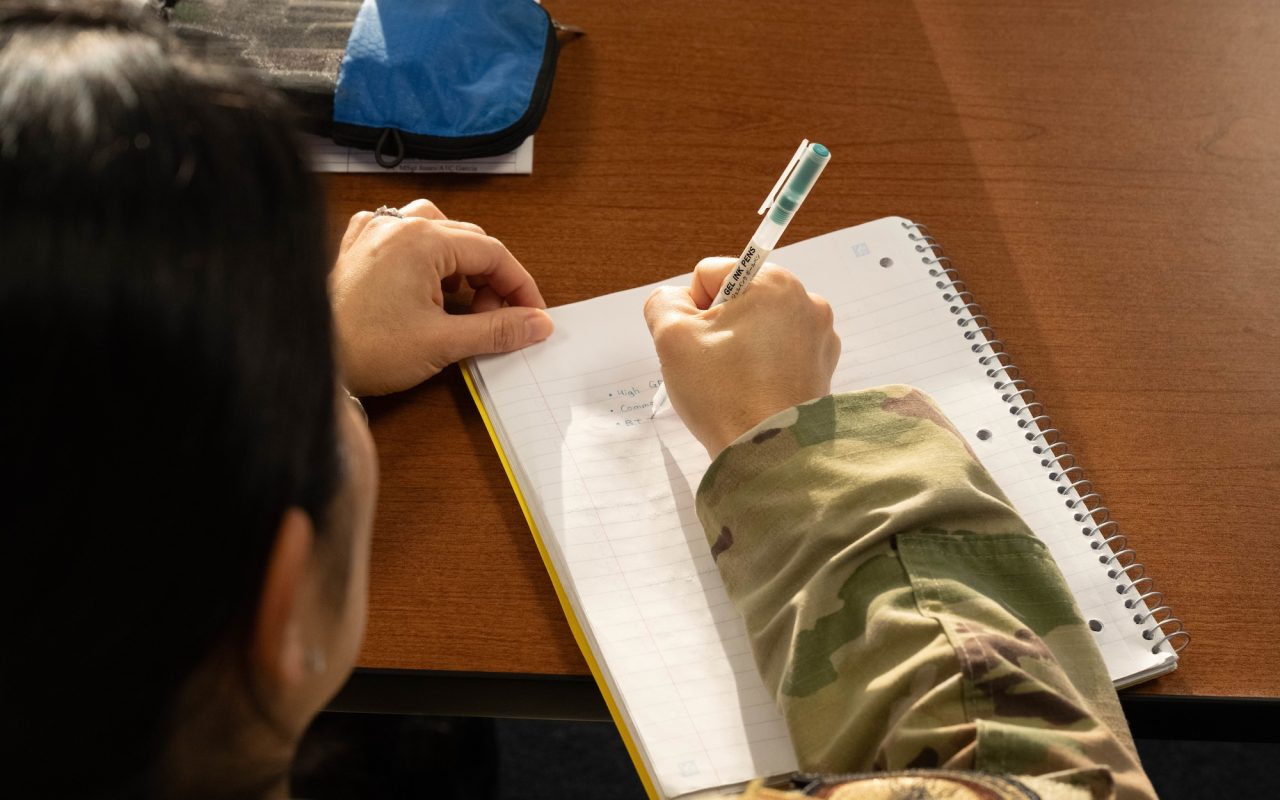
Writing reference sources: Purdue OWL — Paragraphs and Paragraphing, Harvard College Writing Center — Organizing Your Essay, and University of Utah Writing Center — Constructing an Academic Argument. Photo: U.S. Air Force / Airman 1st Class Emma Wright, public domain, January 2026. The photo shows real note-taking during classroom training and illustrates drafting skills; it is not a photograph of the fictional essay prompt.
Sık Sorulan Sorular
What are the five paragraphs in a five-paragraph essay?
One introduction, three body paragraphs that each develop a supporting idea, and one conclusion.
How long should a five-paragraph essay be?
There is no universal word count; follow the assignment's length and evidence requirements. Paragraphs should be long enough to explain and support the point without padding.
Where does the thesis statement go?
Often near the end of the introduction in a basic five-paragraph essay, but exact placement can vary with audience and writing purpose.
Do all essays need five paragraphs?
No. Five paragraphs can help beginners practice organization, but complex arguments often require additional paragraphs or different structures.