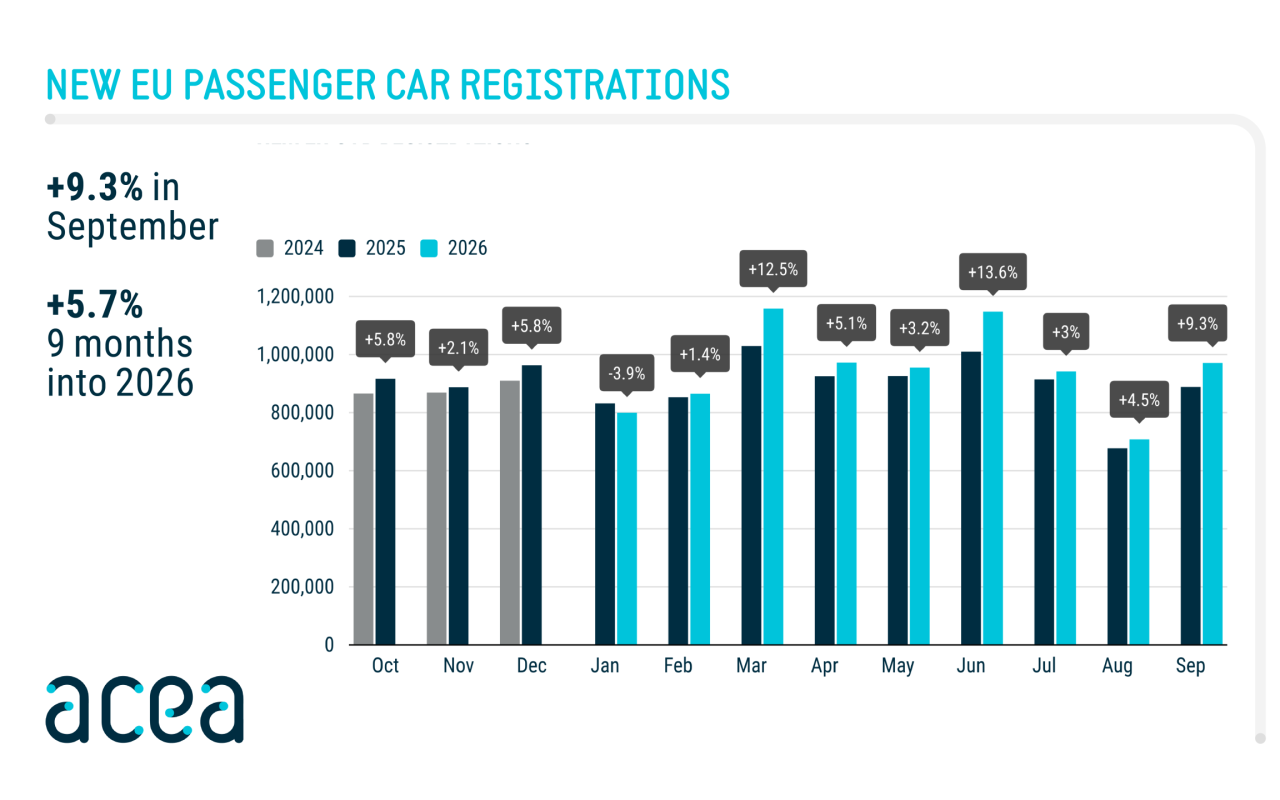
Battery-electric cars accounted for 22.7% of new passenger car registrations in the European Union during the first nine months of 2026, according to figures released by the European Automobile Manufacturers’ Association (ACEA) on 22 October. The share increased from 16.1% during the corresponding period in 2025.
1,931,465 new battery-electric cars registered in the EU
ACEA recorded 1,931,465 new battery-electric passenger car registrations across the EU between January and September 2026. The figure placed fully electric cars ahead of petrol-powered cars by registration volume during the nine-month period. Petrol models accounted for 1,802,078 registrations and a market share of 21.2%.
ACEA described battery-electric cars as the second most popular powertrain category. Non-plug-in hybrid-electric vehicles continued to hold the largest individual share, with 36.3% of the market.
EU car market share by powertrain: January–September 2026
| Powertrain | EU market share | Recorded registrations where reported |
|---|---|---|
| Hybrid-electric (HEV) | 36.3% | 3,090,530 |
| Battery-electric (BEV) | 22.7% | 1,931,465 |
| Petrol | 21.2% | 1,802,078 |
| Plug-in hybrid (PHEV) | 10.1% | 860,257 |
| Diesel | 7.1% | Not specified in this summary |
Figures are for the European Union rather than the larger EU, EFTA and United Kingdom grouping. BEV and plug-in hybrid vehicles are separate categories. Conventional hybrid-electric vehicles do not have to be charged from an external electricity supply.
Electric car growth across European markets
ACEA reported higher battery-electric car registrations in several major markets. For January–September, France recorded growth of 79.1% year on year, Germany grew by 58.1% and Denmark by 40.3%. Belgium registered an increase of 15.7% over the same period.
Across all powertrains, new EU passenger car registrations rose by 5.7% year on year in the first nine months. ACEA said the market continued to experience high energy prices and economic uncertainty alongside demand for electrified cars.
Petrol and diesel shares decline
Petrol-powered car registrations were 19.1% lower in January–September 2026 than in the equivalent period of 2025. Petrol’s market share decreased to 21.2%, from 27.7%. Diesel vehicle registrations fell 19.5% year on year, leaving the category with a 7.1% share, compared with 9.3% a year earlier.
Combined petrol and diesel cars held 28.2% of EU new passenger car registrations over the nine months, down from 36.9% a year earlier.
Plug-in hybrid and conventional hybrid registrations
Plug-in hybrids accounted for 860,257 EU registrations in the first nine months, up 18.6% compared with the same period in 2025, according to ACEA. Their market share rose to 10.1%, versus 9% a year earlier.
Registrations of non-plug-in hybrid-electric cars reached 3,090,530, with demand supported by increases in countries including Italy and Spain. The category retained the highest overall share of the EU passenger car market.
For separate developments in Europe’s public charging market, see Qwello’s October 2026 EV charging investment announcement.
Registration figures: ACEA, 22 October 2026. Featured graphic: ACEA’s September 2026 passenger car registrations release.