Quick answer: In the United States, many electric vehicles can charge from a suitable 120-volt household outlet using compatible, manufacturer-approved portable charging equipment. This is called AC Level 1 charging. It is usually slower than a dedicated 240 V Level 2 charger, and it is safe only when the outlet, circuit, charging equipment and vehicle meet their instructions and applicable electrical codes. A plug that physically fits is not proof that an old or shared outlet is suitable for hours of EV charging.
The U.S. Department of Energy’s home-charging guidance explains that Level 1 can meet the daily driving needs of many households when an appropriate dedicated branch circuit is available. The U.S. Fire Administration advises using certified equipment, inspecting the electrical installation and avoiding extension cords or multi-plug adapters.
What does charging an EV from a regular outlet mean?
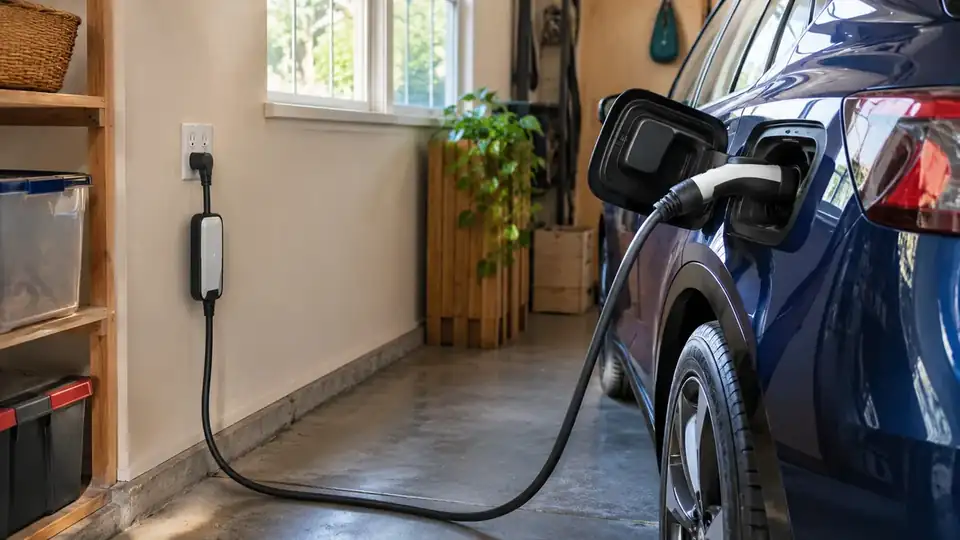
AC Level 1 is a North American charging category based on a nominal 120 V supply. The portable charging cable assembly, technically electric vehicle supply equipment (EVSE), manages safety functions and communicates charging limits to the car. The vehicle’s onboard charger converts AC electricity into the DC electricity stored in its traction battery. The correct plug, outlet, electrical protection and EV inlet vary by manufacturer and market.
Important regional distinction: An ordinary outlet in many European markets supplies approximately 230 V. That does not make it a U.S. 120 V Level 1 circuit. Portable charging rules, socket types, current limits and required protection vary by country. Never apply North American outlet or amperage instructions to a different electrical system.
How fast is Level 1 charging in real life?
The DOE’s EV consumer guide gives a broad order of magnitude of about 2 to 5 miles of range per hour for Level 1, depending on the car and charging conditions. That is a planning range, not a guaranteed charging speed. A vehicle with high highway energy consumption gains fewer miles per hour than a more efficient one at the same charging power.
Worked example: 120 V, 12 A and a 10-hour night
For an illustrative electrical calculation only, assume the vehicle and a properly assessed circuit permit an actual continuous current of 12 A at 120 V. Nominal charging input power would be 120 V × 12 A = 1,440 W = 1.44 kW. Over ten hours, that represents a maximum simplified estimate of 14.4 kWh purchased (1.44 × 10), before variability and losses. If an example system delivered 85% of that energy into the battery, the battery would gain about 12.24 kWh. Efficiency is not a universal 85%: real results depend on temperature, the charger and the car.
| Illustrative 120 V setting | Nominal input power | Input energy over 8 hours | Battery energy if example efficiency is 85% |
|---|---|---|---|
| 8 A | 0.96 kW | 7.68 kWh | 6.53 kWh |
| 12 A | 1.44 kW | 11.52 kWh | 9.79 kWh |
These rows are not electrical installation recommendations. Never select a charging current based only on this table. The vehicle, portable EVSE and qualified electrician must establish the permissible setting for the particular circuit. For how kW, kWh and state of charge influence time, see our EV charging-time calculation guide.
Can Level 1 charging cover your daily commute?
The relevant question is not “Can it fill my entire battery overnight?” but “Does it replace the energy I normally use each day?” Suppose a hypothetical driver covers 25 miles a day and their car uses 0.30 kWh of battery energy per mile. They need roughly 7.5 kWh returned to the battery after that day’s driving. Assuming 85% charging efficiency, the grid would need to supply approximately 8.8 kWh. A nominal 1.44 kW input would take around 6.1 hours in a simplified constant-power model. Cold weather, battery management, charging interruptions and vehicle limits can change the result.
For longer daily commutes, a larger battery, frequent road trips or a household with limited overnight parking, Level 2 may be more practical. The DOE describes both options in its home-charging overview.
Safety checklist before using a household wall outlet
- Use the exact manufacturer-approved charging equipment. Confirm both ends of the cable suit your vehicle and electrical market, and that the equipment has the required safety certification.
- Have a qualified electrician assess the supply. In particular, verify the receptacle, wiring condition, protection devices, circuit rating and any other connected loads. The U.S. Fire Administration recommends a dedicated circuit for EV charging.
- Plug directly into the suitable outlet. Do not use extension cords, cube taps, multi-plug adapters, power strips or improvised wiring. The official fire-safety instructions explicitly warn against these arrangements.
- Inspect without opening electrical components. If you see damage, scorch marks or discoloration, or notice unusual heat or a burning smell, stop charging when safe and contact a qualified professional.
- Keep cables and connectors protected. Do not place them where vehicles can crush them or where people may trip; comply with the manufacturer’s wet-weather and outdoor-equipment instructions.
- Observe any warning messages. Repeated charging faults or an outlet that trips are reasons to stop and investigate, not to bypass protective devices.
Regular outlet versus a dedicated home EV charger
| Consideration | U.S. 120 V Level 1 | U.S. 240 V Level 2 |
|---|---|---|
| Typical use case | Modest daily driving with long parking periods | Greater energy replacement during a shorter home parking window |
| Electrical supply | Suitable 120 V outlet on an appropriately rated, assessed circuit | Appropriate 240 V equipment and dedicated installation |
| Installation assumption | No new charger installation if an appropriate dedicated circuit already exists | Qualified installation and any required permits |
| Time to add energy | Usually slower | Usually faster, limited by vehicle onboard charger |
| Electricity cost | Metered kWh multiplied by the tariff, plus other charges | The same billing principle; equipment efficiency and tariff may differ |
A faster charger is not automatically billed at a higher price per kWh. Your utility tariff, taxes, household consumption and charging losses matter. See our EV charging-cost calculation guide for examples.
Can you charge overnight or in the rain?
Home overnight charging is a common EV use case when equipment and electrical installation are approved and operated as instructed. Outdoor charging likewise requires suitable weather-rated equipment and the correct installation. A cracked plug, compromised outlet, flooding or water-damaged vehicle is not an ordinary rain-charging situation. Read our separate EV charging-in-rain safety guide for those distinctions.
What if you live in an apartment or share a garage?
Do not assume an outlet in a communal garage is available for personal charging, electrically appropriate or separately metered. Confirm property permission, fire-safety rules, circuit suitability and who pays for electricity. Shared AC chargers or permitted workplace/public charging may be safer and easier to administer; our apartment EV charging guide explains alternatives.
When a regular outlet is not a good EV charging solution
Choose professional assessment or an alternative charger if the wiring is old or unknown, the receptacle shows wear, charging repeatedly trips a breaker, the vehicle cannot replenish enough energy between trips, or the manufacturer disallows the proposed outlet/equipment combination. Do not increase current, replace circuit protection with a higher rating, or modify an adapter as a workaround. For unexplained sessions that fail to start, see our safe EV charging troubleshooting guide.
Bottom line
Yes, a suitable household outlet can charge many EVs slowly, but outlet safety must be verified—not guessed. Level 1 works best where daily mileage is modest and charging can run for many hours. Use approved portable charging equipment, correct electrical protection and manufacturer guidance. For larger daily energy requirements, ask an electrician about a properly installed Level 2 charger.
Editorial method: U.S. voltage categories and consumer charging figures come from U.S. DOE publications; safety advice follows the U.S. Fire Administration. All power and time calculations are explicitly illustrative, not specifications for a particular vehicle, socket or country.
Sık Sorulan Sorular
Can I plug an electric car into a normal wall outlet?
In North America many EVs can charge from an appropriate 120V outlet using compatible manufacturer-approved Level 1 equipment, provided the circuit and socket meet the electrical and safety requirements.
How long does it take to charge an EV from a standard outlet?
Level 1 charging is comparatively slow; the U.S. DOE provides a typical order of magnitude of about 2–5 miles of range added per hour, but the actual rate depends on the EV and installation.
Can I use an extension cord to charge my electric car?
The U.S. Fire Administration advises plugging Level 1 charging equipment directly into a suitable outlet and never using an extension cord or multi-plug adapter.
Is every household outlet safe for overnight EV charging?
No. The outlet, wiring, circuit and protective equipment must be suitable for prolonged charging, and the manufacturer’s instructions and local codes must be met. Have an electrician evaluate uncertain installations.