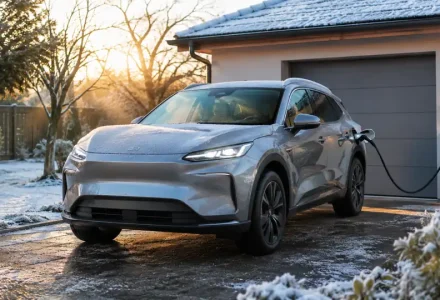
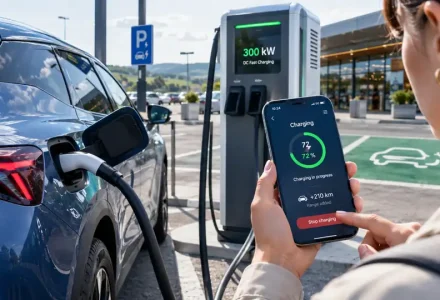
Quick answer: To plan an electric-car road trip, choose chargers compatible with your vehicle, estimate the energy needed for each leg using realistic highway consumption, and keep a sensible arrival reserve with a backup charger in mind. Do not plan the route from the dashboard’s advertised full-charge range alone. Check connector type, charge-station access, operating status, payment method and weather before leaving. A reliable itinerary is built around energy, not simply distance.
The US Department of Energy’s consumer EV guidance specifically recommends checking whether public stations along a proposed route are compatible and whether the vehicle can reach the next station under expected conditions. DOE also identifies hills, heavy loads, heating and air conditioning as factors that can change range. This guide turns those principles into a step-by-step planning method for routes in miles or kilometers.
Electric car road trip checklist: what to know before leaving
- Your vehicle’s usable battery capacity, if specified (kWh).
- Expected highway electricity use at your chosen speed (kWh/100 km or kWh/100 miles), ideally from previous similar trips.
- Initial battery state of charge (SOC), target SOC after each stop and an arrival reserve that suits the route.
- The car’s DC fast-charging connector, maximum supported rate and any preconditioning feature.
- Alternative compatible public chargers along each leg, including any membership, payment or access requirements.
- Weather, elevation, traffic, passengers, luggage, towing and charging-network availability.
If you are unsure about charging connectors, start with the vehicle manual rather than assuming a station of the same brand will work. For charging duration fundamentals, see our EV charging time guide (kW versus kWh).
How to calculate the battery energy for each leg
The core metric is electricity consumption. For a distance measured in kilometers, use required battery energy (kWh) = distance (km) × expected consumption (kWh/100 km) ÷ 100. For miles, use the matching kWh/100 miles number instead. Check whether your source measures battery energy during driving or electricity purchased from a charger: these are different values because charging has losses.
Example: An illustrative EV averages 22 kWh/100 km at highway speed. For a 180 km leg, driving energy is 180 × 22 ÷ 100 = 39.6 kWh. The exact consumption rate here is a hypothetical planning input, not an EPA rating or a measured claim about any particular model.
How much battery reserve should you leave at a charger?
There is no single safe reserve percentage for every journey. A remote winter highway with long gaps between reliable chargers deserves more margin than a short urban section with multiple backups. First identify the longest stretches without alternatives, then set a reserve that accounts for uncertainty. The following 15% reserve is an example assumption only—not a universal minimum or manufacturer recommendation.
Worked road-trip example: 70 kWh usable battery, starting at 80%
Suppose a hypothetical EV has a 70 kWh usable battery, begins a segment at 80% SOC and consumes 22 kWh/100 km. It has 56 kWh stored when departing (70 × 0.80), but a driver intending to arrive with 15% SOC sets aside 10.5 kWh (70 × 0.15). That leaves 45.5 kWh for the drive. At 22 kWh/100 km, the idealized planning distance between those SOC levels is 45.5 ÷ 22 × 100 ≈ 207 km. This is an arithmetic scenario, not a guaranteed safe driving range.
| Leg distance | Energy used at 22 kWh/100 km | Battery used as % of 70 kWh | Estimated arrival SOC from 80% |
|---|---|---|---|
| 150 km | 33.0 kWh | 47.1% | 32.9% |
| 180 km | 39.6 kWh | 56.6% | 23.4% |
| 210 km | 46.2 kWh | 66.0% | 14.0% |
In this example, the 210 km leg would fall below the hypothetical 15% arrival target even before allowing for unexpected headwinds or diversion. The sensible response is to choose an earlier charger, start with more energy, reduce expected consumption or increase available alternatives, not to assume the range display will prove accurate.
Where to find compatible EV chargers along a route
In the United States, the official DOE Alternative Fueling Station Locator lets drivers find charging sites by location and along routes. Its documentation describes route-search and filtering tools. For other countries, use official operator maps, vehicle navigation and local public infrastructure listings to verify compatibility. A map entry is not a guarantee that a connector is free, operating or accessible to your particular vehicle.
What to verify at every planned stop
| Check | Why it matters |
|---|---|
| Connector type and vehicle compatibility | DC connectors are not universally interchangeable |
| Public access and opening hours | Some chargers are behind gates, at hotels or limited to guests |
| Current status and available stalls | A mapped charger may be occupied, unavailable or out of service |
| Payment and roaming | Network access, apps, cards and fees vary |
| Charging power and your car’s DC limit | Headline station power does not guarantee actual vehicle power |
| Backup station within reach | Provides a practical contingency for an unplanned stop |
DOE’s charging-network definitions explain that a network provider may supply live status, payment and session control, but not every station uses the same system. Before you leave, recheck the charging operator’s information and keep a second option on each remote stretch.
Should you charge to 80% or 100% on the road?
Many battery-electric vehicles can charge quickly through part of their SOC range and then reduce power as SOC rises, although the charging curve varies significantly by vehicle, battery temperature, charger and software. 80% is a common route-planning reference, not a fixed charging rule. You may need more energy for the next remote section or your vehicle may behave differently. Compare the extra time spent charging against the ability to reach an earlier compatible stop. For winter charging preparation, see our EV battery preconditioning guide.
Six road-trip problems and the best response
- The predicted range falls faster than expected: review the actual energy use and distance remaining, slow to a safe legal speed if suitable, and plan an earlier charging stop.
- Highway speed or headwind increases demand: treat consumption data from calm city driving as insufficient for a fast highway leg.
- The planned charger does not work: use your prepared alternative before SOC falls too low to divert safely.
- Charging power is lower than the station’s headline kW: look at SOC, temperature, vehicle limits and the charger’s actual delivered power before concluding that either is defective.
- Payment fails: check the operator’s posted methods and available support rather than disconnecting cables incorrectly or using an unapproved adapter.
- The destination has no reliable charger: plan enough energy to reach a public charger after arrival, or confirm the hotel’s actual access rules in advance.
For accommodation-specific questions, see our guide to booking hotels with EV charging.
How to estimate the charging cost of a road trip
For each charging stop, multiply the electricity billed by the station (kWh) by the displayed rate and add any required connection, parking, idle or subscription charges. That is different from multiplying battery capacity by the rate. To compare journey options, also budget charging time, parking restrictions and possible delays. Currency and tariff examples should use the operator’s current local prices, not a worldwide average.
A practical 10-minute pre-departure checklist
- Confirm your initial SOC and the first compatible charging stop.
- Read the latest route and traffic conditions.
- Check weather and consider any cold-weather or towing range penalty.
- Verify the primary and backup charge stations’ current listings.
- Check the vehicle manufacturer’s cable, adapter and charging-network compatibility instructions.
- Bring charging accounts or accepted payment methods and maintain enough phone power for navigation.
- Review safety warnings and the vehicle recovery section in the owner’s manual.
- Keep flexibility in stop timing rather than driving to a predicted zero-charge arrival.
Bottom line
A stress-reducing EV road trip is not about squeezing the highest number of miles from one charge. It is about planning manageable charging legs, monitoring real consumption, verifying charger access and preserving alternatives. Use vehicle-specific navigation when it is available, but cross-check the route and stations before departure.
Editorial methodology: All numerical values are explicitly hypothetical, with arithmetic shown so readers can substitute their own battery capacity, efficiency and desired reserve. Charging access and station status must be checked close to departure. Technical principles and US locator capabilities were verified against official DOE sources.
Sık Sorulan Sorular
How do I calculate how much battery an EV road trip uses?
Multiply leg distance by a realistic energy-consumption figure in matching units (kWh/100 km or kWh/100 miles), then divide by 100. Compare the result with usable battery energy and your chosen arrival reserve.
Should I always charge to 80% on an EV road trip?
No. The best departure state of charge depends on charging speed, battery limits, next-leg distance, station availability and route reserve. Follow vehicle guidance and plan for the route.
Can I use the car's advertised range to select chargers?
Use the advertised rating as background, not a guarantee. Adjust using your actual highway energy consumption and expected conditions such as weather, elevation and luggage.
What if my planned public charger is out of service?
Check current operator status when possible, keep a compatible backup stop that remains reachable with your reserve, and reroute early if the primary station is unavailable.