Key facts
- 2026 U.S. EPA ranges for long-range RWD are 318 miles (IONIQ 5) and 319 miles (EV6).
- Matched AWD with 19-inch wheels are rated 290 and 295 miles; selected 20-inch AWD variants 269 and 270 miles.
- The review compares published EPA and maker data, not firsthand range or charging tests.
Quick answer: For U.S. model-year 2026, the Hyundai IONIQ 5 and Kia EV6 are remarkably close in official EPA efficiency when equivalent powertrains and wheel sizes are compared. Their long-range rear-wheel-drive versions are rated at 318 and 319 miles, respectively. With 19-inch wheels and all-wheel drive, the figures are 290 and 295 miles; on selected 20-inch AWD configurations they are 269 and 270 miles. This article is a documented specification and EPA-data comparison, not a claimed hands-on road test.
The meaningful decision goes beyond a one-to-five-mile difference: buyers should compare their exact trim, charging hardware, available charger networks, driving conditions, tyres and recurring electricity costs. We checked the government’s 2026 electric-vehicle listings, Hyundai’s U.S. specification page and Kia’s U.S. specification page as of November 11, 2026.
2026 IONIQ 5 vs Kia EV6: verified EPA comparison
| Configuration | 2026 Hyundai IONIQ 5 | 2026 Kia EV6 |
|---|---|---|
| Long-range RWD, EPA combined range | 318 miles | 319 miles |
| Long-range RWD, EPA combined energy use | 30 kWh/100 miles | 30 kWh/100 miles |
| AWD with 19-inch wheels, EPA range | 290 miles | 295 miles |
| AWD with 19-inch wheels, energy use | 32 kWh/100 miles | 32 kWh/100 miles |
| AWD with 20-inch wheels, EPA range | 269 miles | 270 miles |
| AWD with 20-inch wheels, energy use | 34 kWh/100 miles | 35 kWh/100 miles |
Where these numbers come from: U.S. government IONIQ 5 RWD, IONIQ 5 AWD on 19-inch wheels, IONIQ 5 AWD on 20-inch wheels and the 2026 Kia EPA listing. Kia also lists the 319-, 295- and 270-mile figures for the respective EV6 configurations. The manufacturer’s published figures and the government database are used here as specifications, not as results of our own testing.
Why the wheel and drivetrain labels matter
A comparison between a 319-mile EV6 Long Range RWD and a 269-mile IONIQ 5 AWD on 20-inch wheels would be a poor way to judge either vehicle. It mixes different drivetrains and configurations. A consistent comparison uses RWD against RWD or AWD with similar wheel packages against AWD with similar wheel packages.
The published results also illustrate why an advert saying up to 319 miles should not be interpreted as the range of every EV6 or every IONIQ 5. AWD models have additional propulsion hardware, and equipment and wheel-and-tyre packages may alter certified consumption. It would be misleading to attribute every range difference exclusively to wheel diameter; a complete causal comparison would require controlled tests holding other factors constant.
The EPA’s explanation of real-world mileage variation warns that driving style, weather, road conditions and other factors change results. In practical terms, a regular 70-mph interstate journey or a freezing morning can produce a different result from the standardized combined estimate.
Charging: why the 350-kW sign alone does not choose a winner
Both manufacturers advertise rapid DC charging capabilities, but the number on a charging-station cabinet is a ceiling for the equipment, not a promise of constant power into the battery. For the 2026 IONIQ 5, Hyundai publishes an approximately 20-minute 10%-to-80% charge with a compatible higher-power 800-volt CCS-equipped charger using its CCS adapter, and around 30 minutes in the manufacturer’s specified 150-kW, 400-volt NACS scenario for the long-range battery. For the 2026 EV6, Kia lists approximately 20 minutes from 10% to 80% at a compatible 350-kW DC charger, and around 29 minutes with its specified 150-kW equipment on long-range variants. Charging conditions and trim can change results. Hyundai source; Kia source.
Owners should check the connector used by the actual car, whether the necessary manufacturer-approved adapter is supplied, the site’s electrical voltage and network access, and whether battery conditioning was completed before arrival. These factors may affect a roadside charging stop more than a one-mile EPA difference. For a full explanation, visit our Charging & Batteries section and the EV Technology section.
Electricity cost: an apples-to-apples example
Using the EPA combined kWh/100-mile values and a purely illustrative $0.20 per kWh household tariff provides a useful same-basis arithmetic comparison. It is not a local electricity quote or a forecast of what an individual will pay.
| EPA vehicle configuration | EPA kWh/100 miles | Example cost |
|---|---|---|
| IONIQ 5 or EV6 long-range RWD | 30 | $6.00 |
| IONIQ 5 or EV6 AWD, 19-inch wheels | 32 | $6.40 |
| IONIQ 5 AWD, 20-inch wheels | 34 | $6.80 |
| EV6 AWD, 20-inch wheels | 35 | $7.00 |
For example, the EPA-rated 19-inch AWD configurations have identical listed combined energy use at 32 kWh per 100 miles. Different real trips, charging tariffs, climate control and wheel choices can still change expenses. If a public DC charger charges more than your home’s off-peak electricity rate, model the trip separately. Our home charging cost guide explains how to enter the tariff you actually pay.
What the EPA numbers do not tell you
Highway-only range: The combined EPA estimate blends test conditions. It is not a guarantee of an interstate trip at a fixed speed. Compare the EPA city and highway figures, but do not assume either is an identical real-road result.
Winter charging experience: Temperature affects both range and a battery’s ability to accept power. On supported vehicles, route-based battery conditioning can help the vehicle approach a charging stop at a suitable temperature. U.S. Department of Energy winter guidance recommends conditioning while plugged in where possible.
Cabin practicality: Rear-seat access, driving position, cargo shape and child-seat installation cannot be ranked from EPA data. Visit a dealer, try the seat and the actual luggage you carry, and measure space yourself rather than relying on an imagined hands-on test in this article.
Charging-network access: Both North American charging networks and vehicle charging ports have been changing. Confirm vehicle software support, accessible sites, connector types and adapter approval using current manufacturer instructions. A matching-shaped plug is not sufficient proof that every stall is open to a given vehicle.
Practical 2026 buyer scenarios
If you drive 40 miles a day and can charge at home
Both long-range RWD configurations have substantially more EPA-rated range than a 40-mile daily round trip. Focus on the equipment you actually need, charge access, purchase pricing, insurance quotes, warranty terms and seating comfort. Because long-range RWD energy use is rated equally at 30 kWh/100 miles, neither model has a stated combined EPA efficiency advantage in that exact comparison.
If you take frequent long-distance highway trips
Plan around reliable charging sites rather than the nominal single-charge range alone. Confirm plug compatibility, whether an adapter is required at your chosen site, charging speed under the equipment available and an alternate station if the first choice is occupied. Manufacturers’ fastest-charge marketing figures depend on test conditions and should not be inserted into travel itineraries as guaranteed stop times.
If you want AWD and larger wheels
Compare like-for-like configurations. The 19-inch AWD IONIQ 5 and EV6 differ by five EPA miles; their 20-inch AWD counterparts differ by one EPA mile. Those small official differences should not substitute for checking exact tyres, availability and dealer quotations. If traction in cold weather is important, appropriate tyres and driving conditions remain critical.
Seven checks before you sign for either vehicle
- Record the exact vehicle model year, drivetrain, trim, wheel size and EPA label; do not rely on the manufacturer’s highest advertised range.
- Ask for written figures for the specific VIN, including destination, taxes, dealer charges and available equipment.
- Check home outlet and electrical installation requirements with a qualified electrician; verify the current vehicle manual.
- Map your most frequent charging routes using the vehicle’s port type and a backup station.
- Confirm any required CCS/NACS adapter is manufacturer-approved and rated for the intended AC or DC use.
- Compare battery warranty terms and official service coverage, not anecdotal assumptions about failure rates.
- Arrange a real test drive of each actual configuration: seating, visibility, controls and ride quality cannot be established by published specs alone.
Frequently asked questions
Which has the longer EPA range in 2026, IONIQ 5 or EV6?
In the matched U.S. long-range RWD figures, EV6 is rated at 319 miles and IONIQ 5 at 318. The EV6 is rated five miles higher in the 19-inch AWD configurations and one mile higher in the 20-inch AWD configurations.
Do both 2026 models support fast DC charging?
Yes. Both makers publish fast-charge specifications, but actual speed depends on charger power and voltage, current battery charge, battery temperature and the compatible connector and adapter setup.
Do these figures come from real-world road testing?
No. They are standardized EPA estimates and manufacturer specifications. This comparison does not imply we drove or independently charge-tested either model.
Can either model always charge in 20 minutes?
No. Approximately 20 minutes is a manufacturer-stated 10%-to-80% capability under specified high-power DC charging conditions, not an all-conditions guarantee and not a time to reach 100%.
Are these U.S. ranges valid for cars sold in Europe or Turkey?
No automatic equivalence should be assumed. Other markets may have different configurations and WLTP or local homologation figures. Compare the official figures for the actual market of purchase.
Sources and editorial methodology
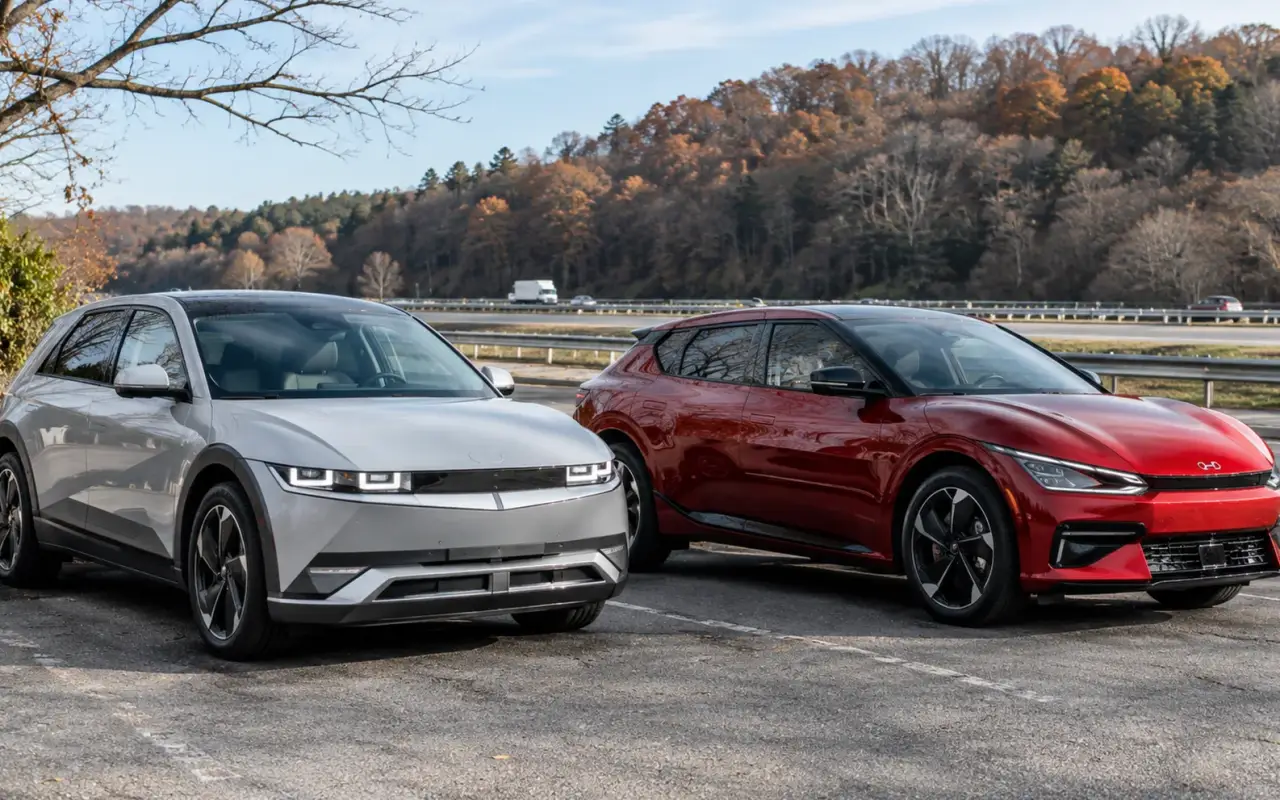
Primary documents: U.S. DOE/EPA 2026 electric cars list; IONIQ 5 AWD EPA entry; EV6 AWD EPA entry; Hyundai 2026 specifications; Kia 2026 specifications. No first-person drive impressions, measured acceleration, independently recorded charge curves or invented customer quotes are presented. The cover image is an original AI-generated photorealistic editorial representation, not evidence of a real comparison test. For further comparisons see Reviews & Tests and New Models. Reviewed November 11, 2026.