

Key facts
- Level 1 EV charging uses suitable 120-volt household equipment but requires a safe, compatible electrical installation.
- A ten-hour 120 V x 12 A calculation yields 14.4 kWh of wall energy before losses, only as an illustrative power example.
- Charging extension cords, damaged outlets and unverified electrical circuits can create risks and should not be improvised.
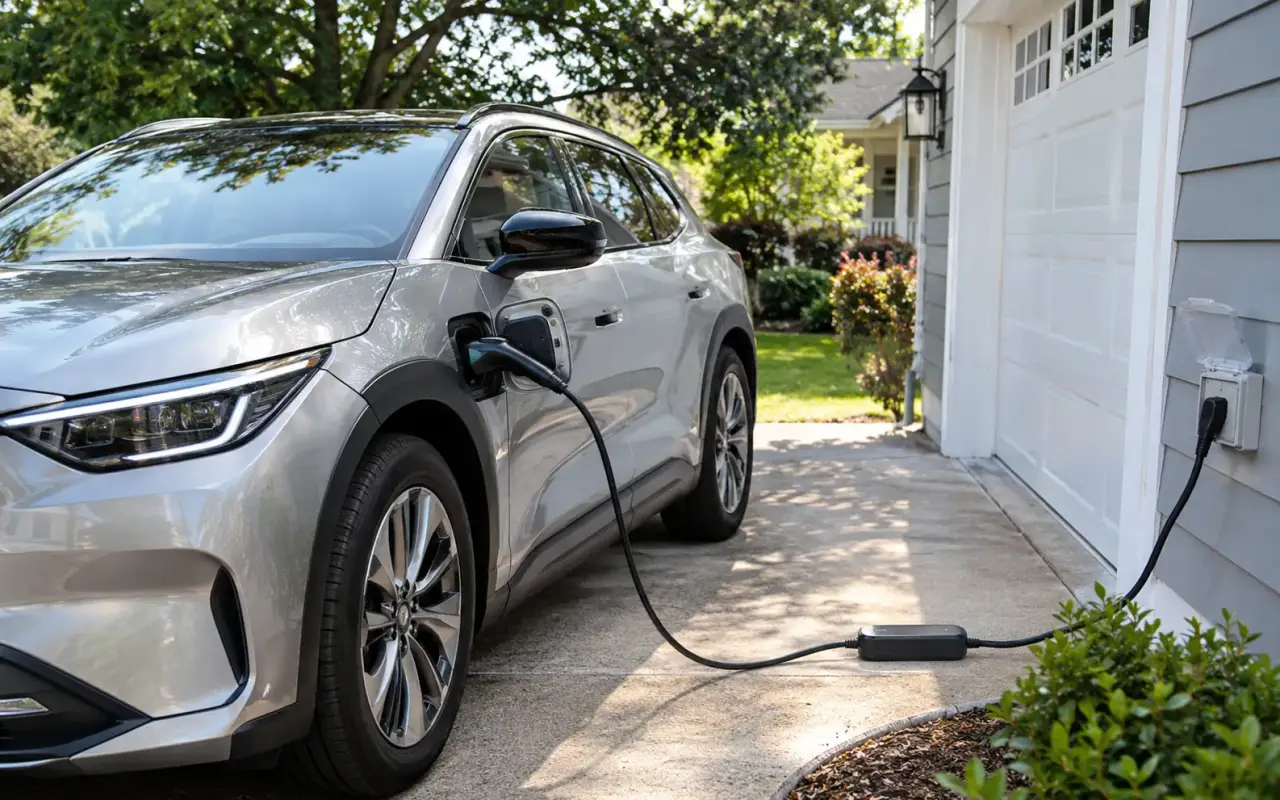
Quick answer: Yes. Many electric vehicles can charge from a suitable standard U.S. 120-volt household outlet using manufacturer-approved Level 1 charging equipment. But an outlet that physically accepts the plug is not automatically safe for hours of EV charging. Verify the circuit, receptacle condition, equipment rating, outdoor protection and manufacturer instructions before using it.
Level 1 charging can suit short daily drives when the car spends many hours parked. It is not a substitute for a qualified electrician’s inspection of an uncertain electrical installation, and it is usually much slower than a properly installed 240-volt Level 2 system. This guide separates what a driver can calculate from what only an electrical professional can assess.
What does Level 1 charging actually mean?
Level 1 charging uses alternating-current electricity from a compatible 120-volt supply and an electric-vehicle supply equipment (EVSE) cordset. The EVSE controls the charging connection between the source and the vehicle. The U.S. Department of Energy Alternative Fuels Data Center (AFDC) describes Level 1 as commonly using a standard household receptacle, with charging rate depending on the vehicle and equipment.
It is the same general charging category used by many portable charging products. The vehicle still controls how much power it accepts. A familiar household plug on one end does not mean that any old receptacle, extension cord or adaptor is appropriate.
How much charge can a 120V outlet add overnight?
The power calculation is volts × amperes ÷ 1,000 = kilowatts. Multiply kilowatts by hours to estimate electricity drawn at that power. Actual vehicle charging power can be lower, and energy stored in the battery is less than wall energy because of losses.
| Hypothetical supply | Wall power | Grid energy over 10 hours | Battery gain at an illustrative 90% efficiency |
|---|---|---|---|
| 120 V × 8 A | 0.96 kW | 9.6 kWh | 8.64 kWh |
| 120 V × 12 A | 1.44 kW | 14.4 kWh | 12.96 kWh |
Illustrative range example: At an assumed 3.0 battery-side miles per kWh, 12.96 kWh could support roughly 39 miles of travel. This is not a measured result for any particular vehicle. The vehicle, temperature, accessory energy, charger and utility supply all matter. AFDC gives a broad consumer-level indication of roughly 2–5 miles of range per charging hour for Level 1, not a guaranteed rate. See AFDC’s EV consumer guide.
Safety note: The 8 A and 12 A figures above are mathematics examples, not instructions to set a charger to those currents. The safe operating limit depends on the circuit, protection, receptacle, cordset and local rules and must be established from the equipment instructions and a qualified professional’s evaluation.
Seven safety checks before using an ordinary household outlet
- Ask whether the branch circuit is suitable. EV charging is a long-duration load. A qualified electrician should verify circuit rating, breaker, wire, connections, and whether other significant appliances share the circuit. DOE guidance specifically discusses an appropriate dedicated circuit for home Level 1 charging.
- Inspect the receptacle professionally if uncertain. A loose plug, discoloration, excessive warmth, cracks, a damaged faceplate or unexplained breaker trips are reasons to stop and have it evaluated. Do not try to repair the electrical system yourself.
- Use a vehicle-compatible, safety-certified EVSE. Follow the automaker and EVSE manufacturer instructions. Look for equipment evaluated by a nationally recognized testing laboratory and intended for the installation environment.
- Avoid ordinary extension cords, power strips and improvised adapters. Do not try to extend the reach of a charging cable with a household extension cord or multi-outlet strip. If the outlet is too far from the parking spot, ask an electrician about a code-compliant solution instead.
- Keep outdoor installations suitable for outdoor use. Verify appropriate weather-rated equipment, receptacle enclosure and protection. Outdoor residential charging is possible with properly rated equipment; it does not justify placing indoor-only equipment in rain or snow.
- Protect the cable path. Avoid driveways where vehicles could run over the cord, closing garage doors on cables, pedestrian trip hazards and locations where plugs or connections may be exposed to damage.
- Stop when an abnormal condition appears. Overheating, unusual smells, visible arcing, repeated fault messages or breaker trips mean stop charging and contact the appropriate professional or equipment manufacturer. Never bypass a protective feature to finish a charge.
The DOE home-charging guidance recommends suitable equipment and professional electrical review. Its workplace Level 1 guidance also emphasizes applicable electrical codes, good receptacle condition, dedicated breakers and outdoor shock protection; residential requirements must be assessed for the actual location.
Is Level 1 enough for your commute? A decision test
Start with energy use, not battery size. A large battery does not necessarily require you to refill it every night.
- Measure your typical daily distance for at least a normal working week, including errands.
- Read your vehicle’s consumption in miles per kWh or kWh per 100 miles, and note the season.
- Estimate battery energy needed. Example: 28 miles ÷ an illustrative 3.5 miles/kWh = 8 kWh.
- Calculate available overnight battery energy from your equipment’s actual safe power and time, allowing for losses.
- Include a margin for occasional long trips, winter efficiency changes and evenings when you cannot charge.
Example comparison: If a typical weekday uses 8 kWh from the battery and your reviewed Level 1 arrangement can replenish about 9 kWh overnight under the conditions that apply, the weekday energy balance may work. If you routinely use 20 kWh and replenish much less than that, the deficit accumulates across the week; Level 2 or supplemental public charging becomes more practical.
Cost: the outlet is not the electricity tariff
Level 1 and Level 2 do not inherently have different retail energy tariffs. Your utility charges according to your plan, consumption timing and other applicable billing items. Using the hypothetical 120 V × 12 A, 10-hour example above, 14.4 kWh at $0.20/kWh equals $2.88 in energy-only wall consumption. The price and power are example inputs, not a local quote.
For a full bill calculation, visit our home EV charging cost guide. It explains the distinction between energy entering the battery and energy metered by the utility, and why losses must be accounted for only once.
Common mistakes that waste time or create risk
- Confusing an EVSE cordset with a simple wire: EVSE contains communication and protective functions; a random cord is not equivalent.
- Assuming all 120V outlets are identical: outlet age, installation quality, circuit sharing and protection differ.
- Choosing current based only on the outlet shape: suitability is an electrical assessment, not a visual guess.
- Counting ten plugged-in hours as ten hours at maximum power: the vehicle may pause or reduce power for battery management or temperature.
- Equating plug compatibility with safe use: adapters and extension cords can introduce new risks even when connectors fit.
When should you consider Level 2 instead?
Level 2 is worth evaluating if you regularly return home with a large energy deficit, have two EVs, take spontaneous long trips or have limited parking time. You may also choose Level 2 for convenience even when Level 1 technically covers the commute. But installation expense can be significant when electrical service upgrades, long wiring routes or permits are needed.
Before spending money, ask a licensed electrician for the possible equipment configurations and a written estimate, and check local utility time-of-use plans. For plug compatibility and the difference between AC and DC charging, see our U.S. EV charging connector guide. If your parking is controlled by a landlord or condominium association, read our apartment and condo charging guide first.
What if I need to charge at a rental property?
Do not assume that access to a parking space gives permission to use an unrelated electrical outlet. Ask the owner or property manager who supplies and pays for the electricity, whether an outlet is approved for vehicle charging and how long-term parking and cable routing are handled. For multi-unit buildings, a shared charging plan may be more suitable than an informal personal connection.
Frequently asked questions
Can I plug a modern EV into a regular U.S. wall outlet?
Many can, using an approved Level 1 cordset and an electrical supply suitable for prolonged EV charging. Verify the exact vehicle and charging equipment instructions and the circuit before doing so.
Is using an extension cord acceptable?
Ordinary household extension cords and power strips should not be used to charge an EV. Follow your EVSE manufacturer’s instructions and consult a professional when an outlet is out of reach.
How far can Level 1 charging get me overnight?
It depends on safe available charging power, time, losses and vehicle consumption. AFDC describes a broad 2–5 miles per charging hour range, but your own result may differ.
Is it safe to charge outside in the rain?
Properly installed, outdoor-rated charging equipment is designed for outdoor conditions. This does not make a damaged outlet, indoor-rated EVSE or unsafe cable routing acceptable.
Will a standard outlet charge a fully empty long-range EV overnight?
Generally not for a large battery. Level 1 is more naturally suited to replacing typical daily energy use than to rapidly replenishing a nearly depleted large pack.
Sources and method: Electrical safety recommendations are based on U.S. DOE AFDC consumer, home-charging and workplace-charging materials. The voltage, amperage, efficiency, range and price examples are explicitly hypothetical calculations, not individualized electrical approval or charging guarantees. This guide is educational and does not replace a licensed electrician’s assessment.
Continue exploring EV Guides and Charging & Batteries.

1 comment
Comments are closed on this article.