Key facts
- Apartment charging plans depend on parking rights, electrical service, access rules, billing and management responsibilities.
- A public charging listing does not guarantee an available or working port when the driver arrives.
- Rights and restrictions on installing EV charging equipment vary by state and property type.
Quick answer: You can own or lease an electric vehicle without a personal home charger, but the plan must work for your actual parking, commute, budget and local charging access. For a U.S. apartment renter or condominium owner, the most practical options are an approved shared building charger, workplace charging, dependable nearby public charging, or an individually approved installation in an assigned parking space.
The difficult part is not simply finding a plug. It is knowing whether charging is allowed, reliably available and billed fairly. This decision guide breaks the problem into steps you can take before buying an EV, moving into a building or asking management to install charging equipment.
First, identify your parking situation
The U.S. Department of Energy’s Alternative Fuels Data Center (AFDC) multifamily charging resource highlights electrical service, parking, legal and billing challenges in multi-unit dwellings. The right answer is different for a tenant with street parking and a condo owner who has a deeded parking space.
| Your parking situation | First option to investigate | Key question |
|---|---|---|
| Assigned, private garage space | Approved individual Level 2 charger or suitable Level 1 arrangement | Who can authorize electrical work and billing? |
| Shared residential parking lot | Shared managed Level 2 charging | How will residents reserve spaces and pay for energy? |
| Unassigned or street parking | Workplace, curbside or nearby public charging | Is a compatible charger available when you actually need it? |
| No regular overnight parking | Evaluate the public-charging routine before buying | Is the time, cost and backup plan acceptable? |
Do not assume an ordinary utility outlet in a shared garage is approved for EV charging. The building may not own the receptacle, the circuit may be shared and electricity charges may be allocated to someone else. Our 120V Level 1 home-charging guide explains the necessary electrical safety checks.
Step 1: Calculate the energy you actually need each week
Start with a normal seven-day driving log and calculate approximately how much energy the EV will use. That tells you whether an occasional destination charge is practical or whether you need predictable access several times per week.
Illustrative example: A driver covers 210 miles a week in a vehicle consuming a hypothetical 30 kWh of battery energy per 100 miles. Weekly battery demand is (210 ÷ 100) × 30 = 63 kWh. Public charging equipment and vehicles do not all measure or bill energy at the same point; use the actual station price and its billed kWh rather than blindly applying a home-charging loss percentage.
The energy estimate does not tell you how many visits are needed. Charging power tapers at high states of charge, equipment can be occupied and a station may limit session time. Test your actual travel route and intended vehicle.
Step 2: Check the three charging opportunities in your real routine
Option A: Charging in your building
Ask the manager whether chargers already exist, whether they are for residents only, the current price, any parking or idle fee, and whether a stall is assigned. If charging must be installed, ask who owns the equipment, who pays for operation and maintenance, and how the building handles repair requests. In a shared setup, access control and transparent billing matter as much as installation.
Option B: Workplace charging
An employer may provide Level 1 or Level 2 charging. The DOE’s workplace charging guidance covers program planning and charging policy. Ask whether access is guaranteed or first-come-first-served, whether parking is permitted outside work hours, and how fees are calculated. Do not rely solely on a workplace charger if it frequently fills or your work schedule changes.
Option C: Public charging near home
Search the federal Alternative Fueling Station Locator by location and connector, and verify details in the operator’s live app. Compare at least two independent locations with similar connector compatibility. A map listing is not a promise that a port will be free or working on arrival. See our public charger troubleshooting and backup guide before relying on a single site.
Step 3: Ask the landlord or condo board the right questions
Instead of asking only “Can you install an EV charger?”, provide a proposal that allows management to compare options. For a building with multiple interested residents, a shared program may be easier to justify than repeated one-off projects.
- How many parking spaces are assigned, shared or reserved, and where are the electrical distribution panels?
- Can a qualified contractor conduct a feasibility review of service capacity, wiring routes and the permitting process?
- Would Level 1, shared Level 2 or load-managed Level 2 best match residents’ parking durations and travel demand?
- Who pays for infrastructure, charger hardware, electricity, network service and repairs?
- How are users authenticated and metered, and are fees transparent before a session starts?
- What policies prevent vehicles occupying charging spaces after charging ends without creating unfair or inaccessible rules?
- Who is the contact for maintenance, an equipment fault or a billing dispute?
AFDC provides material specifically for owners, managers, homeowners associations and residents. Building upgrades may also have utility or state incentives, but eligibility changes. Confirm today’s actual program rules and application deadlines with the sponsor before making a financial commitment.
Can a landlord or homeowners association refuse a charger?
There is no single nationwide legal answer. State statutes differ, and rules depend on tenure, parking rights, building ownership and safety requirements. Some states have adopted measures limiting unreasonable barriers in certain multifamily settings; others have narrower or different provisions. Never assume that a rule in one state automatically applies in another.
For example, the AFDC legal database separately summarizes Colorado multifamily EV policies, Maine condominium policies and Washington association policies. These are jurisdiction-specific summaries; consult current state law, building documents and qualified local advice for an actual request.
Step 4: Build a charging budget that includes more than energy
Public charging may cost more than home charging, but there is no one universal national price. Compare the total price shown by the operator, including energy, session, parking and possible idle fees.
| Hypothetical price | Monthly billed electricity | Energy-only cost |
|---|---|---|
| $0.18/kWh | 250 kWh | $45 |
| $0.30/kWh | 250 kWh | $75 |
| $0.50/kWh | 250 kWh | $125 |
These three price inputs are intentionally hypothetical and do not represent any current local provider or a guarantee of charging availability. A network with a lower per-kWh price might be less convenient or impose parking fees. A monthly subscription might reduce energy price but raise total cost if you rarely use it. Use our EV charging electricity-cost calculation guide to distinguish energy delivered, battery energy and billed wall energy.
Step 5: Test a real charging week before committing
Do a dry run using your likely commute and nearby chargers. Visit during the hours you would normally arrive, verify payment and connector compatibility, assess lighting and safety, and record how long the trip to and from the charger actually takes. Do not count a station across a busy highway or inside a restricted parking structure as an easy neighborhood option without checking access rules.
Before buying a car, confirm its exact charging-port standard and network eligibility, including any approved adapter. Our EV connector and charging level explainer separates plug shape from network authorization and charger power.
How to make a building-wide charging proposal stronger
Present the property manager with a short, nontechnical information sheet: number of interested residents, parking occupancy duration, approximate weekly energy needed, potential installation locations, available utility programs, and a request for a professional feasibility study. A sensible proposal considers future residents and accessibility, not only the first vehicle owner.
Shared charging can be managed through scheduling, resident accounts or load management. The building should understand reliability obligations, ongoing service costs, payment handling and what happens when residents move out. Avoid promises of “free installation” unless an actual funding source has confirmed it.
Red flags that mean your plan needs more work
- A charging plan depends on running a cable from an apartment window or across a pedestrian walkway.
- No one can say who owns the outlet, whether the installation is safe or who pays for the electricity.
- Only one public fast charger is available, with no usable alternative route.
- The advertised network price excludes a large recurring garage parking fee.
- Building management approves the idea verbally but not the installation, access, payment or maintenance arrangements.
Frequently asked questions
Can I own an EV if my apartment has no chargers?
Potentially yes, if dependable workplace or nearby public charging fits your mileage, schedule and total cost. Test the routine before committing to the vehicle.
Can my condo association require approval?
Requirements vary by state and property documents. Even where certain installations have statutory protections, reasonable safety, insurance, permitting and billing conditions may apply.
What is the best shared charger for a building?
There is no universal answer. The solution depends on electrical capacity, parking time, resident demand, installation costs and management policies. A qualified contractor should evaluate the site.
What if my apartment parking space is outdoors?
Outdoor-rated equipment can be used in appropriately designed installations. Outdoor cables must be protected and the whole installation must meet applicable electrical codes.
Should I use only public fast charging?
That may work for some drivers, but compare energy cost, travel and waiting time, vehicle charging capability and the availability of a backup site. Regular DC charging is not a substitute for a reliable everyday schedule.
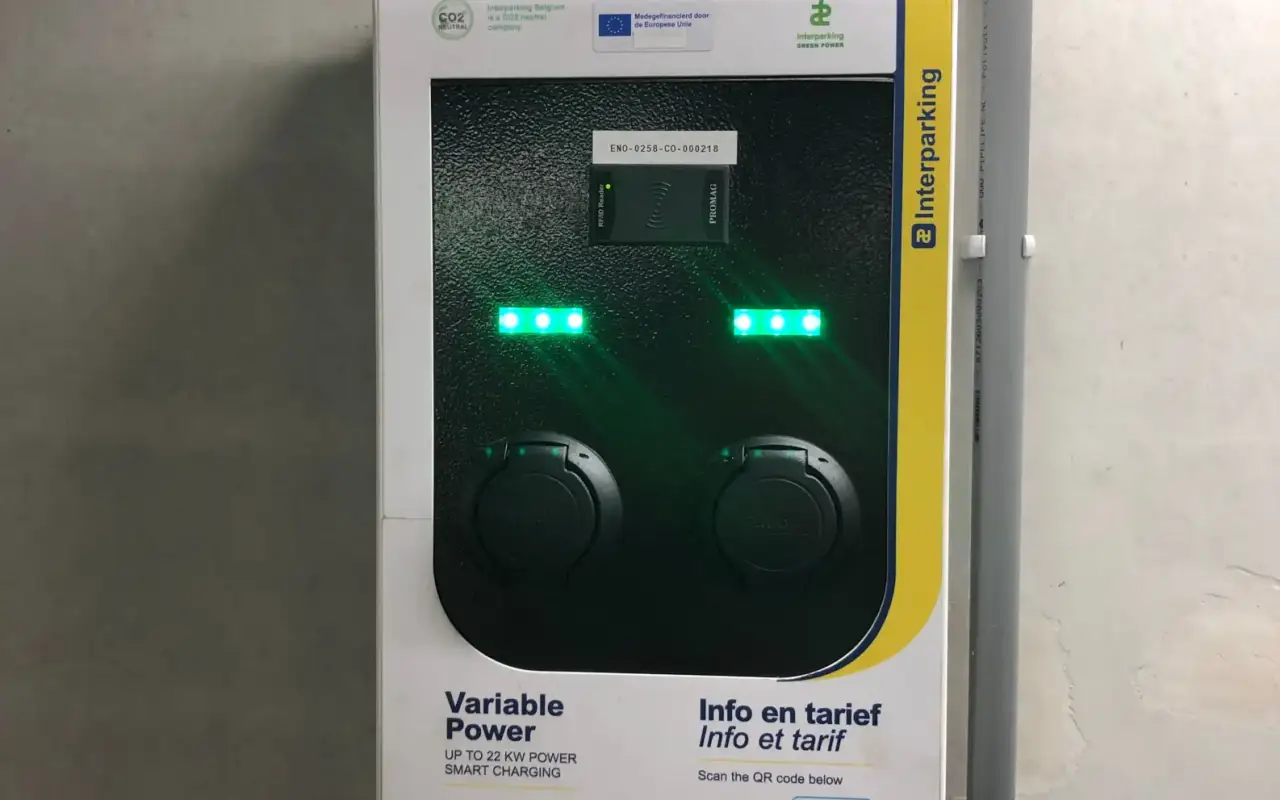
Editorial method: This guide is based on U.S. DOE AFDC multifamily, workplace and EV consumer resources and clearly labeled illustrative budgeting scenarios. It does not claim any state’s charger law applies everywhere or represent hypothetical charges as real network prices. The featured photograph shows charging equipment in an indoor parking garage in Belgium, not a specific U.S. apartment building.
Browse all EV Guides and Charging & Batteries.
Featured image attribution: Alexis Jazz, Wikimedia Commons (2024), WTFPL. Example parking-garage charging equipment; photographed in Antwerp, Belgium. The location is not represented as a U.S. apartment.