To find EV charging stations in Europe, start with the European Commission’s European Alternative Fuels Observatory (EAFO) and its linked TENtec infrastructure map, then verify the specific station with the charging operator before setting off. The official map is useful for checking regional coverage, but a pin on an infrastructure map does not guarantee that a charger is working, unoccupied, compatible with your car or available at the price you expect.
Where is the official European EV charging map?
Visit the European Alternative Fuels Observatory interactive map page. Its TENtec map link is maintained within the European Commission’s transport infrastructure information system. The map covers alternative-fuel infrastructure in EU Member States and neighbouring countries and helps users understand how charging provision relates to major road networks.
Important limitation: The EAFO/TENtec resource is oriented toward infrastructure analysis, not guaranteed real-time consumer navigation. The actual uptime, occupancy, payment method, connection type and tariff of an individual charger should be checked against the operator’s latest public information. A map entry is not a reservation.
How to find a charger for a European EV road trip
- Choose your start, destination and main route. Include realistic highway and city stops rather than relying on a single destination charger.
- Review official infrastructure coverage. Use EAFO/TENtec to see where charging networks and transport corridors have infrastructure.
- Filter by the connector your car actually supports. Check whether you need Type 2 AC, CCS Combo 2 DC or a different manufacturer-supported option.
- Confirm operating information. Check the charge-point operator’s website or app for exact address, opening times, connector count, operational status, access restrictions and whether stalls are occupied.
- Verify how you will pay. Review any ad hoc payment option, card reader, contactless method, QR-based payment or charging account requirements before arrival.
- Save a backup station. Keep at least one alternative on the same portion of the route, particularly before a border crossing or when travelling with children, luggage or in winter.
Some charging facilities are physically located inside paid car parks, garages or motorway service areas. A charging point described as ‘publicly accessible’ does not always mean unrestricted parking access around the clock. Verify opening hours and any additional parking charges.
Type 2 vs. CCS Combo 2: which plug do you need?
| Connector | Typical use in the EU | What the driver should verify |
|---|---|---|
| Type 2 | AC destination, street and parking charging | Vehicle AC port, usable cable, on-board charger power and station access |
| CCS Combo 2 (CCS2) | DC high-power charging on longer journeys | Vehicle’s DC CCS capability, connector availability and charging-power curve |
| Other connector types | May remain available on certain older or specialized vehicles and charging stations | Whether the exact car and station support that plug, without assuming universal compatibility |
EU interoperability rules require Type 2 at covered public AC charging points and CCS Combo 2 for covered DC high-power points. That does not mean every vehicle can charge at every location; individual vehicle ports, older hardware and regional equipment can differ. See the EAFO overview of recharging systems.
Why a 22 kW charger may not give your vehicle 22 kW
A charger rating is an upper limit for the equipment, not a promise of charging power to every car. With AC charging, the vehicle’s onboard charger often determines the maximum it can draw. For example, a car limited to 11 kW AC will not charge at 22 kW simply because the charging post advertises 22 kW. On DC chargers, charging power also varies with the vehicle’s limits, battery temperature, state of charge and other conditions.
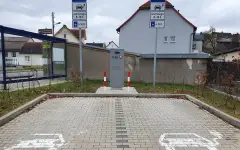
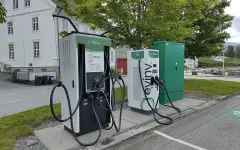
The featured photograph is a real 22 kW charging station, not an illustration of the official EU map or an indication of the station’s current operating status.
Can you charge without an app? What EU AFIR rules actually require
The EU’s Alternative Fuels Infrastructure Regulation (AFIR, Regulation (EU) 2023/1804) sets requirements for publicly accessible infrastructure. For charging points deployed from April 13, 2024, operators must provide ad hoc charging using widely used electronic payment methods. At points rated 50 kW or more, the relevant mechanisms include payment-card readers or contactless devices that can read payment cards. For points below 50 kW, secure internet-based payment methods, including certain QR approaches, may be allowed.
That is not a claim that every European charger, including every older installation or charger outside the EU, already accepts the same credit card. There are separate transition provisions and differences in how specific installations are classified. Consult the official AFIR legal text and the European Commission’s detailed AFIR Q&A for regulatory scope and deadlines.
How to compare the real price of charging across countries
Check the final tariff immediately before you begin, including any per-kWh energy charge, time-based charge, session fee, parking fee and idle/occupancy fee. Displayed currency, taxes and payment-provider terms may vary by country and network.
Worked example (illustrative, not a quoted European tariff): If charging costs €0.55 per kWh and you receive 30 kWh, the energy cost is €16.50, before any additional permitted charges. An operator may bill a different amount based on its actual tariff, sessions or time-based fees. Always use the actual price shown for the selected charger and payment channel.
Cross-border checklist: EU countries vs. the rest of Europe
The map may display neighbouring countries, but EU legislation does not automatically apply identically throughout geographical Europe. The United Kingdom, Switzerland and other non-EU countries can have different regulations and consumer-payment requirements. If your trip crosses a border, review the rules and charging options on both sides.
- Confirm the same connector is available on both sides of the border.
- Check the operator’s current network coverage and any roaming agreements before relying on one account.
- Save a payment fallback in case your preferred app or contactless method fails.
- Plan for lower winter efficiency, motorway driving, towing and battery temperature when deciding where to stop.
- Keep additional driving range for detours, charging queues and a backup location.
- Avoid scanning an unfamiliar QR sticker placed over the charger’s original payment information; verify the official domain or operator identity first.
How to avoid route-planning mistakes
Do not plan to reach a charging stop at exactly zero remaining range. Account for road speed, weather, elevation and traffic. Avoid selecting charging points solely by headline power rating: physical access, number of working connectors and your own car’s charging capability often matter more.
When travelling from one EU country into another: Find the main charging area on the EAFO map, then use the operator’s current station listing to verify the exact motorway junction, connector, price and whether you can start a session without an account. Save a second station before leaving your last convenient charging area.
Further EV travel guides and official references
Read our EU charging regulation explainer, guide to European EV charging costs and charging plug types reference.
Primary references: European Alternative Fuels Observatory, EAFO Recharging Systems and Regulation (EU) 2023/1804.
Information prepared for November 2026; maps, prices, operating status and laws can change. Featured image: actual 22 kW EV charging station photographed May 10, 2025 by Nogetdigitalt, Wikimedia Commons / CC0 1.0; it is not a live station-status screenshot.
Sık Sorulan Sorular
Where can I find an official map of EV chargers in Europe?
The European Commission's European Alternative Fuels Observatory (EAFO) provides an interactive infrastructure page linked to the TENtec map. It is useful for understanding charging infrastructure coverage; confirm live operation through the station operator or a consumer charging service.
Which EV charging plugs are common in Europe?
Type 2 is the standard interoperability connector for public AC charging, while CCS Combo 2 is standard for interoperable high-power DC charging in the EU. Always verify your vehicle's port and the precise station's plugs.
Do I need a charging app in the EU?
Not necessarily. AFIR requires specified ad hoc payment arrangements at qualifying public chargers, particularly newer installations. Some older or non-EU stations can have different arrangements, so check the operator and payment options before travel.
Does the EAFO map show whether a charger is free right now?
Do not rely on the EAFO/TENtec policy map as a guaranteed live occupancy indicator. Cross-check the location, maintenance status and real-time availability with the charging network's own service.