Quick answer: To balance a chemical equation, count the atoms of each element on both sides of the arrow and adjust only the coefficients (numbers before formulas) until every count matches. Never alter chemical subscripts. For example, the balanced equation for forming water is 2H2 + O2 → 2H2O.
Balancing equations is an essential skill in U.S. middle school, high school and introductory college chemistry. This guide explains the procedure with real worked examples, an atom-count check, and practice problems with answers. It follows the explanations published by OpenStax Chemistry 2e and the American Chemical Society.
What does it mean to balance a chemical equation?
The left side of an equation lists reactants; the right side lists products. The arrow indicates the direction in which the reaction is represented. A balanced equation has the same number of atoms of each element on the reactant and product sides. This represents the conservation of matter during an ordinary chemical reaction.
A coefficient is a number placed before a complete formula, as in 3H2O. It means three water molecules, containing six hydrogen atoms and three oxygen atoms. A subscript is part of the formula: the 2 in H2O means two hydrogen atoms in each water molecule. Changing H2O to H2O2 creates a different chemical substance.
How to balance chemical equations in five steps
- Write the correct unbalanced equation. Identify reactants, products and each chemical formula.
- Count atoms on both sides. List elements separately and include any subscripts or brackets.
- Adjust coefficients only. Start with a substance or element that occurs in fewer formulas; leave oxygen and hydrogen until later if doing so simplifies the problem.
- Recount every element. Fixing one count may change several others. If fractions appear during the working, multiply all coefficients by a common denominator.
- Reduce and verify. Use the smallest possible whole-number coefficients and confirm every element’s count matches.
Worked example 1: Hydrogen and oxygen form water
Unbalanced: H2 + O2 → H2O.
There are two oxygen atoms on the left and one on the right. Put a 2 in front of H2O to obtain two oxygen atoms on the right. That makes four hydrogen atoms on the right, so place a 2 in front of H2 on the left.
Balanced: 2H2 + O2 → 2H2O.
| Element | Reactants | Products |
|---|---|---|
| Hydrogen | 2 × 2 = 4 | 2 × 2 = 4 |
| Oxygen | 1 × 2 = 2 | 2 × 1 = 2 |
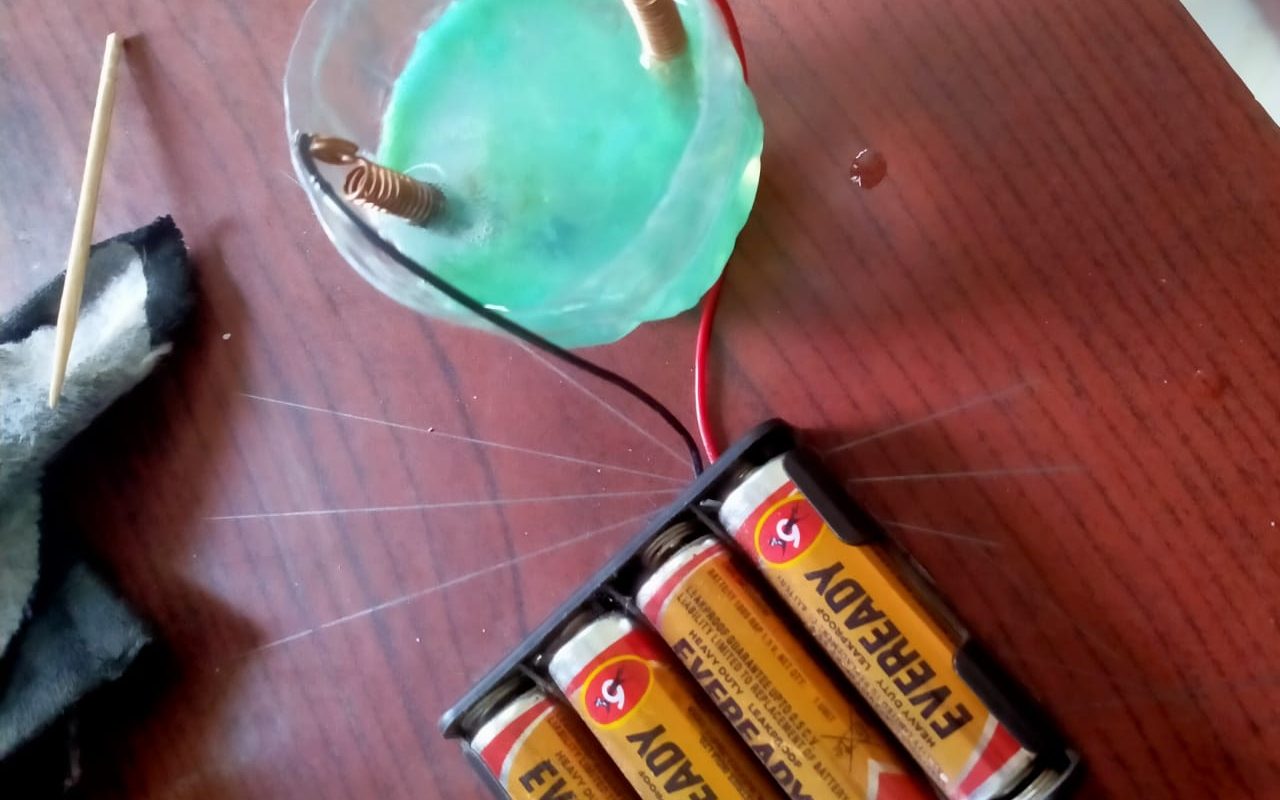
The U.S. Department of Energy explains water-splitting electrolysis and its electrode half-reactions on its official electrolysis education page. The featured photograph shows a real salt-water electrolysis apparatus, which is a different chemical setup from pure-water electrolysis. This is an educational illustration, not instructions to perform electrolysis: electrolysis of salt water can generate hazardous gases.
Worked example 2: Methane combustion
Unbalanced: CH4 + O2 → CO2 + H2O.
There is one carbon atom on both sides. Four hydrogen atoms on the left require two water molecules on the right. The products then contain four oxygen atoms in total: two from CO2 and two from 2H2O. Therefore the reactants require two O2 molecules.
Balanced: CH4 + 2O2 → CO2 + 2H2O.
Atom check: Carbon 1 = 1; hydrogen 4 = 4; oxygen 4 = 4. The ACS chemistry lesson also teaches conservation of atoms through reaction examples.
Worked example 3: Iron forms iron(III) oxide
Unbalanced: Fe + O2 → Fe2O3.
The least common multiple of the oxygen counts 2 and 3 is 6. Put 3 before O2 and 2 before Fe2O3, giving six oxygens on each side. The two product formulas then contain four iron atoms, requiring a 4 before Fe on the left.
Balanced: 4Fe + 3O2 → 2Fe2O3.
Atom check: Iron 4 = 4; oxygen 6 = 6. This is a simplified overall representation of iron oxidation, not a description of every intermediate process involved in rust formation.
Worked example 4: Propane combustion
Unbalanced: C3H8 + O2 → CO2 + H2O.
Balance three carbons with 3CO2, then eight hydrogens with 4H2O. The products contain 6 + 4 = 10 oxygen atoms, so use 5O2.
Balanced: C3H8 + 5O2 → 3CO2 + 4H2O.
How do parentheses affect atom counting?
In Ca(OH)2, the 2 outside the parentheses multiplies both O and H: one Ca, two O and two H. The equation Ca(OH)2 + 2HCl → CaCl2 + 2H2O is balanced. Reactants and products each contain one Ca, two O, four H and two Cl atoms.
Common mistakes to avoid
- Changing subscripts instead of coefficients.
- Forgetting that a coefficient multiplies every atom in the formula.
- Failing to multiply an entire group inside parentheses.
- Checking only oxygen and hydrogen but not other elements.
- Leaving coefficients as 2:4:2 when the lowest ratio is 1:2:1.
- Assuming a mathematically balanced equation proves a reaction actually occurs; chemistry and experimental conditions must also be correct.
Practice quiz: balance these five equations
- Na + Cl2 → NaCl
- N2 + H2 → NH3
- Mg + O2 → MgO
- C2H6 + O2 → CO2 + H2O
- CaCO3 → CaO + CO2
Answer key with minimum whole-number coefficients
- 2Na + Cl2 → 2NaCl
- N2 + 3H2 → 2NH3
- 2Mg + O2 → 2MgO
- 2C2H6 + 7O2 → 4CO2 + 6H2O
- CaCO3 → CaO + CO2 (already balanced)
Related lessons and evidence
Review chemical symbols with our periodic table study guide or browse Chemistry & Periodic Table. Academic references include OpenStax Chemistry 2e, Section 4.1 and the American Chemical Society. Photo credit and reuse: Vanadict / Wikimedia Commons, CC0 1.0, real photograph from December 2025.
Sık Sorulan Sorular
What is the easiest way to balance chemical equations?
Write correct formulas, count each element's atoms, change coefficients, recount and reduce to the smallest whole-number coefficients.
Can I change subscripts to balance an equation?
No. Subscripts define each substance, so changing them changes the chemistry. Adjust coefficients only.
What is the balanced equation for water formation?
2H₂ + O₂ → 2H₂O. Both sides have four hydrogen atoms and two oxygen atoms.
Why do both sides of a chemical equation need equal atoms?
In an ordinary chemical reaction, atoms are rearranged rather than created or destroyed, so the same amount of each element is represented on both sides.