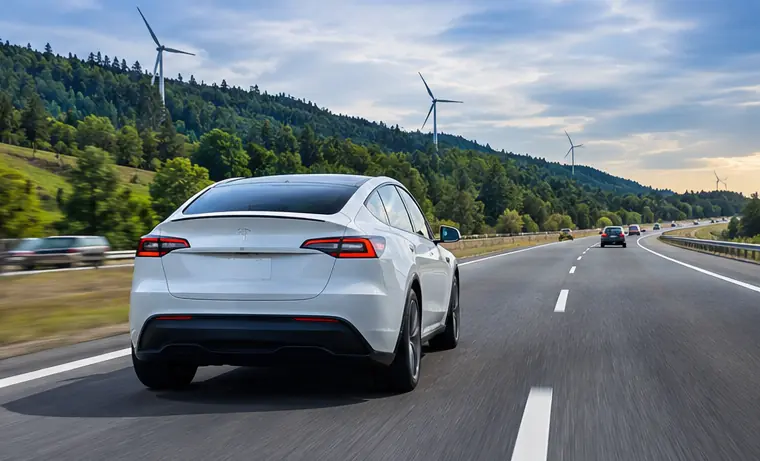
Electric cars can consume more energy per mile on a fast highway than in slower city driving. A major reason is aerodynamic drag: maintaining high road speed requires more power to push air aside. City driving may also let an electric vehicle recover part of its kinetic energy through regenerative braking, although that recovery is never complete.
Air resistance and speed
Aerodynamic drag force grows approximately with the square of vehicle speed relative to the air, while the power needed to overcome that drag grows roughly with the cube of speed under otherwise equal conditions. This does not mean total energy consumption per mile automatically triples when speed changes: tires, drivetrain efficiency, climate control, wind and grade also matter. It explains why rising highway speed can have a pronounced effect on range.
Why stopping in city traffic is different for an EV
In a combustion vehicle, braking ordinarily converts kinetic energy into heat at the brakes. An electric motor can instead act as a generator while decelerating and send some energy back toward the traction battery. This is regenerative braking. It reduces energy lost during many decelerations but cannot recover the energy lost to tire friction, air resistance or conversion inefficiencies.
Illustrative trip comparison
Imagine a hypothetical EV whose observed consumption is 26 kWh/100 miles in one set of moderate-speed conditions and 34 kWh/100 miles on a faster highway trip. Over 150 miles, that would be 39 kWh versus 51 kWh, an extra 12 kWh. These are invented teaching inputs to illustrate arithmetic—not measured figures for any make, model or test. The difference on your route may be larger, smaller or reversed, depending on conditions.
Why regeneration cannot cancel high-speed drag
Regenerative braking recovers some energy during slowing. It does not replenish energy continuously while cruising, and repeated acceleration and deceleration still entail losses. Even with strong regeneration, steady high-speed motion must overcome aerodynamic resistance. The U.S. FuelEconomy.gov energy-flow explanation distinguishes energy losses in charging, electric drive systems, accessories and driving.
Five practical ways to interpret your trip computer
- Compare journeys using the same unit—kWh/100 miles or miles/kWh—before drawing conclusions.
- Check average speed and weather, including headwind and exterior temperature.
- Note elevation change and whether the trip is a one-way climb or descent.
- Remove unnecessary roof carriers when safe and appropriate; follow manufacturer guidance for tires.
- Build a charging stop buffer rather than assuming the official combined-cycle range is the highway result.
For deeper comparisons, read our EV headwind and tailwind guide and hill-climbing energy example. The U.S. government’s EV technology overview provides additional context.
Sık Sorulan Sorular
Are EVs always more efficient in cities than on highways?
Not always. Many EVs benefit from low-speed operation and regeneration, but temperature, terrain, stops and individual vehicle design can change results.
Does regenerative braking recover all braking energy?
No. Conversion and battery limitations mean only a portion of kinetic energy can be recovered.