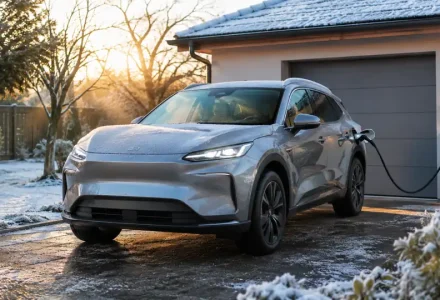
The 2026 Nissan LEAF has a U.S. EPA-estimated range of 303 miles in S+ trim, 288 miles in SV+ and 259 miles in Platinum+. All three currently advertised U.S. versions use a 75 kWh battery and front-wheel drive. The different range figures illustrate why comparing electric cars by model name alone can be misleading: even within one nameplate, wheels and equipment can affect measured energy consumption.
This is a research-based specifications and buying guide, not a first-hand road test. The numbers below are drawn from Nissan’s U.S. model information, its specifications and the U.S. government’s 2026 LEAF EPA listings. They should not be presented as European WLTP figures or guaranteed highway range.
2026 Nissan LEAF specifications: S+ vs SV+ vs Platinum+
| 2026 U.S. LEAF trim | S+ | SV+ | Platinum+ |
|---|---|---|---|
| EPA combined estimated range | 303 mi (approximately 488 km) | 288 mi (approximately 463 km) | 259 mi (approximately 417 km) |
| EPA combined efficiency | 121 MPGe | 114 MPGe | 103 MPGe |
| EPA electricity consumption | 28 kWh/100 mi | 30 kWh/100 mi | 33 kWh/100 mi |
| Battery (manufacturer specification) | 75 kWh lithium-ion, without assuming the full figure is usable battery energy | ||
| Drive and motor | Front-wheel drive; 160 kW (214 hp) AC synchronous motor | ||
| Wheel specification | 18-inch steel with aerodynamic covers | 18-inch alloy | 19-inch alloy |
| Manufacturer-advertised starting MSRP | $29,990 | $34,230 | $38,990 |
| Listed destination charge | $1,545, separate from starting MSRP | ||
Sources: Nissan U.S. 2026 LEAF overview, Nissan trim comparison and EPA fuel-economy database, consulted 6 November 2026. Kilometres have been rounded; they are mathematical conversions of miles, not a separate range test. Manufacturer prices can change and are not final tax-inclusive dealer quotations.
Why does the LEAF Platinum+ show 259 miles instead of 303?
The 44-mile EPA range difference between S+ and Platinum+ is real in the published U.S. combined estimates, but it does not mean the Platinum+ has a smaller advertised traction battery. Nissan lists a 75 kWh battery in these configurations. The variants have different wheel designs, tires and equipment; the complete vehicle configuration matters to official efficiency tests.
EPA’s electricity-consumption values reflect the difference: the S+ is rated at approximately 28 kWh/100 miles, while the Platinum+ is rated around 33 kWh/100 miles under the U.S. combined procedure. That does not prove wheels alone caused the whole gap; EPA tests the vehicle configuration as a system. Check the exact wheel and equipment package before comparing.
Highway speed, weather, climate control, terrain and tyre choice can also alter real-world results. Our EV dashboard range-estimate guide explains why displayed miles and realised journey distance can differ from the EPA label.
How fast can the 2026 Nissan LEAF charge?
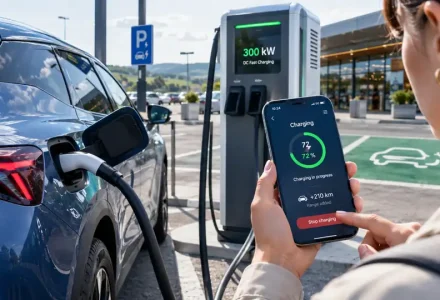
According to Nissan’s official U.S. 2026 LEAF specifications, all three plus versions include a 7.2 kW onboard AC charger and a 150 kW-rated DC quick-charge port. Nissan quotes an estimated 10–80% DC charging time of approximately 35 minutes in its published specifications, subject to the stated charging conditions.
A separate U.S. brochure quotes 20–80% in about 30 minutes at a suitable 150 kW DC charging setup. These figures are not interchangeable: the sessions begin at different battery percentages, and charging power is not constant. Always quote the starting percentage, ending percentage, reference charging equipment and publication context when comparing a fast-charge time.
A 150 kW rating is a peak capability, not a sustained average through an entire session. Battery temperature, state of charge, available station power and protection controls can lower the delivered rate. See our EV charging time calculator and explanation for how kW and kWh differ.
Does the 2026 Nissan LEAF use NACS, CCS or CHAdeMO?
The U.S.-specification 2026 LEAF has a NACS connection for DC fast charging and a J1772 connection for AC charging. Nissan’s official material identifies both ports, with Plug & Charge compatibility at supported networks. This is a major distinction from earlier LEAF generations that are often associated with CHAdeMO fast charging; do not assume an older LEAF plug guide describes the 2026 vehicle.
Nissan’s NissanConnect charging FAQ explains that some participating Tesla Superchargers and Electrify America locations support Plug & Charge for the 2026 LEAF. Electrify America uses CCS connectors, so a compatible Nissan CCS adapter is required at those stations. Network participation and connector compatibility still must be checked for the chosen site.
A physical connector alone does not guarantee payment authorisation or a successful session. Never assume every Tesla or CCS unit is available to the vehicle or that an unapproved adapter is safe. Our NACS, CCS and J1772 connector guide explains the broader standards.
How long does the LEAF take to charge at home?
The U.S. Nissan specifications list an onboard AC charging capacity of 7.2 kW, while the current trim information includes an example of about 6.5 hours for the manufacturer-specified charging window at 240 V. This is not a 0–100% guarantee, and the vehicle may draw less when the electrical equipment, circuit or charging setting is limited.
A practical 120 V outlet typically charges much more slowly than a correctly installed 240 V circuit. Home equipment must be installed and used according to the applicable electrical rules and manufacturer instructions. For a separate analysis of safe low-power charging, read our regular household outlet safety guide.
What equipment changes between S+, SV+ and Platinum+?
| Feature | S+ | SV+ | Platinum+ |
|---|---|---|---|
| Central/instrument displays | Dual 12.3-inch widescreen displays | Dual 14.3-inch widescreen displays | Dual 14.3-inch widescreen displays |
| Google built-in | Not listed as standard in Nissan’s trim comparison | Listed | Listed |
| Wireless Apple CarPlay and Android Auto | Listed | Listed | Listed |
| Interior and wheel priorities | Core equipment and 18-inch aero-cover wheels | Additional comfort/connectivity features and 18-inch alloys | 19-inch wheels, panoramic roof and Bose audio among listed features |
Equipment availability may depend on market, build and any package or software-service requirements. The presence of a driver-assistance system does not make the vehicle self-driving. Check the manufacturer’s current trim list and operating instructions before relying on individual features.
What about the LEAF’s battery heater and winter charging?
Nissan lists a battery heater in its published specification, with availability varying by trim and package. A battery’s temperature can influence rapid-charging performance. A buyer in a cold climate should verify the exact vehicle’s battery-heating and route-planning capabilities rather than assuming every LEAF on the market has identical thermal hardware.
Even with appropriate conditioning, winter range and charging time vary with weather and driving conditions; no official EPA range guarantees a particular cold-weather journey.
How should buyers compare LEAF trims fairly?
- Select the exact U.S. trim: S+, SV+ or Platinum+—the differences in EPA range are substantial.
- Compare EPA consumption as well as total range. The 28/30/33 kWh-per-100-mile figures highlight different whole-car efficiency.
- Confirm charging access at the stations you actually use, including whether an approved CCS adapter is needed.
- Use real out-the-door pricing that includes destination, tax, fees and selected equipment. MSRP is not the final purchase amount.
- Evaluate comfort and technology, including wheel choice, screen layout and any desired winter or driving-assistance features.
- Arrange a test drive and verify the precise vehicle’s warranty and service availability in your location.
2026 Nissan LEAF: quick buying assessment
The S+ prioritises the highest official EPA range of the three featured U.S. versions and the lowest Nissan-advertised starting MSRP. The SV+ adds equipment, including larger displays and Google built-in, while keeping a listed 288-mile EPA rating. The Platinum+ emphasises comfort, styling and features, with a lower 259-mile combined EPA estimate.
Bottom line: the 2026 LEAF is not a one-number vehicle. Compare the exact trim, test-cycle range, NACS/adapter requirements and equipment before purchasing. The figures above are independently cross-checked specification data, not first-hand range, charging or ride-quality test results.
U.S.-market model-year information checked on 6 November 2026. International LEAF configurations and WLTP ratings may differ.
Sık Sorulan Sorular
What is the EPA range of the 2026 Nissan LEAF?
For U.S. trims, the published EPA combined estimates are 303 miles for S+, 288 for SV+ and 259 for Platinum+.
Why does the 2026 LEAF Platinum+ have less range than S+?
The trims have different wheel and equipment configurations. EPA rates the complete configurations differently, with higher combined electricity consumption for the 19-inch-wheel version. Wheels alone should not be assumed to explain the full difference.
Does the 2026 Nissan LEAF use a Tesla NACS charging port?
Yes. The U.S. 2026 LEAF uses NACS for DC fast charging and J1772 for AC; a compatible Nissan CCS adapter is required at participating CCS fast chargers.
How long does the 2026 Nissan LEAF take to DC fast-charge?
Nissan quotes an approximate 35-minute 10–80% DC session under stated conditions and a separate 20–80% estimate of about 30 minutes in its brochure. Actual charging varies.
Does the 2026 Nissan LEAF have Apple CarPlay?
Nissan's U.S. trim comparison lists wireless Apple CarPlay and Android Auto. Google built-in is listed on the SV+ and Platinum+ configurations.