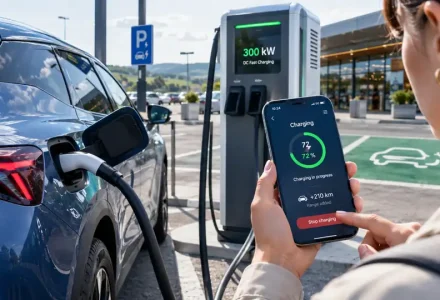
A 350 kW EV charger does not mean your electric car will charge at 350 kW. The number describes the station’s maximum rated power under suitable conditions. The actual power is negotiated with the vehicle and can be much lower because of the vehicle’s charging limit, battery state of charge, temperature, voltage and current requirements, or limits at the charging site. That is why a 350 kW charger is not automatically twice as fast as a 150 kW unit.
What does “350 kW” mean on an EV charger?
A public 350 kW charger is a high-power DC fast charger capable of delivering up to 350 kilowatts at a compatible charging connection. The rating is an upper limit, not a promise for every vehicle or every minute of a charging session. Charging-network operator IONITY explicitly explains that a car limited to 70 kW will not charge faster merely because the station is rated at 350 kW.
When charging with DC, the station supplies regulated direct current for the traction battery. This is different from AC charging, where the vehicle’s onboard charger converts incoming AC electricity to DC. For a primer on the distinction, see the U.S. Department of Energy’s Alternative Fuels Data Center.
kW versus kWh: power is not energy
kW (kilowatts) is the rate at which energy is delivered at a particular moment; kWh (kilowatt-hours) is the amount of energy transferred or stored. A charger delivering a constant 100 kW for 30 minutes would transfer approximately 50 kWh, before accounting for charging losses and the energy used by cooling or heating systems.
This distinction matters when comparing charging stations. A 350 kW sign tells you the potential peak power. It does not tell you how many kWh your particular vehicle will gain during a 20-minute stop.
Why is a car charging at 90 kW on a 350 kW charger?
1. The vehicle has a lower DC charging limit
Every EV has its own maximum DC charging capability, set by its battery, electronics and manufacturer controls. A vehicle with a 100 kW maximum cannot obtain 350 kW even from a fully operational high-power station. The Electrify America charging guidance confirms that station output is matched to the vehicle’s capabilities.
2. Charging power changes as the battery fills
Most battery-electric vehicles do not hold their peak charging power from 10% to 80% and certainly not all the way to 100%. Their DC charging curve generally reduces charging power as state of charge rises. The exact shape is model-specific; a car that briefly reaches a high peak may still have a modest average charge rate.
3. The battery is too cold or too hot
Battery-management systems limit charging to protect cells when their temperature is outside a suitable range. A vehicle with battery preconditioning may warm or cool the pack before arrival, provided the feature is supported and used as directed. See our EV battery preconditioning guide for the conditions that influence this process.
4. The station or cable has its own constraints
A high-power unit may reduce output because of equipment temperature, current limits, maintenance conditions or shared electrical capacity. Some charging cabinets distribute available power between adjacent charging stalls. Electrify America describes balanced chargers that can supply different maximum power depending on use of the neighbouring stall. Actual arrangements vary by network and location.
How long should a 10–80% charging session take?
A useful rough calculation starts with usable battery energy, not the charging station’s maximum kW. Consider an illustrative 75 kWh usable battery charged from 10% to 80%. The energy added to the pack is approximately 75 × 0.70 = 52.5 kWh, assuming the displayed percentage corresponds proportionally to usable battery energy. Dividing by an assumed average charging power gives an idealized time:
| Illustrative average power | Approximate time for 52.5 kWh | Important qualification |
|---|---|---|
| 75 kW | 42 minutes | Assumes a steady 75 kW average |
| 100 kW | 31.5 minutes | Assumes a steady 100 kW average |
| 150 kW | 21 minutes | Assumes a steady 150 kW average |
These are worked examples, not predictions for a specific model. They exclude session setup time and charging losses and assume the indicated average power can actually be maintained. A 350 kW station does not imply a 350 kW average. For additional calculation methods, read how long it takes to charge an electric car.
150 kW vs 350 kW: which charger should you choose?
First check your vehicle manufacturer’s published maximum DC charging rate and, ideally, its typical 10–80% charging time under stated conditions. For an EV that accepts no more than 100 kW, a functioning 150 kW charger and a functioning 350 kW charger may provide very similar charging speeds, provided both can deliver the power the car requests.
For a vehicle able to sustain substantially more than 150 kW over part of its charging curve, a 350 kW connection can reduce charging time—particularly at a relatively low state of charge and suitable battery temperature. Availability, connector compatibility, price per kWh or per minute, station reliability and whether power is shared still matter. Do not assume a higher-priced session is the best choice purely because of the sign on the charger.
A practical checklist before your next DC fast-charge stop
- Confirm the connector and charging standard: the station must physically and electrically support your model.
- Check the car’s published DC limit: distinguish peak kW from the 10–80% time and the charging curve.
- Plan an appropriate arrival charge: use the route planner and preserve a sensible reserve rather than arriving at zero.
- Use battery preconditioning if supported: follow the vehicle’s manual and navigation instructions.
- Check the stall’s status: look for shared-power notices, outages or reduced-output warnings.
- Watch energy added and charging time: a falling instantaneous kW reading near a high battery percentage can be normal.
Is 350 kW charging bad for the battery?
A charger rated at 350 kW does not force a car to accept 350 kW. The vehicle’s management system requests power within its own operating limits. Fast charging generates heat and can influence long-term ageing, but battery life depends on many variables, including cell chemistry, temperature, total energy throughput and charging habits. Follow the manufacturer’s guidance rather than treating any single charger rating as universally safe or unsafe.
If you routinely wonder whether to stop at 80%, our daily 80% versus 100% charging guide explains why recommendations differ by model and battery chemistry.
The bottom line
350 kW is a charger capability, not an EV charging-speed guarantee. The fastest practical stop is the one that matches your vehicle’s hardware, charging curve, battery condition and trip requirements. Compare real 10–80% charging performance and the station’s availability—not just the largest kW number on its casing.
Sık Sorulan Sorular
Can any electric car use a 350 kW charger?
Only if the station's connector and charging standard are compatible. A compatible EV can generally use a high-power charger without accepting its full 350 kW rating; the vehicle limits the requested power.
Why is my EV charging at 70 kW on a 350 kW station?
Possible reasons include the vehicle's DC charging limit, a high battery state of charge, battery temperature, power sharing, equipment limits or a charging curve that has already tapered.
Is a 350 kW charger faster than 150 kW?
It can be for vehicles that can accept more than 150 kW under the current conditions. For cars with lower charging limits, both stations may deliver very similar speeds.
Does a 350 kW EV charger add 350 kWh in an hour?
Only hypothetically if it actually delivered 350 kW continuously for one hour. EVs rarely maintain peak charging power for an entire session; energy added is the integral of power over time.