
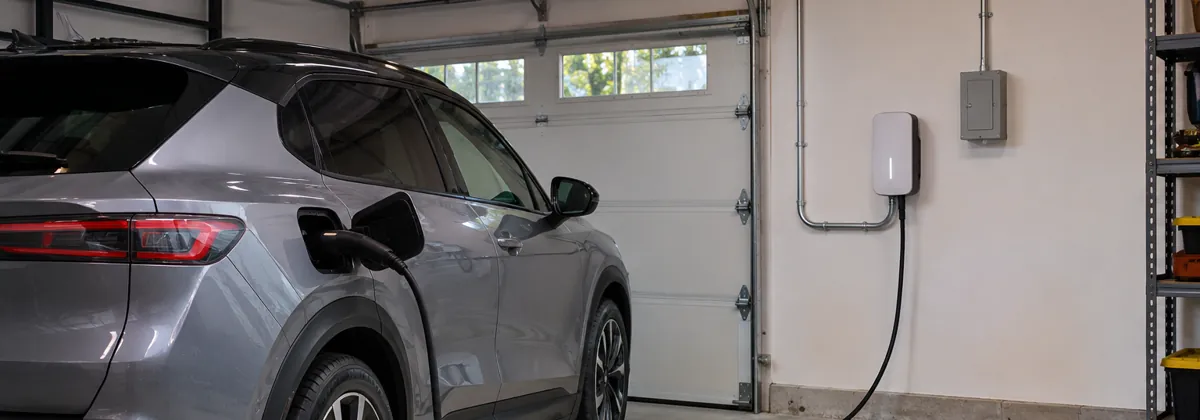
Level 1 or Level 2 home EV charging? Level 1 may be sufficient for drivers with modest daily mileage and long overnight parking. Level 2 is usually the better fit when the car must replenish more energy in a shorter window. The safe choice starts with the daily energy needed, not the charger’s advertised maximum.
What is the difference?
In the United States, Level 1 typically delivers alternating current through a 120-volt circuit. Residential Level 2 charging normally uses 240-volt equipment. In both cases, the vehicle converts AC electricity into DC power for its battery. DC fast charging is a separate technology generally used at public facilities.
Estimate the overnight energy requirement
Consider a hypothetical driver covering 35 miles each day in an EV that uses 30 kWh per 100 miles. Driving energy is 35 × 30 ÷ 100 = 10.5 kWh per day. This is energy used for travel, not the total drawn from the wall; charging losses and climate conditions increase the electricity required. If charging is available for ten hours, the wall-socket energy demand averages more than 1.05 kW before considering losses and equipment limitations. This calculation helps establish whether a particular Level 1 setup can keep up, but it does not certify any outlet or circuit.
Checklist before choosing Level 1
- Confirm your car supports the portable charging equipment and connector.
- Ask a qualified electrician to assess the outlet, circuit, grounding and continuous load suitability; do not assume an old garage outlet is appropriate.
- Check whether nightly hours normally restore the energy you use each day.
- Avoid improvised extension cords or adapters not approved by the equipment manufacturer.
When Level 2 makes more sense
A driver with frequent long journeys, multiple electric vehicles or limited overnight charging hours may benefit from Level 2. Actual charging power is limited by the lowest-capacity component among the charging equipment, electrical supply and vehicle onboard charger. A higher-rated wall unit does not override a lower-rated onboard charger.
Installation, outdoor use and safety
The U.S. Department of Energy says properly rated outdoor equipment can be installed outdoors and operated in rain. Equipment must be appropriate for the location and installed in accordance with applicable requirements. For a home charger, ask a licensed electrician about panel capacity, permits and local electrical codes before purchasing hardware. Apartment residents should also confirm parking rights and building arrangements.
Compare the decision, not just the plug
Calculate your weekly driving, your real parking window and the vehicle’s charging specifications. Next compare the total cost of installation, possible electrical upgrades and convenience. For a separate consumer calculation, see our home EV charging cost guide. DOE’s official home-charging guidance explains equipment selection and installation considerations.
Scope: U.S. household charging terminology and electrical arrangements; requirements vary by country, building and equipment.
Sık Sorulan Sorular
Is Level 1 charging enough for an EV?
It can be if the miles restored during your available parking time cover your daily use, with a buffer for unexpected journeys.
Can every EV charge faster on Level 2?
Level 2 is usually faster than Level 1, but the vehicle's onboard AC charging limit, equipment and electrical installation cap the actual rate.


