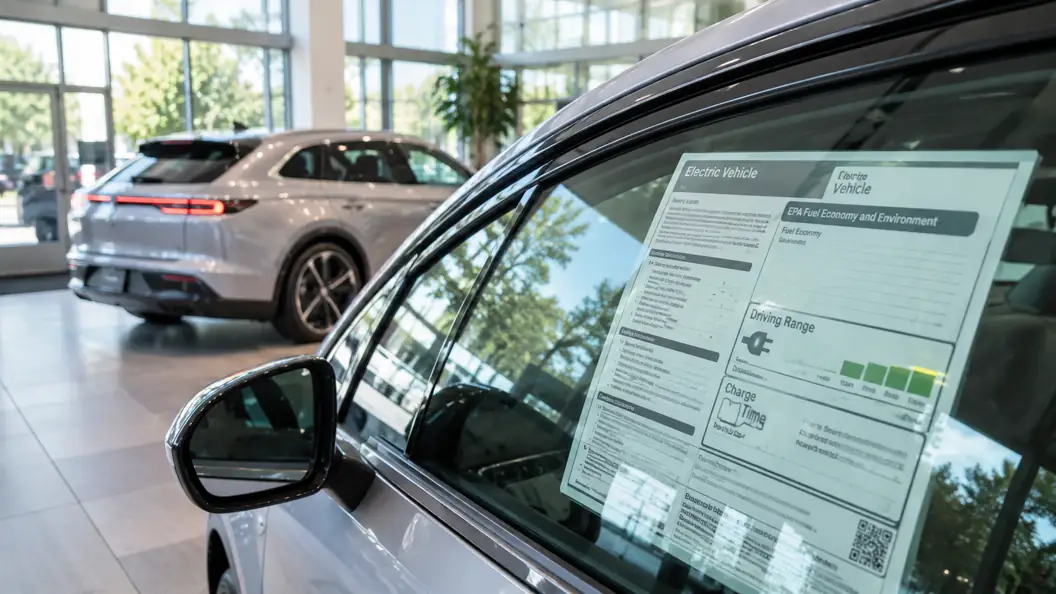
The three figures to read on a U.S. electric-vehicle window sticker are estimated range, kWh per 100 miles and MPGe. Range helps compare how far vehicles can travel under standardized testing. kWh/100 miles helps compare electrical energy use. MPGe expresses efficiency using a gasoline-equivalent reference.
EPA estimated range is a test-based comparison
Range is an estimate of distance from a full battery charge under an EPA methodology, not a guarantee for an individual journey. Faster highway driving, cold weather, heating or cooling, hills and cargo can change the achievable distance. For this reason, compare vehicles on the same standardized basis, then allow a practical buffer for your own driving circumstances.
What kWh per 100 miles means
Electricity consumption is often shown as kilowatt-hours per 100 miles. Lower numbers mean a vehicle uses less electricity to cover the same distance under the comparison conditions. The U.S. government’s FuelEconomy.gov explains that EV fuel-economy testing measures electricity at the charging source, accounting for charging losses in its reported consumption measure. This is important when estimating the energy you pay for.
Worked example: comparing two hypothetical EVs
Suppose Vehicle A is rated at 28 kWh/100 miles and Vehicle B at 36 kWh/100 miles. Over 1,000 miles using those label figures, Vehicle A would correspond to 280 kWh and Vehicle B to 360 kWh. At an illustrative, not current market electricity price of $0.18/kWh, the arithmetic is $50.40 versus $64.80: a $14.40 difference over 1,000 miles. Taxes, tariffs, actual consumption and charging circumstances may change a household’s bill. This is an educational calculation, not a quoted vehicle specification.
What MPGe measures
MPGe means miles per gallon of gasoline-equivalent. It does not mean a battery-electric vehicle consumes gasoline, and it is not the number of miles a car gets per kilowatt-hour. It is useful for cross-powertrain efficiency comparisons. For electricity bill comparisons between EVs, kWh/100 miles is usually more intuitive.
Why you cannot calculate rated range from gross battery size alone
Manufacturers may restrict the usable part of a battery, and EPA range comes from standardized testing and adjustment procedures. FuelEconomy.gov specifically cautions against simply dividing advertised battery capacity by efficiency to recreate the official range. Use the model- and configuration-specific EPA figure when comparing vehicles.
What to check before buying
- Read the exact model year, trim, wheels and drivetrain shown on the label.
- Compare EPA-rated consumption alongside range; they answer different questions.
- Use your own electricity tariff to estimate monthly charging expenses.
- Account for cold-weather and highway-range variability rather than treating label range as a guaranteed minimum.
See the site’s home charging cost calculation and cold-weather range explainer. Read the government’s EPA label explanation and EV range testing FAQ for primary reference.
Sık Sorulan Sorular
Is a higher MPGe better?
Yes. Higher MPGe indicates higher efficiency in the EPA gasoline-equivalent comparison.
Does EPA range guarantee the distance of every trip?
No. It is a standardized estimate; speed, temperature, accessories, terrain, tires and driving style alter real-world range.