Quick answer: You can charge an electric car using electricity generated by rooftop solar panels, but the number of panels required depends on driving distance, vehicle energy consumption, charging losses and local solar production. A practical starting point is to calculate your annual EV electricity use in kWh, then compare it with the estimated annual AC output of a proposed photovoltaic (PV) system. Annual solar energy matching does not mean the car charges from sunshine at every hour of the day.
The U.S. Department of Energy (DOE) confirms that rooftop photovoltaic systems can supply EV charging energy and that required capacity depends on how much the car is driven. DOE’s homeowner’s solar guidance explains roof suitability, electricity bill credits and storage options. For a location-specific estimate, use the DOE-supported PVWatts calculator.
Can solar panels charge an electric car directly?
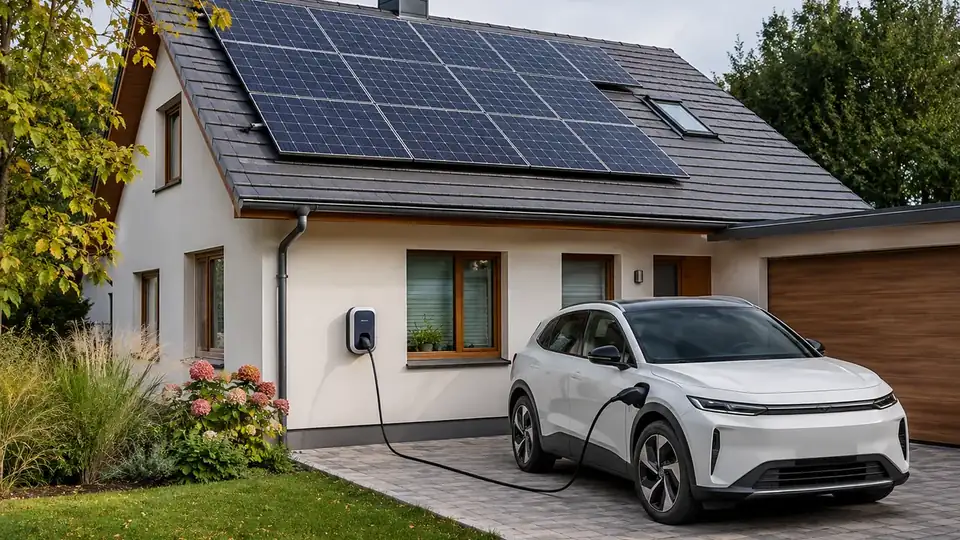
Yes, but most residential installations work through the home’s electrical system, not an ordinary rooftop panel wired straight into the car. PV panels produce DC electricity; suitable inverters and equipment convert and manage that power for household appliances and AC EV charging. The vehicle’s onboard charger then handles AC-to-DC conversion for its battery. Other professionally engineered arrangements are possible, but a random panel-to-car cable is not a safe DIY substitute for certified charging equipment.
Three practical configurations
| Setup | How EV charging is supplied | Key limitation |
|---|---|---|
| Grid-connected rooftop solar with an AC EV charger | Solar output and the grid serve household circuits; an eligible EV charger draws electricity from the home system | Clouds, other home loads and nighttime charging may require grid imports |
| Solar plus stationary home battery | Some PV energy can be stored and discharged later, subject to system capability | Added cost, energy losses, power limits and installation requirements |
| Solar-aware smart charging | Compatible equipment can change EV charging current in response to available surplus production | Behavior depends on specific inverter, meter, charger and vehicle integration |
Even if a solar array produces more energy than a vehicle uses over a year, the house can still import electricity at night or during cloudy periods. Export rules and bill credits determine the financial result, not just annual kWh totals.
How many solar panels do you need for an EV? The formula
Start with four quantities: daily kilometers or miles driven, EV battery-energy consumption, charging efficiency, and the estimated location-specific PV production.
- Calculate driving energy. In metric units,
daily battery energy (kWh) = distance (km/day) × consumption (kWh/100 km) ÷ 100. - Allow for charging losses.
daily electricity input (kWh) = daily battery energy ÷ charging efficiency. The efficiency should ideally come from actual measurements; illustrative assumptions are not universal. - Estimate annual need. Multiply daily input by driving days per year; this is a first-order approximation and may need adjustments for travel, seasonality or changes in mileage.
- Estimate annual PV energy per kWp. Enter your location, roof orientation, inclination, shading and proposed system size into PVWatts, which reports expected AC energy.
- Compare annual amounts.
additional solar nameplate capacity (kWp) ≈ annual EV input energy (kWh) ÷ annual AC PV yield (kWh per kWp). This assumes the modeled PV generation is available to offset the EV’s energy through self-consumption or the applicable electricity tariff/accounting arrangement.
Worked example: 40 km of daily driving
Consider a hypothetical EV driven 40 km each day, using 18 kWh/100 km from its battery. Battery energy consumed is 40 × 18 ÷ 100 = 7.2 kWh/day. If we assume a 90% charging efficiency for this example only, the supply must deliver 7.2 ÷ 0.90 = 8.0 kWh/day.
Over a hypothetical 365-day driving year, that equals 2,920 kWh of AC charging input. Now suppose a location-specific simulation for illustration predicts 1,200 kWh AC per installed kWp per year after modeled PV system losses. The solar size that generates an equal annual quantity would be 2,920 ÷ 1,200 ≈ 2.43 kWp. If you were considering hypothetical 400 W panels, the arithmetic is 2.43 ÷ 0.4 ≈ 6.1 panels, rounded up to 7 panels for the illustrative nameplate capacity.
This is not a proposal to install seven panels anywhere in the world. Output per kWp changes with the site, roof, season, shading and equipment, and real system sizing may require more capacity for household loads or less for charging only some days. Rooftop space, inverter selection, local electrical rules and export treatment also matter.
| Illustrative variable | Example value | What to replace with your data |
|---|---|---|
| Distance driven | 40 km/day | Your observed average, including weekends and annual trips |
| Battery energy consumption | 18 kWh/100 km | Your car’s measured use, ideally for your climate and routes |
| Illustrative charging efficiency | 90% | Measured battery gain versus metered supply where available |
| Annual EV grid-side energy equivalent | 2,920 kWh/year | Your annual measured charging electricity |
| Illustrative annual PV yield | 1,200 kWh/kWp/year | Location-specific PVWatts modeled AC output |
| Annual-matching extra PV capacity | ~2.43 kWp | Result from your actual energy and PV yield inputs |
Does a solar-powered EV still need the electricity grid?
Often, yes. An ordinary grid-connected photovoltaic installation can export surplus power at noon and import power later. Whether the export is credited at a favorable rate depends on the local utility’s rules. DOE notes that net metering and solar credit arrangements differ widely; never assume each exported kWh will automatically cancel a later imported kWh at the same retail value.
Battery storage can shift energy into the evening if the solar/storage system supports it. However, a home battery does not generate new energy and introduces cost and conversion losses. In a grid outage, many standard grid-tied systems must disconnect unless designed and installed with compliant backup/islanding capability. An EV charger also needs adequate electrical power, controls and safety equipment.
How much can solar reduce the cost of EV charging?
Solar electricity is not automatically free. A valid financial comparison includes the installed PV system cost, financing, inverter maintenance, avoided imported electricity, export compensation, taxes and any time-of-use charging tariff. For example, suppose a household avoids purchasing 1 kWh at an illustrative $0.25 while giving up an $0.08/kWh export payment that otherwise would have applied. The immediate value of consuming that kWh rather than exporting it is $0.17/kWh before other costs and losses. This comparison is hypothetical and the result could change or reverse under another tariff.
Read our EV charging-cost formula and worked examples to calculate the grid price correctly. Charge scheduling also matters: solar-oriented charging during daylight can increase direct self-consumption, but if the car is at work during the day, workplace chargers or home energy storage may change the plan.
Do you need a special EV charger for rooftop solar?
Not necessarily. A properly installed and compatible AC EV charger can draw electricity from the home’s electrical system, which may be supplied partly by PV. A solar-aware charger may be useful when you want to follow surplus generation, but it must be matched to the inverter, meter and vehicle, and it needs enough available power for the minimum current required by the charging equipment. The installer should verify all interactions and local grid-connection rules. The DOE home-charging guide explains why EV charging equipment and circuit ratings need professional assessment.
Seven questions to ask before buying panels for your EV
- What does my car really use in kWh/100 km or kWh/100 miles?
- How many days per week and hours per day is the car parked at home in daylight?
- How much roof space is unshaded and suitable for professional installation?
- How much annual AC energy does PVWatts predict for the proposed system?
- How are imported electricity and exported solar power priced by my utility?
- Does my desired charging system need storage, load balancing or service-panel upgrades?
- What are the total installed cost, warranties, permissions and maintenance assumptions?
Common solar EV charging mistakes
Do not equate solar-panel headline watts with guaranteed year-round output; assume a battery stores every sunny-day surplus; treat a 240 V charger as a mandatory requirement for every EV owner; or estimate solar savings using full retail electricity prices while ignoring exported-energy value. Avoid combining unapproved electrical devices, improvised plugs or rooftop DIY wiring. For residents without a private driveway or rooftop rights, our apartment charging options guide explains alternatives.
Bottom line
The useful answer to “How many solar panels charge an EV?” is a calculation based on your actual driving energy and a site-specific solar production model, not a worldwide panel count. For a first estimate, divide the annual AC energy needed for EV charging by modeled annual AC solar yield per installed kWp. Then evaluate sunlight timing, export rules, safety and total costs with qualified professionals.
Editorial methodology: PV principles and system planning follow DOE resources and the DOE-supported PVWatts model. All driving, energy-efficiency, panel wattage, solar-yield and cost numbers in this article are labeled hypothetical for transparent calculations, not local predictions or price offers.
Sık Sorulan Sorular
How many solar panels do I need to charge an electric car?
Calculate annual EV charging electricity from driving distance, energy use and losses, then divide it by modeled annual PV production per kWp for your exact location. A panel count depends on each panel's rated watts, roof and solar conditions.
Can I charge my EV at night using solar panels?
Yes, if the setup can supply the car at night from the grid or a properly designed storage system. Solar panels alone do not produce electricity at night.
Do I need a dedicated solar EV charger?
Not always. A compliant, properly installed home AC EV charger can draw power from the home electrical system, including available rooftop solar. Solar-aware features can adjust charging to surplus output on compatible systems.
Is charging an electric car with solar free?
Not automatically. Installed solar and storage have costs, and electricity bill credits depend on local policies. The financial value of using solar energy can differ from its physical energy contribution.